Maryland Gov. Moore announces $3 million investment to renovate storefronts and historic buildings along Purple Line
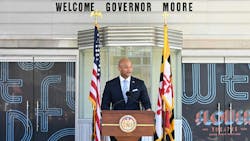
Maryland Gov. Wes Moore unveiled a $3 million investment through the fiscal year 2027 budget proposal that’s designed to drive economic development along the Purple Line corridor. The proposed funding would support renovation projects, including upgrades to storefronts and to restore historic buildings, with the goal to revitalize local business districts as the Purple Line nears completion.
“We are investing in the Purple Line corridor because you cannot have a competitive state without thriving communities,” Gov. Moore said. “When it opens, the Purple Line will not just move our people from point A to point B. It will move entire communities forward. By expanding Montgomery County, Md.,'s Facade Improvement Program, we are strengthening communities, supporting small businesses and making Maryland more competitive.”
According to the governor’s office, the proposed investment would support exterior upgrades for businesses within a half-mile of Montgomery County Purple Line stations—allowing the opportunity to improve the aesthetic appeal of older properties. The administration says that facade renovations will foster a more inviting and safer commercial environment, attracting additional private investment and ensuring that local businesses are fully prepared to leverage the economic connectivity provided by the Purple Line.
The funding would be administered by the Montgomery Countywide Facade Improvement Program to support projects in communities such as Long Branch—Maryland’s most recently designated Main Street. Past projects supported by the program include Montgomery Housing Partnership’s restoration of the historic Flower Theatre, which is part of the organization’s revitalization strategy that includes phased facade improvements for surrounding Long Branch businesses near the future Purple Line station.
“As the Purple Line creates new connections and brings more people into Long Branch—and communities along the corridor—these investments help ensure small, local businesses are not displaced,” said Maryland Department of Housing and Community Development Secretary Jake Day. “Facade improvements strengthen commercial districts, attract investment and help small businesses thrive because a strong downtown tells the story of a strong community.”
In addition to physical improvements, the governor’s office notes that the state is continuing to provide direct financial assistance to entrepreneurs most directly impacted by Purple Line construction through the Purple Line Small Business Grant Program. In 2025, the Maryland Department of Transportation (MDOT) awarded $2 million in grants to nearly 200 small businesses. The program provides direct grants of up to $50,000 to eligible small businesses for critical expenses such as payroll, rent, utility payments and marketing while development and construction progressed.
MDOT secured the funding for the Purple Line Small Business Grant Program—launched in February 2025—through a contract re-negotiation with the project’s concessionaire, Purple Line Transit Partners. The contract was approved by Maryland’s Board of Public Works in March 2024.
The application period for the first round of 2026 grants opened last week. The application can be found on the Maryland OneStop Portal.
“The future Purple Line will serve to connect Marylanders with local businesses, spurring economic development all along the route from New Carrollton to Bethesda,” said Maryland Transit Administrator Holly Arnold. “Gov. Moore’s support for small businesses along the Purple Line and his commitment to Maryland's transit investments will help further uplift communities where people want to live, work and shop.”
Construction for the Purple Line—a 16-mile light-rail line that will connect communities from College Park and New Carrollton in Prince George’s County to Bethesda and Silver Spring in Montgomery County—is nearly complete, as 88% of the track is laid, including all of the track in Prince George’s County. All 21 stations are under construction and all 28 light-rail vehicles are now onsite.
The governor’s office notes that the construction project has been an economic driver for the region, employing more than 2,000 skilled workers throughout its construction phase. The administration also notes that the Purple Line project has paid out more than $500 million to socially and economically disadvantaged small businesses for the design and construction.
“I appreciate Gov. Moore for proposing additional resources, so we can help more small businesses strengthen their storefronts and keep these communities and businesses in the Purple Line corridor vibrant,” said Montgomery County Executive Marc Elrich. “Small businesses along this corridor have been dealing with construction and disruption for years, and they deserve support. Programs like our Countywide Façade Improvement Program help property owners make practical upgrades that improve safety, appearance, and accessibility for both businesses and residents.”