Transit Unplugged Down Under: From driverless trains to century-old steamships
Over the past decade, I've visited more than 110 public transportation operations around the world and interviewed more than 500 transit agency leaders through Transit Unplugged. One of the things I value most about these experiences is discovering innovative approaches, learning the best practices of successful leaders and sharing those ideas with our industry. That's really what Transit Unplugged is all about—giving transportation leaders a platform to tell their stories and helping great ideas travel beyond the communities where they originated.
My recent journey through Australia and New Zealand was a perfect example. From cutting-edge automated railways to innovative bus operations and a century-old steamship still carrying passengers, I discovered remarkable innovations and met extraordinary people who are helping shape the future of public transportation.
We traveled through Sydney, Australia, and Auckland and Queenstown, New Zealand, filming Transit Unplugged TV along the way—filled with some terrific conversations with transportation leaders.
What stood out wasn't simply the scale of the investment. It was the imagination, engineering, teamwork and pride behind these projects—and the commitment of the people making them happen.
Here are some of the people, places and innovations that made this journey so memorable.
Sydney: Modernizing a century-old railway
Sydney Metro, Australia's largest public transportation infrastructure program, was quite a sight to see. The region is taking an old railway corridor and making it part of a modern automated network—and the results are remarkable.
During our visit, the city was celebrating the Oct. 30 opening of its Southwest Metro extension, which transformed a roughly 130-year-old railway corridor into a modern, fully automated metro.
The extension creates a continuous line of approximately 66 kilometers (44 miles), connecting Sydney's northwest, central business district and southwest. Trains operate as frequently as every four minutes during peak periods, with substantially increased passenger capacity.
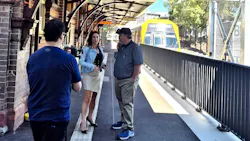
I spent time with Alia Karaman, Sydney Metro project director of the city and southwest, who helped lead this remarkable transformation.
Imagine converting a roughly 130-year-old railway while modernizing stations, installing platform screen doors, introducing driverless trains and connecting everything to an existing automated network. Each part has to work with the others: trains must stop precisely at platforms, signaling must support automated operation and passengers must be able to move safely through stations built for a different era.
One of the most fascinating innovations I saw involved the older, curved station platforms. Sydney Metro uses mechanical gap fillers that extend from the station platforms toward stopped trains, bridging the space at the doors. Rather than placing the equipment on the trains, the solution is built into the stations—an ingenious way to adapt historic infrastructure for safer, easier boarding.
“The challenge wasn't a single engineering problem. It was solving and integrating multiple complex challenges at once, within a tight delivery window,” Karaman explained. “Success came through pragmatic risk management, engineering excellence, and a shared commitment to delivering a safe, modern metro.”
The stations themselves were impressive, too. Modern design, thoughtful use of color, public art and attention to the passenger experience made these facilities attractive places to travel through, not simply places to catch a train.
What makes Sydney's transformation especially interesting for transit leaders is how many challenges had to be solved together. Three practical points stood out to me: understand the limitations of legacy infrastructure before finalizing the design; treat trains, signaling, stations and operations as one connected system; and look for creative solutions, like the platform gap fillers, that preserve useful infrastructure while improving safety and accessibility.
It was especially rewarding to see passengers already enjoying the new system just days after it opened.
One transportation network working together
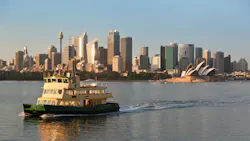
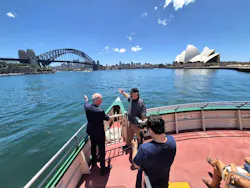
Another highlight was spending time with Transport for New South Wales (TfNSW) Coordinator General for Transport Howard Collins, who joined us for a ferry ride across Sydney Harbour to Manly and a visit to a major electric bus depot.
Collins has spent decades in senior railway leadership, including major roles in London and Sydney. Talking with him offered a fascinating look at how Sydney brings transportation services together across modes and organizations.
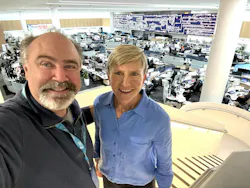
At Sydney's Rail Operations Center, I met with Magda Robertson, head of intercity services at Sydney Trains, and got a firsthand look at an impressive example of integrated railway operations. The center brings together train operations and signaling, engineering and maintenance, safety and security, crew coordination, incident response and customer communications under one roof.
Instead of working in separate silos, those disciplines are side by side, sharing information and coordinating decisions. When something goes wrong, the teams responsible for running trains, addressing faults, managing safety and keeping passengers informed can respond together—with the entire customer journey in mind.
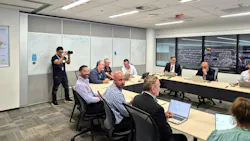
I also joined the daily operational meeting, where leaders reviewed the previous day's performance, identified problems and agreed on actions to improve service.
What impressed me was the discipline and accountability of the process. The questions were refreshingly straightforward: What happened yesterday? What went well? What can we do better today?
I loved seeing that kind of daily teamwork in action.
What makes the meeting worth paying attention to is its rhythm: review actual performance, identify the problem, assign action and come back to it. That’s a practical approach to operational accountability in any transportation system.
Contracting as a partnership
Another interesting part of our Sydney visit was seeing how the public transportation authority and its contracted operating partners work together.
David Eason, head of intelligent transportation systems and sales at Trapeze Group ANZ, explained a major new project his team had won with TfNSW: the bus component of the Opal Next Generation program. It will bring updated intelligent transportation technology to approximately 5,000 buses, giving operators better real-time visibility of their services while providing passengers with more accurate arrival predictions, service updates and onboard information about upcoming stops.
For anyone who has waited for a bus that an app says is coming but never appears, the value is easy to understand. I enjoyed hearing how this behind-the-scenes technology could make everyday bus trips more predictable and easier to navigate.
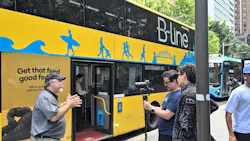
Private companies deliver metropolitan bus services under contracts with TfNSW. Ferries, light rail and portions of the rail network also involve private operating partners while Sydney Trains continues operating the traditional suburban and intercity railway system.
During our visit, we met with several impressive international transportation leaders, including David Franks, CEO of Keolis Australia and New Zealand; Jay Zmijewski, COO of Keolis ANZ; Brian Brennan, CEO of Transdev Australia and New Zealand; Peter Lensink, COO of Transdev ANZ; and Denis Masure, managing director of RATP Dev Australia and New Zealand.
Michael Zink, managing director of Zelra, shared another exciting innovation. His company recently won a contract with RATP Dev to provide workforce management technology for the new Sydney Metro–Western Sydney Airport line. The system streamlines rostering, staff allocation and fatigue compliance as a single connected process that reduces reliance on inefficient manual tasks. This provides RATP Dev’s planners with real-time compliance visibility as rosters are built and changed, rather than checking them retrospectively.
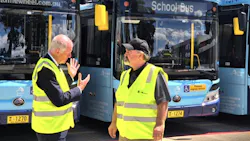
We also visited the Keolis-operated Brookvale bus depot in Sydney's Northern Beaches, where we learned more about how a major contracted operator delivers services in partnership with the public transportation authority. The visit highlighted the region's continued focus on transitioning toward zero-emission buses, including investments in vehicles, charging facilities and supporting infrastructure.
Even the appearance of the vehicles caught my attention, with colorful bus wraps and distinctive designs contributing to the public-facing identity of the system. It's another reminder that customer experience includes what people see and feel when they use public transportation.
What particularly interested me was how the agency sets the direction while operators handle daily delivery. The important question isn’t simply who operates the service, but how responsibilities, performance expectations and information flow between partners.
TfNSW retains responsibility for network planning, service standards and customer outcomes while private operators contribute their management expertise, specialized capabilities and international experience. The result is an approach that combines public direction with private sector operational resources.
There isn’t one operating model for every city, but Sydney shows why good contracts need more than a price and a scope of work. Clear accountability, shared service goals and practical coordination are what make a partnership valuable to passengers.
A global gathering of transportation leaders
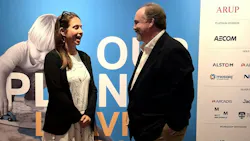
Our visit also included the Global Transport Leaders Summit, organized by the Public Transport Association Australia New Zealand (PTAANZ) under the leadership of Lauren Streifer, its chief executive.
It was a terrific gathering of transportation executives, policymakers and industry experts from Australia, New Zealand and around the world.
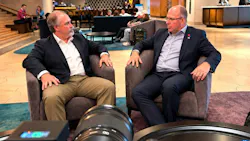
Among those participating was Transport for London Commissioner Andy Lord, whom I had the opportunity to interview for a special episode of the Transit Unplugged podcast while we were in Sydney.
Our conversation explored his experiences leading one of the world's largest and most complex transportation networks, adding a valuable international perspective to our visit.
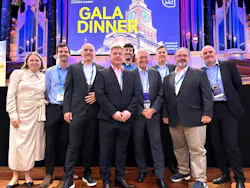
The formal presentations were excellent, but some of my favorite moments came through conversations with fellow transportation leaders between sessions. We discussed everything from infrastructure development and contracting to customer experience, operational efficiency and emerging technologies.
Different cities, different challenges, but so much common ground. Everyone was talking about how to connect people and make transportation work better.
Streifer and her team created an outstanding opportunity for exchanging ideas and building relationships across the global transportation community.
Auckland: A new era of rail transportation
Next stop: New Zealand, where Auckland is in the midst of a remarkable transformation of its rail network.
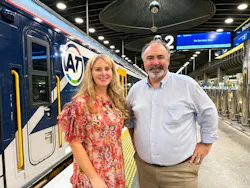
We spent time with Stacey van der Putten, chief executive of Auckland Transport, learning about her vision for improving connectivity throughout New Zealand's largest metropolitan area.
The centerpiece is the City Rail Link, the country's largest transportation infrastructure project, which opened to passengers on Sept. 13, 2026, just weeks before our arrival. The project includes 3.45 kilometers (2.1 miles) of twin underground rail tunnels, two new underground stations and major upgrades to existing stations.
Previously, Auckland's downtown rail network effectively ended at Waitematā Station. The City Rail Link transforms it into a through-running network, allowing trains to travel across the city center and create new connections throughout the region.
The project is designed to increase peak rail capacity by approximately 50%.
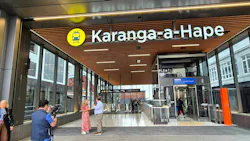
We toured the spectacular Karanga-a-Hape Station, where striking modern architecture incorporates Māori cultural identity into the station design. It was another example of something we noticed throughout our travels: Transportation infrastructure can be both functional and beautiful. Architecture, artwork and cultural identity were being incorporated into the facilities in ways that made the stations destinations in their own right.
And just as in Sydney, it was remarkable to see how many passengers were already using this new infrastructure. Seeing the new stations, meeting the people behind the work and watching passengers put the system to use made Auckland's rail investment especially exciting to experience.
Bus rapid transit (BRT) and operational excellence
Auckland also provided one of my favorite BRT experiences.
We rode the Northern Express across the Auckland Harbour Bridge and along the Northern Busway, where dedicated, physically separated lanes allow buses to bypass highway congestion.
The service is fast, frequent and comfortable, with well-designed stations and convenient connections. It's the kind of ride that makes you appreciate what dedicated bus infrastructure can do.
We also toured the Auckland Transport Operations Center, where transportation professionals monitor network conditions, coordinate responses to incidents and help keep the region's transportation system running smoothly.
Like the daily operations meeting we observed in Sydney, Auckland’s operations center showed the value of having different transportation disciplines working together in one place. That proximity helps teams communicate quickly, coordinate incident responses and make decisions with the entire customer journey in mind—not just their own part of the system.
Van der Putten and her team are combining major infrastructure investments with operational improvements to create a more connected transportation network.
Once again, I was reminded that the people in the control rooms, on the front lines and behind the scenes are every bit as important to the passenger experience as the infrastructure itself.
Queenstown: Transportation as history and experience
Our New Zealand adventure also took us to spectacular Queenstown for a weekend of filming, where transportation offered a completely different kind of experience.
We traveled aboard the TSS Earnslaw, a coal-fired steamship that began operating on Lake Wakatipu in 1912—the very same year the Titanic made its ill-fated maiden voyage. More than 114 years later, the Earnslaw is still carrying passengers. For generations, it transported livestock, mail and supplies to communities along the lake. Today, it's an extraordinary piece of living transportation history, still steaming across the beautiful waters of Lake Wakatipu. The vessel remains a remarkable connection to New Zealand’s transportation history.
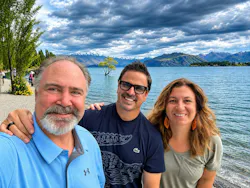
We also rode the Skyline Gondola high above Queenstown, explored the historic gold-mining community of Arrowtown and visited the famous Wānaka Tree.
I loved that contrast. Transportation isn't only about the daily trip to work. It also connects us to recreation, tourism, history and the places that give communities their character. Sometimes that connection comes aboard a modern automated railway. Other times, it's aboard a century-old steamship or a gondola climbing a mountainside.
A few things that stayed with me
I didn’t come home with a checklist for American agencies. I came home excited by the people and projects we saw—and with a few practical ideas worth discussing with transit colleagues everywhere.
Big ideas were brought to life. At a time when major rail projects in North America can take decades to plan, approve and deliver, it was heartening to see Sydney and Auckland opening transformative new rail infrastructure. These projects weren't easy, and they certainly weren't without challenges, but they're getting built, they're carrying passengers and they're demonstrating what sustained vision, leadership and determination can accomplish.
People make transportation work. In the operations control centers we visited, multiple disciplines work side by side, sharing information and coordinating responses in real time. Bringing everyone together makes communication faster, breaks down silos and keeps decisions focused on better outcomes for customers.
Partnerships in action. In Sydney, we saw public transportation agencies and contracted operators working together to deliver services for their communities.
Design is worth celebrating. Beautiful stations, public art, thoughtful architecture and distinctive vehicle designs added character to the transportation experience.
Transportation in all its forms. From modern rail networks to historic ferries and mountain gondolas, the trip was a reminder of how many ways transportation connects people to places and experiences.
Those were just some of the moments we were fortunate enough to experience.
We captured many of these experiences for upcoming episodes of our newly branded international television series, Transit Unplugged – How Do I Get There? It begins airing in early 2027.
What struck me most about this trip wasn't just the technology or the billions being invested. It was the determination to turn big ideas into reality—and the extraordinary people making it happen.
We spend a lot of time in our industry talking about what's difficult: funding, construction costs, political obstacles and the complexity of delivering major projects. Those challenges are real,but in Sydney and Auckland, I saw what happens when leaders push through them. New railways open. Passengers show up. Communities gain connections that will serve them for generations.
That's why I love telling these stories on Transit Unplugged. Our industry is full of remarkable people doing remarkable things, often without the recognition they deserve. From a 114-year-old steamship still sailing to new automated metros carrying thousands of passengers, Down Under reminded me of something worth celebrating. Transportation doesn't just connect us to where we've been. At its best, it shows us what's possible next.
About the Author
 Paul Comfort, Esq.
Senior Vice President and Chief Customer Officer, Modaxo
Paul Comfort is senior vice president and chief customer officer at Modaxo, executive director of the North American Transit Alliance and host of the Transit Unplugged Podcast and Transit Unplugged TV. He is a former CEO of the Maryland Transit Administration and author of seven books on transportation and leadership, including his latest, Find Your X Factor.