Transit agencies across North America make rider experience upgrades
Transit agencies across North America are working to improve the rider experience with new comfort and technology upgrades.
Connecticut Department of Transportation (CTDOT), city of Hartford announce the installation of 21 new bus shelters
CTDOT and the city of Hartford, Conn., have announced the installation of 21 new bus shelters across the city through CTDOT’s Bus Stop Enhancement Program after it began the program’s state-wide push late last year in Hamden, Conn. An additional 47 bus stops in Hartford are currently in the design process for future improvements.
CTDOT says the 21 stops serve an average of approximately 360 passenger boardings each weekday, meaning more than 131,000 passenger boardings will benefit from the new shelters annually.
“Every rider deserves a safe and comfortable place to wait for the bus, especially when it's cold, rains or snows," said CTDOT Commissioner Garrett Eucalitto. "These new shelters are an important investment in Hartford, and I am grateful to the city for partnering with us to build 68 new shelters across the city."
The Hartford installations mark the first completed project under the Greater Hartford Mobility Program, a regional planning effort that brings together Hartford area communities to identify and advance shared transportation priorities. The department notes that the bus stop improvements emerged directly from community outreach and feedback conducted through the program.
"Public transportation is an important service for many residents in the city of Hartford, and they deserve to have clean, safe spaces to wait for the bus," said Hartford Mayor Arunan Arulampalam. "I am grateful to the Department of Transportation for their collaboration in constructing 21 new bus shelters in the city of Hartford."
The Bus Stop Enhancement Program is a $20 million statewide initiative to modernize high-ridership bus stops with new amenities, including shelters, benches, solar lighting and real-time information displays. The program aims to install 600 new bus shelters by 2029 while bringing eligible stops into compliance with the Americans with Disabilities Act and creating a more consistent, accessible experience for riders across Connecticut. The program has delivered 36 bus shelters and four benches with lighting statewide.
More than 100 additional installations are planned in Bridgeport, Farmington, Hartford, Mansfield, Stamford, Stratford, Trumbull, Waterbury and West Haven, Conn. The average cost to design and construct a bus shelter in Hartford is approximately $26,000 per site. A map of completed and planned bus shelter installations is available on the department’s website.
CTDOT has opened the next round of applications for the program, expanding eligibility to more than 1,000 bus stops statewide, including locations where existing shelters need to be replaced. The department says that high-ridership locations will be prioritized, with a goal of delivering 150 additional installations through the next round.
Calgary Transit adds passenger information screens to buses and community shuttles
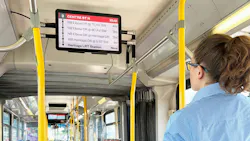
Calgary Transit is improving wayfinding on the road with new onboard display screens on buses and community shuttles. Passengers can view real-time route detail, route number, requested stops, upcoming stops and estimated arrival times, as well as service announcements on ceiling-mounted displays.
“Customers want accurate, consistent and timely information to help them make decisions during their trip,” said Calgary Transit Service Vehicles Manager Dennis Uvbiama. “They also want to know about service changes or disruptions that may affect their journey. These new screens deliver useful information to customers where and when they need it.”
As part of a pilot project, Calgary Transit notes that it has installed new 21- or 29-inch screens on 100 service vehicles. Starting in October 2026, the agency plans to roll out passenger screens broadly across its 1,000-plus fixed route bus and shuttle fleet, with installation expected to be completed by early 2027.
The agency says this upgrade is possible because of modernized computer-aided dispatch/automatic vehicle location/advanced passenger information (CAD/AVL/APIS) system it uses to share real-time vehicle tracking and manage its bus fleet operations. The system integrates dispatching, safety, emergency response and communication with the agency’s transit control center, helping improve service reliability and trim passenger waiting times.
The agency also notes that the upgraded system has also improved bus tracking accuracy in all its rider-facing tools, including in the Transit App, its own trip planning app, the trip planner on the Calgary Transit website and on its older phone-based Teleride and Teletext services.
New CAD/AVL/APIS system features for operators include simplified employee login, turn-by-turn navigation, detailed information about incidents and up-to-date construction detours and live videos in case of emergencies.
About the Author
 Noah Kolenda
Noah Kolenda
Associate Editor
Noah Kolenda is a recent graduate from the Craig Newmark Graduate School of Journalism with a master’s degree in health and science reporting. Kolenda also specialized in data journalism, harnessing the power of Open Data projects to cover green transportation in major U.S. cities. Currently, he is an associate editor for Mass Transit magazine, where he aims to fuse his skills in data reporting with his experience covering national policymaking and political money to deliver engaging, future-focused transit content.
Prior to his position with Mass Transit, Kolenda interned with multiple Washington, D.C.-based publications, where he delivered data-driven reporting on once-in-a-generation political moments, runaway corporate lobbying spending and unnoticed election records.