MTA expands open stroller program to all local and Select Bus Service buses
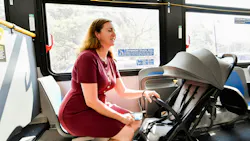
The Metropolitan Transportation Authority (MTA) is expanding its open stroller pilot to include all local and Select Bus Service buses across the five boroughs. The program, which was expanded and later entered phase two in 2023, provides parents and caregivers with a marked space—separate from existing priority seating for wheelchair users—where they can ride without needing to fold their stroller.
The agency notes that buses are currently being retrofitted on a depot-by-depot basis with stroller spaces, either as an open space near the rear door, or as a space created by flipping up two side-by-side seats—depending on the bus model. As of 2024, all new buses in procurement or purchased for service come with a dedicated stroller space already built in.
“The expansion of the Open Stroller program allows us to make buses more accessible for more riders while providing fast, safe, reliable service for New Yorkers and their families,” said New York City Transit President Demetrius Crichlow. “We understand even the youngest New Yorkers have places to be and we’re ensuring our bus network continues to get them there.”
This expansion was made possible by a $1.5 million grant from state lawmakers, including Sen. Andrew Gounardes (D-22), former Sen. and current Manhattan Borough President Brad Hoylman-Sigal and Assembly Members Nily Rozic and Jo Anne Simon.
“The Open Stroller program expands access to our bus network for parents and caregivers traveling with children in strollers while preserving equitable access for riders who use mobility devices like me,” said MTA Chief Accessibility Officer Quemuel Arroyo. “This expansion brings us one step closer to our goal of creating a transit system that is accessible for everyone, and I thank our elected partners for their support in making it possible.”
First launched as a pilot in 2023, the MTA says the Open Stroller program was developed after working with disability advocates, parents, bus operators and members of the agency’s accessibility and customer experience teams to address rider concerns and create more streamlined service. The MTA notes that the program quickly gained popularity and has continually received an 80% or higher approval rating in customer surveys since 2023.
Buses participating in the Open Stroller program are identified by a stroller decal on the outside of the bus that customers can see before boarding. Once inside the bus, the designated space is marked with a similar decal. There can only be one open stroller at a time. If the space is in use already, riders must still fold their stroller prior to boarding.
“As a father, I know firsthand: being a parent is challenging enough. It can be a nightmare when you’re trying to shepherd your kids around the city, rushing to school or the doctor’s office, only to find there’s no room for you on the bus. With this program, we make life a little bit easier and a little less stressful for families,” Sen. Gounardes said. “Our transit system belongs to all New Yorkers, and it should be accessible to all New Yorkers, including New York’s cutest. This investment in New York’s families is an investment in New York’s future. Thanks to the MTA for their work to bring this program to fruition.”
The MTA isn’t the only agency offering this style of program, either. The Alexandria Transit Company, which runs the DASH bus service, launched an expanded stroller use program in 2022 when it adopted all-door boarding. The Washington Metropolitan Area Transportation Authority made a similar move in 2023, and the Southeastern Pennsylvania Transportation Authority followed suit in 2025.
About the Author
 Noah Kolenda
Noah Kolenda
Associate Editor
Noah Kolenda is a recent graduate from the Craig Newmark Graduate School of Journalism with a master’s degree in health and science reporting. Kolenda also specialized in data journalism, harnessing the power of Open Data projects to cover green transportation in major U.S. cities. Currently, he is an associate editor for Mass Transit magazine, where he aims to fuse his skills in data reporting with his experience covering national policymaking and political money to deliver engaging, future-focused transit content.
Prior to his position with Mass Transit, Kolenda interned with multiple Washington, D.C.-based publications, where he delivered data-driven reporting on once-in-a-generation political moments, runaway corporate lobbying spending and unnoticed election records.