CA: Report details Larkspur ferry terminal expansion options
Two concepts have emerged as viable options for Golden Gate Ferry to expand service in Larkspur to meet future ridership demand, according to a new report.
The project alternatives are detailed in a draft environmental impact report, which the Golden Gate Bridge, Highway and Transportation District released this month for public comment.
The report examines the district’s plan to increase ferry crossings to and from Larkspur beyond its daily limit of 42 trips up to 76 runs. Both concepts include parking garages, and one includes new shuttles and bicycle hub with repair services.
“There is a lot of enthusiasm among our riders for this,” said Ron Downing, the district’s director of planning. “A lot of them remember how constrained things were before 2020.”
Prior to the COVID-19 pandemic, daily ridership averaged more than 6,000 passengers and sometimes exceeded 8,000, prompting the district to discuss increasing service. The pandemic hit, diminishing ridership and stalling the project.
Ridership is bouncing back. And housing projections call for about 29,000 new residences in Marin and Sonoma counties by 2031. The district expects daily ferry demand to increase to more than 7,000 riders by 2035 and to more than 17,000 riders by 2050.
Downing said that although the study is happening now, the possibility of a parking garage project is many years down the line.
“There is no project to build a parking structure at this time, no decision has been made. That will be the decision of a future board of directors,” Downing said. “But we want to be ready because we don’t know how quickly ridership is going to come back. This draft EIR starts us down the road of being ready to respond as opposed to waiting till something happens and then trying to respond.”
The Larkspur Ferry Terminal was constructed in 1976 on 25 acres. It features four ferry berths and a main parking lot with 1,800 spaces. The north lot, near the SMART station off Larkspur Landing Circle, has 215 parking spaces.
Both project alternatives have similarities. They would enable the district to incrementally increase service as needed. They envision a new pedestrian crossing on Larkspur Landing Circle to improve the connection to the north lot. They would involve drainage and utility connection improvements, solar, electric vehicle charging stations and night-sky-compliant lighting.
Project alternative 1 involves a six-level, 260,000-square-foot parking garage with 850 stalls on the north lot. A second project phase would construct a five-level parking garage with secured bicycle parking on the main lot. The second structure would be 1.2 million square feet with 3,998 stalls. The ground floor would be raised 1 to 5 feet above the existing grade to account for sea-level rise.
Project alternative 2 would construct the same six-level parking garage on the north lot. However, the garage on the main lot would be smaller at 960,000 square feet with four levels and 3,258 stalls. The ground floor would be raised 1 to 5 feet.
Project alternative 2 proposes a suite of activities to encourage ferry riders not to drive to the site. They include expanding one fixed-route shuttle from peak-hour service only to all-day service by 2035, and adding up to two neighborhood shuttles by 2050.
At the main lot, the number of carpool parking spaces on the ground floor would be increased, and there would be 350 spaces for secure bicycle parking and a bicycle hub with repair services. The district also is considering increased parking fees.
The report considers impacts to the Larkspur Landing area and the shoreline, and how to mitigate unwanted consequences of the project.
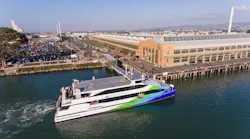
The district is in the process of replacing its fleet with a cleaner, more efficient class of ferries that create less wake.
“As a result, ferry operations are found to have no significant impact on shoreline habitats, wetlands, or other biological resources,” the report says.
The two viable options have the same “significant and unavoidable impacts”: construction activity; altering the visual character and quality of public views; and affecting traffic on Highway 101 at Sir Francis Drake Boulevard.
That said, the study found project alternative 2 to be the “environmentally superior” option, because it achieves the project objectives with greater opportunities for multimodal access and greater reductions to vehicle miles traveled and air emissions. The lower garage height also reduces the project intensity, the report says.
A no-project alternative was dismissed because it does not meet the project goals. An alternative that examined transit and bicycle and pedestrian improvements instead of parking garages was withdrawn from consideration for the same reason.
Larkspur Councilmember Gabe Paulson, a member of the boards governing the Transportation Authority of Marin and Sonoma-Marin Area Rail Transit, said, “Expanding ferry service is a critical piece of the North Bay’s climate, transit and commute goals.”
However, Paulson has concerns about the parking proposals because of costs, traffic, sea-level rise and commitments from the bridge district.
“Adding thousands of garage stalls directly concentrates commuter vehicle trips into our local roadway network rather than dispersing them onto connecting transit,” he said. He is interested in continuing discussions on options for bicycle and pedestrian improvements over parking garages.
Marin County Supervisor Dennis Rodoni said the draft report is a positive step to meet future demand.
“My preference would be to strengthen partnerships with SMART and other transit providers, making it easier for people to reach the ferry without relying on their cars,” said Rodoni, who is a board member of the Transportation Authority of Marin and the Golden Gate Bridge district. “The goal should be to provide better transportation choices while protecting the communities and environment around the terminal.”
Ferry riders are excited about the prospect of increased service.
Blake Parrish, a San Rafael resident who commutes by ferry up to four days a week, said he sees room for more runs during peak commute hours.
“I feel that the frequency of trips right now is adequate, but not optimal,” he said. “An increase in trip frequency would provide more flexibility for commuters. It would be a huge benefit.”
Victor Mora, a San Anselmo resident who commutes three days a week, agreed. He said there is also a demand for departures from San Francisco to leave later in the evening and for shuttle services connecting the Ross Valley to the Larkspur terminal.
“I would absolutely love more public transit that was convenient,” Mora said. “The more options we have to get on transit and a ferry, putting fewer cars on the road, is better in my opinion.”
A public meeting about the report, with a chance to comment on it, is scheduled for 5:30 p.m. Nov. 5 at the Larkspur Library at 10 Rose Lane. The public comment period is open through Dec. 3.
More information is at goldengate.org/larkspurferrystudy.
© 2026 The Marin Independent Journal (Novato, Calif.).
Visit www.marinij.com.
Distributed by Tribune Content Agency, LLC.