2026 40 Under 40: Matt Horton, AICP
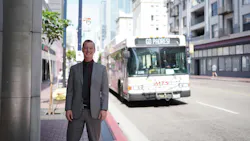
One word to describe yourself: Collaborative
Alma Mater: Undergraduate: Gustavus Adolphus College; Graduate: University of Minnesota
Fast fact: I am an avid Great Courses listener on Audible. My all-time favorite is “The Other Side of History: Daily Life in the Ancient World.” It explores major moments in human history from the point of view of the everyday people who actually experienced them.
What’s your best experience on transit and what made it memorable? Riding the Route 2 bus in Minneapolis to school and work. It was my first real transit experience as a passenger, and it showed me how something as utilitarian as transportation could bring people from all walks of life together. It was a humanizing experience and my first window into how diverse the world truly was.
Matt Horton is recognized as a transit leader who pairs rigorous analysis with operational focus to help agencies navigate tradeoffs to the benefit of riders—turning complex planning into implementable service and capital programs. Since joining Kimley-Horn as a transit planner in 2012, Horton has built a reputation where he’s known as a trusted, conscientious partner who helps agencies make optimal decisions amid complex tradeoffs. His work is known internally to consistently elevate projects, people and the transit industry through a balance of data-driven planning, operational realities and community-centered priorities.
As a transit practice leader at Kimley-Horn, Horton applies a broad skillset garnered throughout his career—public involvement, mobility planning, ridership modeling and geospatial analysis—to integrate divergent transit priorities across communities, agencies and funding partners. He assisted planning efforts in Central Oklahoma, where he reached consensus on five locally preferred alternatives for new high-capacity transit services and led the planning for the region’s first long-range transit plan in over 20 years—aligning jurisdictions, funders and operators around an implementable vision. Additionally, Horton guided Oklahoma City’s NE/S bus rapid transit (BRT) through planning and into the Federal Transit Administration (FTA) Capital Investment Grants program, setting the stage for a transit corridor that will serve thousands of residents while improving connections to jobs, healthcare, education and cultural destinations.
In addition to project delivery, Horton is known to contribute to innovation in the field by helping teams modernize how they plan for service and investment decisions. Drawing from experience in Minneapolis’ Metro Transit’s rail operations department, he works to uncover how concepts will truly manifest in a real-world setting. This mindset is described as having helped teams translate abstract planning concepts into implementable, sustained service. He has further advanced this implementation orientation through the adoption of emerging big data planning tools and by championing specialized approaches to model travel behavior and forecast ridership, enabling public agencies to more easily facilitate improved decisions with fewer resources. He has also led internal initiatives to streamline transit data analysis as part of Kimley-Horn’s firmwide transit practice to empower public agencies with additional transit options and make decisions efficiently.
Within Kimley-Horn, Horton uses his developed leadership skills to support new professionals as they transform into future transit leaders. He has served as an advisor to mid-career transit professionals for the past five years. He is actively building a small-group mentoring program to help emerging transit leaders identify their goals, build relationships, develop technical skills and amplify their impact. Further, Horton serves on Kimley-Horn’s firmwide BRT growth strategy committee. Within the San Diego office specifically, he serves on the infrastructure leadership Team and leads a local team of 16 transit professionals.
Beyond his role, Horton contributes to the industry by building networks and sharing his expertise as a member of the American Institute of Certified Planners, American Planning Association and Railway Association of Southern California (RASC). He regularly participates in RASC industry events—such as touring a Metrolink station and attending the California Passenger Rail Conference—to deepen his railway planning knowledge and collaborate with industry partners on the latest trends.
He also participates in transit-focused volunteer efforts, including the University of California San Diego Design-a-thon, an event aimed at improving mobility of new light-rail stations on campus. Further, Horton has also shared his transit experience with the WTS International San Diego Chapter, guiding transit conversations focused on parking, travel demand management strategies and rail grade crossing strategies. Outside professional endeavors, Horton volunteers as a coach for his oldest child’s little league baseball team and enjoys gardening with his family.
Is there a specific experience that led you to where you are today?
I am where I am today because of the sustained investment that countless mentors have made in me over the years. I have the privilege and incredible opportunity to work with an amazing group of people serving Central Oklahoma, which has been a particularly transformative experience in my career. Collaborating with energized clients and experts from across the country pushed me to be a better leader, expand the bounds of innovation technically and deliver the best possible services to the transit riders—both current and future—of Central Oklahoma.
What do you enjoy most about your job?
I get to work with the most passionate and motivated industry professionals every day to solve real challenges for agencies across the country. I love that every day is a new challenge that requires collaboration and innovation with partners that care deeply about making our communities more connected places.
What’s the most challenging part of your job?
Agencies always have to consider the trade-offs with the services they plan and provide. This is particularly challenging as budgets get squeezed and funding dries up. Real people are ultimately impacted by our decisions, and making recommendations, no matter how supported by analysis, is a complex responsibility that weighs heavy upon all involved.
What is the accomplishment you’re most proud of and why?
I am beyond proud of my three kids! They are still young (7, 4 and 1), but they bring a curiosity to the world that is humbling. Watching them learn, grow and succeed inspires me to be a better version of myself.
What is an accomplishment you would like to work towards in your career?
I am here today because of the mentorship and investment that others have made in me. I feel it is my duty to repay those who gave me so much opportunity by investing back in the next generation of leaders in our industry.
What is your best advice you can share from your area of expertise?
Be curious and ask questions! Our industry is built on a long and rich history, but the world is constantly changing. Intellectual curiosity is essential to more deeply understand the how and why behind transit systems and facilitates the needed innovation within the spaces we work. Asking fundamental questions is also how we critically assess challenges and reframe them in a way that might lead to better solutions. The mantra of “no dumb questions” should be held sacred and is how we discover new ways to serve our communities.
About the Author
 Noah Kolenda
Noah Kolenda
Associate Editor
Noah Kolenda is a recent graduate from the Craig Newmark Graduate School of Journalism with a master’s degree in health and science reporting. Kolenda also specialized in data journalism, harnessing the power of Open Data projects to cover green transportation in major U.S. cities. Currently, he is an associate editor for Mass Transit magazine, where he aims to fuse his skills in data reporting with his experience covering national policymaking and political money to deliver engaging, future-focused transit content.
Prior to his position with Mass Transit, Kolenda interned with multiple Washington, D.C.-based publications, where he delivered data-driven reporting on once-in-a-generation political moments, runaway corporate lobbying spending and unnoticed election records.