NJ Transit launches high-tech bus stop signs pilot
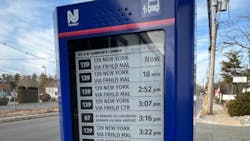
New Jersey Transit (NJ Transit) has begun testing new high-tech bus stop signs with digital screens that show customers the real-time arrival information of the next bus. The pilot program showcases two companies’ technology at eight bus stops. NJ Transit says the companies submitted their ideas through the Transit Tech Lab, which is backed by the Partnership Fund for New York City and provides an accelerated pathway for early to growth-stage companies to solve public transportation challenges for the largest transit agencies in North America.
“Partnering with emerging tech companies allows us to test solutions that directly enhance the customer experience—in this case by improving access to important customer information,” said NJ Transit President and CEO Kris Kolluri. “These digital signs not only provide real-time updates to riders at bus stops, but also supply NJ Transit with valuable data to help us plan more responsive and customer-focused technology solutions.”
The agency has installed five signs from infrastructure provider BusPas at locations in Hudson County—two in Hoboken, two in Union City and one in Jersey City. The signs feature real-time customer information such as arrivals, detours, delays, service alerts and bus occupancy levels. As part of the pilot, the signs are solar powered and employ e-paper displays. They also include text-to-speech announcement capability and automated safety lighting for improved nighttime visibility.
NJ Transit notes a similar pilot is underway in Manalapan Township and Howell Township in Monmouth County, N.J., through a partnership with Urban Solar.
“At NJ Transit, innovation means reimagining how infrastructure, data and emerging technologies come together to shape the future of public transportation,” said NJ Transit Head of Innovation Luna Katbah. “This pilot is an important step toward building a more connected, intelligent transit ecosystem—one where real-time information, adaptive systems and smart infrastructure work seamlessly to anticipate rider needs and evolve with our communities.”
In addition to customer-facing information, the agency says the signs feature artificial intelligence-driven customer analytics such as people-counting, occupancy detection and demand modeling to help with future service planning. The signs also implement leave-behind detection, a capability that enables the agency to count customers unable to board due to full buses or schedule constraints, which NJ Transit says is a crucial metric for service planning and resource allocation.
The pilot is expected to last for one year, and if successful, NJ Transit will consider expanding the signs to other locations. All of the sign locations can be found on NJ Transit’s website.