Transit Tech Lab selects 18 companies to participate in eighth annual challenge cycle
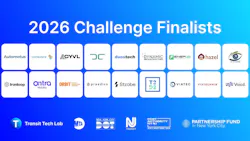
The Transit Tech Lab has selected 18 companies to collaborate with the Metropolitan Transportation Authority, Port Authority of New York and New Jersey, NYC Department of Transportation, New Jersey Transit and the NYC Department of Design and Construction as part of the program’s eighth annual challenge cycle. This year’s two challenges are focusing on technologies designed to help the transit agencies improve infrastructure management, modernize data and update workflow processes.
According to the Transit Tech Lab, the participating companies will conduct proofs of concept over an eight-week period of collaboration with agency partners. The agencies may then opt to further test promising technology through a longer-term pilot.
Over 100 staff across the participating agencies identified the program’s challenges for the year. Over 300 public sector operational staff and leaders then explored potential solutions through a rigorous evaluation period that included in-person pitch and demo days. The 18 participating companies were chosen from 138 applications. Seven companies participating this year are based in New York City.
Data & Workflow Modernization Challenge
- Automotus (Los Angeles, Calif.) – Computer vision-enabled, pole-mounted cameras that leverage artificial intelligence (AI) to monitor vehicle activity at terminal curbs and city curbs, enabling airports and cities to reduce congestion, improve safety and customer experience and increase revenue through automated payment and enforcement of curb and right-of-way rules.
- contextere (Ottawa, Ontario) – Industrial Insight Engine that connects to an agency's existing data systems (maintenance logs, schedules, sensor feeds) and applies operational context (asset, role, task) to provide frontline workers plain-language answers and recommendations to improve service reliability and reduce downtime.
- Cyvl (Boston, Mass.) – Mounts cameras and sensors on vehicles that drive road networks to automatically detect potholes, cracks and other pavement problems, replacing manual inspections with a continuously updated, searchable map of infrastructure conditions.
- Hazel (New York, N.Y.) – AI-powered procurement tool that helps government agencies draft solicitations, find qualified vendors and evaluate bids in a fraction of the time it takes today while aiming to keep staff in control of every decision.
- In A Blink (Montreal, Quebec) – Uses light-based (photonic) wireless technology to transfer an entire day's worth of onboard video and sensor data from a transit vehicle in a few minutes, unlocking data that today can sit trapped on buses and trains.
- Ironloop (New York, N.Y.) – Software platform that monitors the configuration of control systems (like SCADA and PLCs) aiming to catch cybersecurity risks and compliance gaps before they become incidents.
- Ontra Mobility (New York, N.Y.) – AI transit planning platform that leverages ridership, scheduling and operations data in an effort to predict travel demand, recommend service design and optimize timetables under real-world budget and fleet constraints.
- VIATechnik Voyager (Chicago, Ill.) – Digital Twin platform that centralizes access and enables AI-powered insights across Building Information Modeling (BIM) drawings, asset records, reality capture, equipment documents, portfolio attributes and live streaming Internet of Things data so facility teams can find information and make more effective maintenance and operations decisions.
- Voicd (Boothwyn, Pa.) – Voice analysis technology solution that uses AI to verify speaker identity, detect deepfake audio and flag potential threats in real time across secure communications and public safety channels.
Advanced Infrastructure Challenge
- Delphisonic (Wayne, N.J.) – Installs onboard vibration/temperature sensors on railcar components and runs edge-based AI to detect mechanical degradation early, aiming to prevent in-service failures and cutting fleet lifecycle costs.
- Duos Technologies (Jacksonville, Fla.) – AI-powered trackside imaging system that captures high-resolution scans of rolling stock at speed in an effort to automatically detect mechanical defects and anomalies within seconds, available in both fixed and portable configurations for transit fleet inspection.
- Dynamic Infrastructure (New York, N.Y.) – AI platform that seeks to transform inspection reports and imagery into actionable infrastructure intelligence detecting defects, tracking deterioration, forecasting and prioritizing high-value maintenance decisions across infrastructure networks.
- Enspi Technologies (Minneapolis, Minn.) – Builds a real-time digital twin of transit power and OT systems, using AI in an effort to detect anomalies, predict failures and map cybersecurity vulnerabilities across traction power infrastructure.
- Orbit (New York, N.Y.) – Online marketplace for reclaimed construction materials, in an effort to make it easier and faster to buy, sell and reuse salvaged, refurbished and surplus materials while also reducing waste from the construction and demolition sector.
- Praedico (Boston, Mass.) – Predictive software that spatially aligns track and infrastructure data over time to give rail operators a singleview of asset conditions for smarter maintenance and capital planning.
- Strobe Power (Brooklyn, N.Y.) – Autonomously operates behind-the-meter batteries, solar, generators and electric vehicle charging at commercial and industrial sites in an effort to reduce facility energy costs and earn grid services, live in the New York Independent System Operator.
- T2D2 (New York, N.Y.) – Computer vision platform that analyzes inspection imagery from cameras or drones in an effort to automatically detect corrosion, cracks and water penetration on physical assets and track deterioration over time.
- Viatec (Piedmont, Calif.) – Modular battery systems that retrofit onto existing work trucks in an effort to eliminate engine idling at job sites, cutting emissions, noise and operating costs, with 700-plus units deployed across 100-plus utilities and municipalities.
In addition to the Transit Tech Lab, the Partnership Fund operates the Environmental Tech Lab, established in 2023 in partnership with New York City’s Department of Environmental Protection, and the Buildings Tech Lab, launched in 2024 in collaboration with the New York City Department of Buildings. The labs aim to invest in companies and programs that advance the application of new technologies to address urban challenges, including helping government agencies deliver services more effectively. To date, the three labs have addressed 23 challenges, powered 222 real-world technology tests and built a thriving network of 98 alumni companies.