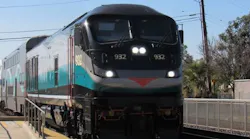
CA: LA Metro puts $6 million behind relocating Commerce Metrolink Station to Pico Rivera
LA Metro’s board of directors recently approved spending $6 million on engineering and environmental work that advances a plan to relocate the Metrolink Commerce Station from Commerce to nearby Pico Rivera.
The plan − which coincides with long-term visions of a possible high-speed rail station in the area − will increase poor ridership numbers currently at Commerce and offer transit-dependent Pico Rivera residents a car-free ride into L.A.’s Union Station or north to Orange County cities, officials said, while positioning the city to take advantage of future transit projects within Southeast L.A. County and the San Gabriel Valley.
“The point is we are doing what we can as a city to improve transportation systems for our residents,” said Pico Rivera Mayor Gustavo Camacho. “So they don’t have to drive their vehicles and they can also avoid paying higher fuel costs.“
The motion was led by L.A. County Fourth District Supervisor and LA Metro Board Member Janice Hahn, with support from L.A. Mayor Karen Bass, Long Beach Mayor Rex Richardson, Pomona Mayor Tim Sandoval, and fellow supervisor Hilda Solis. It has the backing of State Sen. Bob Archuletta, D- Norwalk, Rep. Linda Sanchez, D- Whittier, and U.S. Sen. Adam Schiff who submitted a letter of support.
Commerce, Montebello, and Pico Rivera have all expressed support for the Pico Rivera location, according to Hahn’s Office.
Metrolink, the heavy-rail passenger train serving six counties, runs its diesel-locomotive driven trains through Pico Rivera. While residents get the noise and sit in their cars waiting for trains to pass at one intersection that is not grade-separated, they don’t get the benefit, Hahn and Camacho pointed out.
“Pico Rivera has had Metrolink trains running through its community for years, but residents haven’t been able to get on board,” said Hahn in a prepared statement. “We have an opportunity to change that.”
Metrolink said it is aware of the proposal.
“While Metrolink was not part of the foundational proposal to relocate the station, our trains would serve the station if and when it is completed,” said spokesperson Meredith Yeoman in an emailed response.
“Seven Orange County Line trains currently stop at the station, four northbound in the morning and three southbound in the afternoon and evening,” Yeoman said. “Weekend trains do not stop at the Commerce Station.”
The idea of a Pico Rivera Metrolink Station was first introduced by Hahn and others on LA Metro in February 2023. The new station could be served by two Metrolink train lines, the 91/ Perris Valley line and the Orange County line.
A feasibility study was done after approval of the 2023 LA Metro motion. LA Metro oversees Metrolink and other L.A. County transit agencies. The study found that the Commerce station has about 33 boardings a day on average, while a station in Pico Rivera would attract 350 to 430 daily riders by 2045.
Yeoman confirmed the Commerce station averaged 33 weekday boardings in fiscal year 2026 and the station has seen similar ridership so far in 2027, she added.
Recently, the idea of a Pico Rivera station picked up steam when the California High Speed Rail Authority said it would put a station in Commerce and the existing Metrolink station there must be removed. The CAHSR recommended relocating the station to an industrial area of Montebello, which Hahn and other supporters said is not a good option.
“Instead of moving the station to an industrial area with limited transit connections, we can put it where it will better serve riders and help strengthen downtown Pico Rivera,” Hahn said. She said the cost of the engineering and environmental work for a Pico Rivera station would be repaid by CAHSR.
While no plans have been approved and full construction costs remain unknown, the Pico Rivera station would be situated nearest to the existing Norwalk/Santa Fe Springs Station. The next stop traveling north is L.A.’s Union Station, which has connections to LA Metro rail lines A, B and D, local bus lines and Dodger Stadium Express buses. Southbound on the Orange County Line, Metrolink riders can exit at several OC cities, including Anaheim, located adjacent to Angel Stadium.
The station would integrate with plans for a future LA Metro E Line light-rail extension into Montebello and Whittier and a possible Rosemead-Lakewood Boulevard Bus Rapid Transit Line, connecting north to Pasadena.
Pico Rivera City Manager Steve Carmona said the addition of a Metrolink station is part of an overall city transportation and sustainability plan.
“The Pico Rivera City Council is united in its belief that the Pico Rivera Regional Rail Station is critical to our future,” he said in a statement. He also said the city would coordinate residential and commercial uses around the new station, called Transit Oriented Development.
Camacho said the city is studying a site near the Rio Hondo Riverbed, somewhere near the southwest corner of Washington Boulevard and Paramount Boulevard in an industrial zone. He would not support a station near residential areas.
The station would include a park and ride lot. He envisions the city building a bike trail to the site, and asking bus lines to connect. He cautioned that the station and its possible location are in the study phase, and that projects like this “are years in the making.”
The authorized environmental and engineering reviews will help determine the project’s costs, feasibility and next steps. All parties are pursuing outside funding for the project. Funding for a bike path may come from the San Gabriel Valley Council of Governments. Pico Rivera is also looking to find state and federal dollars.
The San Gabriel Valley Council of Governments will serve as the agency of record for the engineering and environmental work on behalf of the California High Speed Rail Authority, LA Metro and the city of Pico Rivera.
If the station gets built and starts accepting Metrolink passengers, the city sees opportunities to build commercial, retail and residential development around the station. Many cities, such as Arcadia, Monrovia and Pasadena, have built housing projects at or near their LA Metro A Line stations.
“The train station can create economic opportunities, from retail, restaurants, entertainment and housing,” said Camacho, who also sits on the Metrolink board and is also chair of the Legislative Committee of the California Contract Cities Association.
© 2026 San Gabriel Valley Tribune, West Covina, Calif.
Visit www.sgvtribune.com.
Distributed by Tribune Content Agency, LLC.