Metrolinx advances Oakville GO Station enhancements
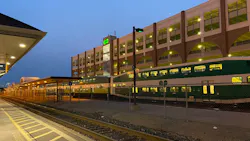
Expansion efforts are underway at Metrolinx’s Oakville GO Station to enhance the experience and accessibility for the rider and to support increased service on GO Transit’s busiest rail line.
Located on the Lakeshore West line, the agency reports the Oakville GO Station was commissioned in 1967, the same year the system launched.
Today, the agency reports the station sees more than 10,000 customers per day, making it the busiest GO station on Lakeshore West and the second busiest on the entire network—behind Union Station in downtown Toronto.
With nearly C$15 billion (US$10.9 billion) invested to date, the GO Expansion program is anticipated by the agency to substantially increase ridership and change the way people use GO Transit to get where they need to go.
The agency says this is why upgrading infrastructure at existing stations is essential—to support population growth, meet increased ridership demands and move more people across the region faster, safer and more efficiently.
Station upgrades
The expanded Oakville GO Station will feature:
- Platform rehabilitation with accessibility upgrades.
- New mini-platforms, canopies and shelters
- Tactile edges and digital signage
- New accessible pedestrian bridge
- Four elevators and four staircases to platforms and parking structure
- Enhanced bus loop
- Six additional bus platforms
- New passenger shelters and digital signage
- Parking lot improvements
- Top course asphalt replacement
- Line painting and signage
- New secured bike shelter
- Station building
- Architectural, mechanical and electrical services upgrades
- Exterior/interior improvements
Metrolinx says it awarded a contract to Kenaidan Murphy Joint Venture (KMJV) to complete the station upgrades and renovations in April 2026.
Metrolinx says the contract award follows a design development phase with the construction manager that began in December 2024, where teams oversaw design details and solutions for the required infrastructure upgrades through the Construction Manager at Risk (CMAR) model.
The CMAR delivery model, according to Metrolinx, encourages early collaboration between the design and construction teams. This allows the design to be informed by the builder’s experience with construction methods, materials and market conditions, setting up the project before it moves into the construction stage.
In April, Metrolinx reports that crews began setting up an area to lay down materials at the northwest end of the station. A construction compound was also set up on the south side of the station to support the expansion work.
The agency notes that trailers and fencing have been installed to keep the site secure. Appropriate signage is designed to communicate any required detours for riders accessing the station and platforms.
Following site mobilization, crews are set to build a temporary crossing to allow access for heavy duty equipment, as well as a temporary widened joint platform to maintain passenger access to trains during construction.