TTC Launches Eglinton Crosstown Line 5 Cutting Travel Times and Linking Up Transit Services
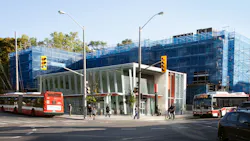
The Toronto Transit Commission (TTC) began phased introductory service of its Line 5 Eglinton Crosstown expansion on Feb. 8 ahead of the service’s full launch after nearly 15 years of construction and decades of planning. The roots of the line can be traced back to the Network 2011 plan made in 1985, though what was delivered today comes after multiple phases of reimagining and a false start in 1995.
Line 5 spans 25 stations across four types of urban environment with a mix of underground, at-grade stops that were designed to meet the moment of their region.
Making the project happen is a consortium engaged by Infrastructure Ontario and Metrolinx, including lead engineering and design firms AtkinsRéalis and Arcadis and construction partners from Crosslinx Transit Solutions, comprised of EllisDon, Aecon, FlatironDragados Canada and AtkinsRéalis. The consortium also hosted teams consulting on 12 primary areas and 18 specialized areas, consisting of nearly 30 supporting companies—working out to more than 700 team members in total to deliver the megaproject.
Whether placed in an area that’s in the midst of a revitalization or a station in the middle of a bustling city core, the new line, according to the consortium, is one built to move people, not just meet a timetable.
As it opens, Line 5 will connect the region in a new way—one that used to take multiple transfers across different modes and nearly two hours to complete. Now, riders can make it from end-to-end of the line in just over 50 minutes, cutting travel times by up to 60%, according to the TTC. Line 5 provides connections to two GO train lines, UP Express, 68 bus routes and three TTC subway stations, providing what Metrolinx CEO Michael Lindsay says is a new experience for transit riders in Toronto.
“It really is inspiring to see people now on the line and enjoying it,” Lindsay said. “You know, the first day of service I was sitting at the [former] Kodak building… and the very first thing that I noticed was people getting off of the Kitchener Line and getting on the Line 5. That is the promise of this system in a very real way, right? Intermodal switching between the GO network and the TTC network.”
Building the line
As the new line mixes station types—underground and at-grade—and connects with multiple other services throughout an established region, the engineering team had their work cut out for them in adding this crosstown connection.
Leading the charge of the consortium through these challenges and innovations were Arcadis Senior Business Development Director Fouad Mustafa and AtkinsRéalis Vice President of Technical Engineering Management and Services Chris McCarthy. The pair helped direct the design and engineering for the Crosslinx Transit Solutions Design Consortium and led engineering throughout the massive project.
“I think the interesting part about Eglinton is really about its scale and complexity. At the time that we started the contract, it was the largest transit project in North America at 19 kilometers (11.81 miles)—a multi-billion-dollar project,” McCarthy said. "When we started the project, we were told this is not just a major project, you've got to think of it as a megaproject and organize yourself accordingly.”
A megaproject it is, as McCarthy notes the team added in new station boxes below existing, sometimes 100-plus-year-old infrastructure, to accommodate the new line. Some fell near major road intersections, others near pre-existing, brittle structures like two-story brick buildings where sediment control would be paramount to not disturbing the existing space around the new installation—all while working to keep roads active.
Keeping roads active during construction led to another complexity—having to excavate without opening the earth all the way up to the surface. McCarthy explained that the team had to perfectly sequence their work to ensure minimal disruptions to the surrounding communities.
Mustafa explained that this type of top-down construction used for three of the underground stations, where the team was able to build under temporary structures without having to close lanes, was a first for Canada. Due to the variety of stations it needed to deliver at multiple depths, the team also employed other methods when possible, like excavating from the side or using sequential excavation.
“We used an excavation method, rather than open-cut, called sequential excavation at three other stations to also maintain vehicular activity,” Mustafa said. “We have to use those at deeper stations and the unique thing about that, what we call the SEM method. It’s typically used in rocky soil conditions. Here it was used in silty and clay conditions—soft, which is unusual, yet it was successfully employed here and allowed for savings in time and effort in that regard.”
Sometimes that could lead to incredibly tight tolerances, like at the Cedarvale station, where Mustafa explains that the project team was “threading a needle” to pass by Line 1, and that there were tight confines the team was working with on either side of the portal tunnel. On the west end, engineers had challenges both in the vertical and horizontal alignments.
The vertical struggles were due to the limited distance between the end of the tunnel and Black Creek Drive, an area Mustafa notes is already environmentally sensitive. The horizontal struggle came from making a tight connection to the rail yard at a different grade. Both challenges engineers had to overcome while still providing minimum clearances, sometimes down to millimeters, due to requirements from the city of Toronto and the maximum grade a light-rail vehicle can operate at.
On the other side of the tunnel portal, the team had to contend with a drop off coming out of the tunnel, crossing the Don River valley and then climbing back up to a bridge before coming to a station and then crossing an intersection—all while dealing with tight width restraints as well. Working within such tight constraints, especially one right after another, Mustafa points to the expertise of the team for how it all came together.
“The composition and the makeup of our team with sufficient expertise on our team—senior resources that would help us address those challenges and provide solution options to each based on that expertise and that experiences of having done it before—a few times, not only once,” Mustafa said. “That's extremely important. I'm speaking from a human aspect… expertise and experience, having done it before, which our team had significantly, you cannot put value in it, really you cannot.”
That expertise allowed the team to tackle a range of feats, including the relocation of the former Kodak Building, placing it onto a new foundation after moving it so that it could be preserved and not just demolished or rebuilt due to the construction.
The team also employed technology to mind for expertise gaps, or for when they simply couldn’t predict something based on previous outcomes, like having to lay densely-packed conduit into concrete while ensuring that everything had enough space to function, travel where it needed outside of the conduit and still allow concrete through. To tackle challenges like those, the team employed 3D modeling technology to plot out the conduits and simulate the action before anything was poured.
They also worked to clear any blind spots that may have come up when bridging the gap between multiple teams by building out a clash-detection bot. This bot allowed the team to input their more than 35,000 drawings of work and be notified if anything being done would impact the work of another team, turning clash events from days-long issues into few-hour fixes.
As for what they learned in delivering such a project, it came back to a principle that they established early on—a one team culture. While stakeholders would be involved in the project all across the country and the world, Mustafa and McCarthy both highlight the close collaboration and early work to foster an environment where everyone worked together toward the same goal, a practice that also made adapting to the working conditions of the COVID-19 pandemic easier for the team.
“Chris and I were very sensitive about, from a design team perspective, not only to speak to the one team culture, but to physically live the one team culture, to the point where we would challenge anybody entering the design area of the project office to tell who's an AtkinsRéalis and who's an Arcadis team member,” Mustafa said. “It was that culture of one team attitude that we lived and was extremely beneficial in our team coming together and resolving key issues and challenges.”
The collaboration became a hallmark to the project as it contended with a variety of different disciplines, terrains, urban densities, existing alignments and nearly two decades of standard project challenges. Mustafa and McCarthy attribute the success of such a large project to the ability of everyone to be flexible, understanding that the 32 different subsystems, station type team divisions and overall organization allowed expertise to be focused, though never truncated away from the project at large.
Designing for the city
When it came to station design, designers focused on a bevy of things over the nearly two-decade span of the project, but the spirit harkened back to three things throughout: being safe, being inviting and being accessible.
Arcadis Systemwide Architectural Lead for the Eglinton Crosstown Lisa D’Abbondanza explains how the system was designed to promote a feeling of safety and warmth no matter the time of day through the way they structured their flagship stations. She explains how Arcadis opted to create glass boxes that sat on top of station cutouts, allowing for natural light to flow into the stations during the day and for the artificial light created in the stations to flow up and out to serve as beacons at night.
“I've been working with this group for 20 years and our mentor, who has since passed away, had this fascination with underground stations and… trying to cut it open and bring light down. That's what he's instilled in us,” D’Abbondanza said. “So really what we wanted to emphasize was these station designs that emphasized openness… This idea of bringing in light-filled spaces and to try and elevate the everyday transit experience in those subterranean spaces.”
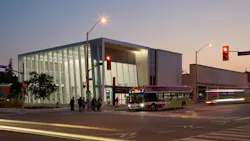
When stretching outside of the city’s core, D’Abbondanza shares how the design team adapted to the distinct types of areas the line would be spanning into—historical areas, areas that are coming up with more development and areas where infrastructure and design are already locked in, leading them to have to create cohesion while mixing in a new, modern system.
"We were really able to reinforce both local distinctiveness while still maintaining this network legibility within this unified architectural language," D’Abbondanza said, highlighting project elements that carried throughout the system, like the orange coloring and textures, while still making sure to weave in the identity of the neighborhood of a new station.
D’Abbondanza also notes the intentional choice of color for certain pieces of station furniture, also using those as wayfinding elements to guide passengers to transit platforms from station entrances and back.
When it came to accessibility, the team didn't stop at the basic requirements. Instead, they worked to ensure that as many people as possible could access the spaces as easily as possible.
"Really, the expectation was that the project would go above and beyond minimum code requirements for things like door access, and the intent was that it would provide maximum usability. So, for us, in terms of universal access to a station, we go back to our first principles: clear, intuitive wayfinding," D’Abbondanza said. "The spaces should allow you to move through. You should be able to see where you are and not feel lost. You should see where you came from, where you're going—so those open sight lines and the clutter free view.”
This went beyond wayfinding, with the team making a variety of choices to design for dignity of access throughout. This can be seen through choices like elevator placement, where the design teams aimed to position them near the main staircases in new underground stations so that users wouldn't need to travel further or be truncated from other passengers for elevator access.
Other accessibility elements were included too, like level-boarding platforms; tactile guiding paths, attention indicators and audio announcements for blind and visually impaired riders; visual indicators for both services and emergency announcements for deaf and hard of hearing passengers; and paratransit drop-off/pick-up zones near accessible entrances to provide seamless connectivity at each step of the transit journey.
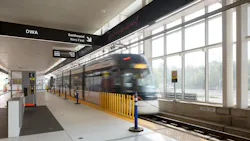
“We had agency versus regional governance versus third party versus international standards, and there was really no clear hierarchy except a need to provide the most accessible requirement for all of these,” D’Abbondanza said. “The length of the project meant that all these standards kept changing. So, over the life of a project that had approximately five years in the design phase by the client and then handing over to us, this project really is a time capsule of accessible standards in our area here in Ontario of standards at the time.”
D’Abbondanza also notes that the team worked to blend both the design and accessibility features when the new line linked with existing services, working to make the transitions as seamless as possible where they could as they worked to blend old, established measures and standards with new. They also worked to ensure that accessibility features not only met the current moment, but would age with the system and, in some cases, be more accessible beyond what current requirements state for necessity. That long-term reliability didn’t stop with the accessibility features, though.
The project team sought out materials that blended design with long-term durability and maintainability. While the Crosslinx Transit Solutions consortium is responsible for maintaining the system for the next 30 years, designers wanted materials to last far longer, stretching through the 100-year intended system life specified for the project.
To achieve this, the team paid specific focus when making materials choices, not only for usability—like choosing materials that will remain slip-resistant with wear—but also in working to choose elements that are singularly replaceable and have fortified supply chains that should last throughout the life of the project.
This close decision-making work is also helping the team plan for future upgrades, like deciding how to best install rebar at platform edges so that platform gates can be eventually installed on the line.
That consideration continued as the designers built out stations with growth in mind, both in the system and in the region. In some applications, the team ensured developable space above its underground stations, added knock-out panels at other stations for easy connection to future additions and left space at some of its at-grade stations for future first- and last-mile transit expansions.
For such a large project spanning so many years, D’Abbondanza offers what success meant for the project, for the agency and the consortium.
“There was a very strong project vision that was communicated [from Metrolinx]—the purposes and the benefit of the project and setting very clear guidelines too,” D’Abbondanza said. “There was a balance between prescriptive specifications with flexibility to ensure that there was guidance but still allowed an ability for innovation from the design team side.”
Like the engineering team, D’Abbondanza also highlights the close collaboration that was fostered throughout the project between the various project teams, agency, ownership, vendors, governments and anyone else who had a role in the project and how it made delivery that much easier.
About the Author
 Noah Kolenda
Noah Kolenda
Associate Editor
Noah Kolenda is a recent graduate from the Craig Newmark Graduate School of Journalism with a master’s degree in health and science reporting. Kolenda also specialized in data journalism, harnessing the power of Open Data projects to cover green transportation in major U.S. cities. Currently, he is an associate editor for Mass Transit magazine, where he aims to fuse his skills in data reporting with his experience covering national policymaking and political money to deliver engaging, future-focused transit content.
Prior to his position with Mass Transit, Kolenda interned with multiple Washington, D.C.-based publications, where he delivered data-driven reporting on once-in-a-generation political moments, runaway corporate lobbying spending and unnoticed election records.