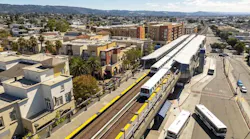
MTC begins Phase 2 of financial review for regional transit measure

The Metropolitan Transportation Commission (MTC) has issued a request for proposals for a financial efficiency review of transit agencies slated to receive funding through the voter-approved Regional Transit Measure (RTM)—the sales tax measure expected to generate nearly $1 billion in annual funding for the agencies. The commission says the review marks the next phase of financial oversight as it advances implementation of the measure.
State Senate Bill 63, which authorized the Connect Bay Area Act, included a two-part Financial Efficiency Review requirement to develop cost saving options for Alameda-Contra Costa Transit District (AC Transit), Bay Area Rapid Transit (BART), Caltrain and San Francisco Muni.
Phase 1 was completed and adopted by the Financial Efficiency Review Independent Oversight Committee in May 2026 while the second phase was conditioned on voter approval of the RTM considered this month by voters in five Bay Area counties. With support for RTM at 63% on Nov. 17, MTC issued the request for proposals for Phase 2 of the review.
Phase 2 of the Financial Efficiency Review is set to evaluate the administrative, operating and capital costs of AC Transit, BART, Caltrain and Muni and identify opportunities to improve efficiency, strengthen financial sustainability, support effective service delivery and improve the customer experience. The review will provide a menu of cost-saving measures that, if implemented, would reduce one-time and ongoing fixed and variable costs and identify revenue-generating strategies and near-term steps to advance and monitor implementation, according to the commission.
About 60% of the tax money generated by RTM will fund transit operations to prevent major service cuts at AC Transit, BART, Caltrain and Muni. By identifying cost-saving measures, the study aims to support the long-term financial health of the agencies so they can continue to provide reliable transit service for Bay Area residents in the years ahead.
The commission also noted that the review will include an assessment of the transit agencies’ real estate assets and the development of a regional strategy for leveraging these assets through housing, commercial, mixed-use and other transit-supportive development and financing approaches.
MTC says it expects the next stage of the Financial Efficiency Review to begin in February 2027 and the report to be completed by March 2028. The transit agencies would then have until mid-2028 to adopt implementation plans, which must be followed for them to receive RTM funds.
About the Author
 Noah Kolenda
Associate Editor
Noah Kolenda is a recent graduate from the Craig Newmark Graduate School of Journalism with a master’s degree in health and science reporting. Kolenda also specialized in data journalism, harnessing the power of Open Data projects to cover green transportation in major U.S. cities. Currently, he is an associate editor for Mass Transit magazine, where he aims to fuse his skills in data reporting with his experience covering national policymaking and political money to deliver engaging, future-focused transit content.
Prior to his position with Mass Transit, Kolenda interned with multiple Washington, D.C.-based publications, where he delivered data-driven reporting on once-in-a-generation political moments, runaway corporate lobbying spending and unnoticed election records.