Chicago RTA releases study laying foundation for coordinated regional transit service
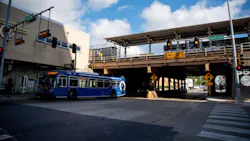
The Chicago Regional Transportation Authority (RTA) conducted a new regional transit service coordination study in an effort to help smoothly transition between current service planning practices and the first Northern Illinois Transit Authority (NITA)-led regional service planning process, which will take effect late next year. NITA will adopt regional service standards and transit propensity thresholds by the end of 2027, followed by its first regionwide service plan in 2028 for implementation in the 2029 budget year. The authority says its goal is to provide riders with more reliable connections and a transit network that functions more effectively across agency boundaries.
Chicago RTA commissioned the study with the goal of benchmarking and improving interagency transfers before NITA’s service planning requirements begin. The study analyzed more than 140,000 scheduled connections at more than 60 locations served by the Chicago Transit Authority (CTA), Metra and Pace Suburban Bus (Pace), identifying opportunities to improve an acceptable transfer window of three to 15 minutes. Presented to the Chicago RTA Board of Directors in July, the study establishes a baseline for improving interagency connections and identifies steps NITA can take to better coordinate schedules, service planning, data and public engagement.
The NITA Act took effect on June 1, 2026, bringing many reforms to the structure of public transit in northeastern Illinois. Chicago RTA will officially transition to NITA on Sept. 1, and the new agency will have expanded responsibility for regional transit service planning.
Study provides planners with a tool to look at transfer schedules
Chicago RTA notes that the study provides planners with a framework to analyze the current state of interagency connectivity and identifies areas for improvements. More than 60 regional transfer locations were reviewed at all time periods and day types (weekday and weekends). The study used a three to 15-minute target transfer window between agencies.
Results focused on 11 high-priority locations representing all six of the region’s counties and offering key connections between the three service boards.
Key findings include:
- Transfer quality is strongest when connecting service is frequent.
- Transfer quality varies throughout the day, especially when spans of service are misaligned.
- The highest rate of acceptable transfers occurs during weekday peak periods, followed by the mid-day period.
- The percent of acceptable transfers drops after 7:00 p.m. on weekdays, even at locations with high levels of service.
- Late night, owl and early morning periods have limited service and low transfer quality.
- Across the entire day on weekdays and Saturdays, the most common reason for a non-acceptable transfer is that a connection is too long.
- Several Metra stations do not have bus connections for their first and last arrivals.
- The highest observed Ventra transfer activity is concentrated at major CTA rail transfer points and bus-rail hubs.
Chicago RTA says that findings show that not every poor connection can be fixed by adjusting a timetable. In some cases, a small schedule change could reduce a wait. In others, meaningful improvement would require additional trips or longer hours of service.
The strongest candidates for investment are locations where high transfer demand overlaps with poor scheduled connections or where a connection plays an important role in the regional network.
Different problems require different solutions
The report presents a toolbox of potential responses based on the type of connection problem:
- When a connection is too short: Agencies could shift individual trips or consider policies allowing buses to wait for certain trains. Any changes would need to account for reliability and possible delays elsewhere along the route.
- When a connection is too long: Agencies could adjust schedules or increase the frequency of the connecting service.
- When no connecting trip is available: Agencies could consider extending the hours or days that the connecting route operates.
Increasing frequency or extending service requires additional operators, vehicles and funding. The study recommends prioritizing improvements based on rider demand, regional connectivity and the effect a change could have on other parts of the network.
Opportunities for regional coordination
The study offers recommendations for how NITA can improve regional coordination in service planning even before transit propensity thresholds and service standards are adopted in late 2027. These recommendations include:
- Evaluating how proposed major schedule changes would affect connections with other transit agencies.
- Conducting joint service coordination and network planning reviews in key areas where CTA, Metra and Pace connect.
- Giving NITA responsibility for coordinating regional stakeholder engagement and determining when to partner with CTA, Metra and/or Pace.
- Centralizing customer research so surveys and other feedback efforts reflect the regional transit experience.
- Coordinating public engagement activities around CTA, Metra and Pace network plans and begin presenting them as part of a unified regional effort.
- Connecting or consolidating data systems so planners can more easily access schedules, ridership, transfer and performance information from across the region.
Transit propensity
NITA will create a regional transit propensity analysis to determine where different types of transit service are justified. The analysis will consider factors such as population and employment density, low-income and disabled populations, zero-car households, intersection density and the presence of sidewalks.
NITA will also establish thresholds showing where different types of transit service may be appropriate.
Regional service standards
Service standards will define the appropriate characteristics for each type of transit service. These can include:
- Mode and vehicle type
- Frequency and hours of service
- Stop spacing and coverage
- Vehicle and stop amenities
- Network connectivity
- Route directness and deviation
The standards will recognize that different services have different purposes. For example, the appropriate service level for a coverage-focused rural bus route will differ from the standard for a high-ridership rail line.
After initial adoption in December 2027, transit propensity thresholds and service standards will be incorporated into the agency strategic plan and updated on a five-year cycle.
Regionwide service plan
NITA will lead an annual planning process that produces a unified plan for CTA, Metra and Pace service. Each plan will cover the next one to three years and must comply with the regional service standards.
The plan will include the location, frequency, days and hours of service; explanations for proposed changes; funding assumptions; and requirements related to reliability, cleanliness, safety, fares, customer information, branding and coordination.
The timeline for this new planning process under NITA is as follows:
- Dec. 15, 2027: NITA will issue a request for proposed service plans from CTA, Metra and Pace.
- Dec. 31, 2027: NITA will adopt transit propensity thresholds and regional service standards.
- March 31, 2028: Service boards will present preliminary service proposals.
- April 30, 2028: Service boards will submit proposed service plans to NITA.
- Dec. 31, 2028: The NITA Board must adopt a regionwide service plan.
- 2029: The first budget year implementing the regionwide service plan.
About the Author
 Noah Kolenda
Noah Kolenda
Associate Editor
Noah Kolenda is a recent graduate from the Craig Newmark Graduate School of Journalism with a master’s degree in health and science reporting. Kolenda also specialized in data journalism, harnessing the power of Open Data projects to cover green transportation in major U.S. cities. Currently, he is an associate editor for Mass Transit magazine, where he aims to fuse his skills in data reporting with his experience covering national policymaking and political money to deliver engaging, future-focused transit content.
Prior to his position with Mass Transit, Kolenda interned with multiple Washington, D.C.-based publications, where he delivered data-driven reporting on once-in-a-generation political moments, runaway corporate lobbying spending and unnoticed election records.