COTA, WMATA introduce next year’s budgets
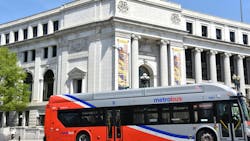
The Central Ohio Transit Authority (COTA) and the Washington Metropolitan Area Transit Authority (WMATA) have introduced new budgets for their systems.
COTA Board approves balanced budget for 2026
The Central Ohio Transit Authority (COTA) Board of Trustees approved a balanced budget for 2026. The budget advances the LinkUS mobility initiative, increases service and improves the customer experience, as well as additional bus operators, more service hours and planning and construction for 37 sidewalk and bikeways projects. COTA trustees authorized approximately $276 million for operations, $230 million for capital improvements and $51 million for LinkUS sidewalks and bikeways projects.
“We offered more service in 2025, and our community responded with a significant increase in ridership,” said COTA President and CEO Monica Tellez-Fowler. “Today, the COTA Board adopted a budget for 2026 that allows us to maintain and build on this momentum as we move closer to a modernized transit system in Central Ohio.”
LinkUS investments in 2026 will include:
- Advancement of the West Broad Street bus rapid transit line.
- Launch of Line 30, a new bus route connecting Dublin, Hilliard and Upper Arlington to The Ohio State University.
- Planning and construction of 37 sidewalks and bikeways projects.
- Launch of a new COTA//Plus Zone.
- Continued stakeholder and community education and engagement.
Highlights of the operations portion of the budget include support for:
- 42 new operators for fixed route and COTA//Plus.
- Approximately 94,000 additional service hours to improve service frequency for existing transit lines and better support COTA Mainstream services.
- Operations at the new mobility center at Rickenbacker.
- Operational efficiency, transit safety and strong cybersecurity.
Highlights of the capital improvements portion of the budget include support for:
- 38 new buses, 30 new COTA//Plus vans, and 15 new COTA Mainstream vehicles.
- Study and design of a downtown transit center.
- Completion of the mobility center at Rickenbacker.
- Technology upgrades and deployment.
“Thanks to strong financial management and the support of the public, the COTA Board is proud to pass a budget that is balanced and invests in our future,” said COTA Board of Trustees Chair Sean Mentel. “The long-term transformation of our system is underway as we deliver an improved COTA for 2026.”
WMATA presents fiscal year (FY26) budget
WMATA presented the proposed budget for FY26 to the board. The budget focuses on bus and rail improvements to increase ridership and revenue without raising fares while continuing to identify cost-saving opportunities.
The service plan calls for shorter weekday wait times on the Orange, Silver and Blue lines and reduced wait times on the Red Line at night. Additionally, bus service would increase on 15% of routes across the region.
“[WMATA] ridership has grown in recent years, and we want to continue to meet that demand for the region,” said WMATA General Manager and CEO Randy Clarke. “This proposal reflects our commitment to delivering safe, frequent and reliable service while preparing [WMATA] for the potential long-term capital challenges ahead.”
WMATA says the new budget overall will make bus and rail operations more efficient through schedule optimization and by adding capacity to address emerging crowding while improving reliability.
For the first time, WMATA notes the budget proposal includes a multi-year budget and service plan forecast to foster better planning and predictability for the agency and its regional partners.
Bus proposals
Bus improvements include shorter wait times on nine high ridership routes, route enhancements on five routes, longer hours of service on four routes and the potential for two new limited-stop routes in Northern Virginia.
Rail proposals
Rail would have better all-day and late-night service with trains running every three to six minutes in the core and six to 10 minutes in others parts of the system on weekdays. After 9:30 p.m., trains would run every four to eight minutes in the core. Overall, the proposal calls for 6% more daily train trips on weekdays.
Specific increases include:
- Orange, Silver and Blue line trains would run every 10 minutes on weekdays, an improvement on the current 12-minute service.
- Red Line trains would run every seven to eight minutes after 9:30 p.m., an improvement from the current 10-minute service.
Capital program proposal
WMATA is proposing two scenarios for its six-year Capital Improvement Program outlook:
- Significantly constrained and assumes no new regional DMVMoves investment. Under this scenario, WMATA will reduce capital spending and defer projects that will lead to declining reliability, worsening customer experience and increased safety risk over time.
- The additional $460 million regional investment called for in the regional DMVMoves endorsement. DMVMoves calls for WMATA to modernize its bus and rail system. Part of the improvements would address and update the rail signaling system, ensure bus reliability and make WMATA safer and more cost efficient.
The WMATA Board of Directors will vote to approve the final budget in April 2026. The new budget year starts July 1, 2026, and runs through June 30, 2027.
About the Author
 Brandon Lewis
Brandon Lewis
Associate Editor
Brandon Lewis is a recent graduate of Kent State University with a bachelor’s degree in journalism. Lewis is a former freelance editorial assistant at Vehicle Service Pros in Endeavor Business Media’s Vehicle Repair Group. Lewis brings his knowledge of web managing, copyediting and SEO practices to Mass Transit magazine as an associate editor. He is also a co-host of the Infrastructure Technology Podcast.