Op-Ed: A Playbook for Building Cheaper and Faster Transit in the U.S.
Key Highlights
- Outdated procurement laws and complex permitting processes contribute to inflated costs and project delays.
- Adopting best-value procurement methods can lead to lower costs and faster project completion by allowing agencies to select the most qualified contractors.
- Streamlining third-party approvals through centralized negotiations can reduce project timelines by years.
- Reforming policies and practices can help make better use of limited transit funding and meet community needs.
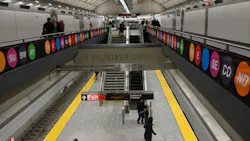
Between 1999 and 2003, Madrid added 47 miles to its metro system for $7.2 billion in today’s dollars—about $150 million per mile. In 2017, after 10 years and for approximately the same price, New York City completed the first 1.7 miles of its Second Avenue Subway. On a per-mile basis, it was the most expensive subway project ever built.
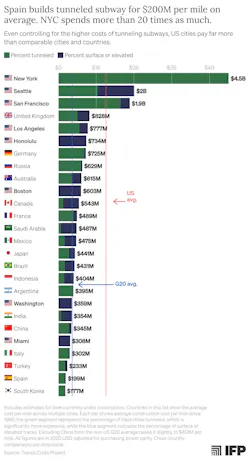
New York’s costs are shocking, but they are not unique. Since voter approval in 2008, California’s High-Speed Rail Authority has spent $15 billion and produced 100,000 pages of environmental review; it has no plan to connect San Francisco to Los Angeles without at least another $90 billion in new funds.
High costs compromise America’s ability to deliver the transit that voters have asked for and that constituents need. Thousands of riders take the Second Avenue Subway every day and millions benefit from the trips taken by their employees, customers, families and friends. If California ever manages to connect its two largest cities with high-speed rail, similar benefits will be felt by millions more. But with the costs of a single project swelling far beyond the entire annual Capital Investment Grants appropriation—and with little hope for major increases in federal funding, at least in the short term—many important projects will never break ground.
But America’s exceptionally high transit costs are not inevitable. The U.S. is the wealthiest country in the world. The fact that it pays more than lower-income countries is no surprise. Yet, while American costs are three times as high as the international average, they are six times as high as in developed countries like Spain and South Korea. If U.S. funds went as far as they do in France—a developed economy with roughly average costs—we could deliver more than twice as many projects for the same level of spending.
Thanks to research from the Transit Costs Project, the Eno Center for Transportation and others, we know the drivers of our cost problem. Outdated procurement laws prevent transit agencies from adopting better practices; insufficient agency capacity leads to overreliance on consultants with little incentive to limit costs; utilities and local governments demand exactions in exchange for necessary permits; federal requirements prioritize box-checking over efficient project delivery and delay important planning steps; over customization and overdesign absorb scarce funds; and permitting laws treat emissions-reducing transit infrastructure with a presumption of environmental harm.
The Transit Abundance Playbook presents 15 solutions to address these problems. In it, experts ranging from transit practitioners to advocates, consultants and researchers identify evidence-based solutions to empower transit agencies and improve their capacity to deliver.
As a case in point, one proposal details an improvement to American procurement laws. Across many states, agencies are required to select the lowest bid for construction and other contracts. Although originally intended as an anti-corruption measure, lowest-bid selection can lock agencies into selecting less qualified bidders and can be gamed through price coordination. Selecting the lowest upfront price can paradoxically raise overall spending, as contractors recoup costs through change orders and delays.
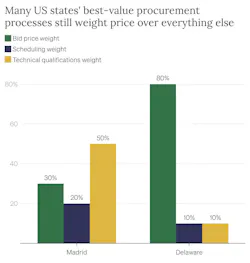
The alternative in countries with low transit costs is best-value procurement, which gives transit agencies the freedom to pick the best contractor for the job. Many U.S. states that technically allow best-value procurement methods weigh price so heavily as to make the designation meaningless. Delaware weighs price at 70 to 90%, giving only marginal consideration to technical qualifications and scheduling. In contrast, Madrid, which has consistently built metro extensions cheaply and on time, weighed price at only 30% during its expansions. Allowing agencies to select better contractors will lead to lower costs and faster timelines.
Another proposal would streamline third-party approvals, addressing the morass of potential veto points that can block linear infrastructure like transit lines. In order to build, transit agencies must negotiate with many different stakeholders, including utilities, local governments, asset owners and other government agencies, each with their own demands—and often, each with the ability to hold up the project. The Santa Clara Valley Transportation Authority negotiated 43 separate third-party agreements for the BART Silicon Valley Phase II project.
In another glaring example, the Los Angeles County Metropolitan Transportation Authority paid for a new police kiosk for the city of Beverly Hills, Calif., in exchange for necessary street closure permits. While third parties have legitimate interests and priorities, the individual negotiations that agencies must undergo give disproportionate leverage for delay and value extraction.
The playbook’s solution would borrow from Italy’s “Conference of Services” model, empowering a single decision-maker—such as a member of the governor’s office—to convene all stakeholders and negotiate an agreement up front, with stakeholders that fail to raise substantive concerns forfeiting the right to litigate afterward. Such a process would create certainty for agencies while respecting the needs of third parties and could shave years off project timelines.
Faster, more cost-effective construction will only deliver results if paired with adequate funding for both construction and operations. But reform complements funding by ensuring that the money agencies receive builds as much transit and creates as much access for riders, as possible. Regardless of how much any lawmaker wants to spend on transit, there is bipartisan agreement that any dollars allocated should go as far as possible.
Other countries’ successes show that high transit costs are a policy choice. The Transit Abundance Playbook authors present solutions to make a better one.
About the Author
 Reed Schwartz
Reed Schwartz
Associate Infrastructure Fellow, Institute for Progress
Reed Schwartz is an associate infrastructure fellow at the Institute for Progress, a public policy think tank that promotes scientific and industrial innovation. He previously worked at the Niskanen Center and at YIMBY Law. He holds an MPhil in political thought and intellectual history from the University of Cambridge, and a bachelor's in the College of Social Studies and in Spanish from Wesleyan University.
 Will Poff-Webster
Will Poff-Webster
Director of Infrastructure Policy, Institute for Progress
Will Poff-Webster is the director of infrastructure policy at the Institute for Progress, leading the institute's work on energy, transportation and housing policy. He previously served as legislative counsel for U.S. Senator Brian Schatz and as a state legislative and city council staffer in Boston. He has a juris doctor from Yale Law School and a bachelor's from Harvard College