Third-party review backs STA double-decker bus collision investigation
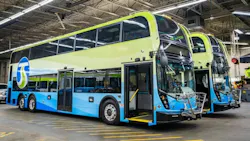
After a collision of a double-decker bus with a railroad viaduct above Cedar Street between First and Second Avenues on Jan. 18, 2026, Spokane Transit Authority (STA) says it investigated the incident in accordance with its federally required public transportation agency safety plan (PTASP). The agency notes that key findings of that investigation were shared publicly in March before the investigation was reopened, with a commitment to conduct a third-party review of STA’s process.
Reese Safety Management, LLC, was engaged by STA to conduct an independent review of its safety response and investigative process. In addition to the independent review, firm principal Reginald Reese assisted with identifying and developing a corrective action plan (CAP) that identifies steps STA is taking to avoid similar incidents in the future.
Through the review, Reese Safety Management confirmed the investigation by STA, including facets completed after March 23, 2026, is consistent with the agency’s PTASP and was not deficient. According to the firm, the additional information discovered at the conclusion of the reopened investigation did not change the final determination of that investigation.
STA’s reopened investigation identified additional findings:
- Gaps existed in the tracking and escalation of reported issues to dispatch, which may have limited STA’s identification of system anomalies prior to the incident.
- An off-route alert configuration issue limited automated notifications to dispatch.
STA notes it has taken further steps in addition to implementing the recommendations in the CAP. To ensure continued transparency, the PTASP is now available online on STA’s website. The agency notes that a consultant is working with operations staff to evaluate and recommend enhancements to operational and communications procedures. Additionally, STA says it has strengthened internal capabilities to detect and remedy software issues as they arise.
“We thank the community for their patience while the independent review was completed,” said STA CEO Karl Otterstrom. “We are actively implementing the suggestions as outlined in the corrective action plan and also extend our thanks to Mr. Reese for his efforts.”
The damaged bus remains out of service, though the repair process is expected to begin soon, as the ordered parts have started to arrive. The process is expected to take several months.
- Implement download validation procedures for computer aided dispatch (CAD) software system and disable turn-by-turn navigation until the software fix is verified and thoroughly reliable.
- Ensure operators receive mandatory double-decker training prior to operating a double-decker coach, to include periodic refresher training.
- Implement safety stop procedures and dispatch authorization process when approaching the downtown railroad viaduct.
- Deploy geofenced dispatch alerts and CAD reminders to notify operators and dispatch when a double-decker leaves its approved route and to increase situational awareness.
- Issue revised operating notices and standard operating procedures with guidance on triage and escalation of reported route and technology issues.
- To ensure route verification and familiarization, implement mandatory double-decker training and refresher training, a safety-stop and dispatch authorization process, geofencing and automated off-route notifications.
- Implement a process to ensure routing information is downloaded correctly and validated before deployment.
- Require double-decker operators to carry current “left/right” route instructions, in addition to their run “paddles” (instructions), which do not provide turn-by-turn directions.
- Implement a tracking process for CAD/AVL issues and operator-reported concerns during service mark-up to identify trends and escalate recurring problems before they affect service.
- Ensure there is a process for vehicle maintenance personnel to complete required double-decker training, before operating a double-decker coach, with defined triggers for new-hire training, content requirements and refresher intervals and update procedures to maintain ongoing proficiency.
About the Author
 Noah Kolenda
Noah Kolenda
Associate Editor
Noah Kolenda is a recent graduate from the Craig Newmark Graduate School of Journalism with a master’s degree in health and science reporting. Kolenda also specialized in data journalism, harnessing the power of Open Data projects to cover green transportation in major U.S. cities. Currently, he is an associate editor for Mass Transit magazine, where he aims to fuse his skills in data reporting with his experience covering national policymaking and political money to deliver engaging, future-focused transit content.
Prior to his position with Mass Transit, Kolenda interned with multiple Washington, D.C.-based publications, where he delivered data-driven reporting on once-in-a-generation political moments, runaway corporate lobbying spending and unnoticed election records.