Paratransit Operators See Improvement With TNC Partners

The average age of the U.S. population is rising. According to the U.S. Census Beareau’s 2024 population estimates, the average age in the U.S. increased by 0.6 compared to the 2020 U.S. Census. The 2024 annual data found that between April 2020 and July 2024, the median age rose in 329 of the nation’s 387 metro areas.
Also rising is the number of people that have disabilities. The Centers for Disease Control and Prevention notes that more than a quarter (28.7%) of people in the U.S. population have a disability. Those that have disabilities often turn to paratransit services to get to medical appointments, leisure activities and more.
Paratransit is reported through Demand Response Ridership, which according to the U.S. Department of Transportation ADA regulations, is any services transporting individuals that is not a fixed route, which includes paratransit services. The latest Demand Response Ridership data from the American Public Transportation Association’s 2025 Q4 Ridership Report shows that there were approximately 186.3 million trips made in 2025, an 8.14% increase year-to-date.
With the increase of individuals with disabilities rising, public transit agencies may have to approach traditional paratransit services differently to handle the growing demand. Further, because of the nature of these door-to-door or curb-to-curb services that paratransit provides, most services require riders to book their rides three days in advance. Some agencies have begun to roll out same-day services in an attempt to meet the increase in demand.
To accommodate more service and increase booking flexibility, agencies have turned to on-demand transportation network companies (TNC), such as RideCo, UZURV and SilverRide, to help make the paratransit experience as efficient as possible for riders and drivers.
The TNCs
SilverRide launched in 2007 initially as a door-through-door service, which is a specialized, non-emergency medical transportation service where drivers enter a client’s home to assist them from their home and into the vehicle. SilverRide got into the paratransit space during the COVID-19 pandemic.
RideCo, which was founded in 2013, uses different sets of technology, including a rider app, a driver app, a control center and data insights, to help riders have complete control over their trip. RideCo’s technology allows passengers to book a ride through the app or a call center. Passengers who use the app can then track their rides in real time, including the van’s license number and the driver’s name.
UZURV was founded in 2017 and helps manage drivers who are trained specifically on the unique needs of paratransit passengers. UZURV allows drivers to provide trips using their personal vehicles. Drivers are independent contractors who must pass national criminal and driving background checks. The company’s driver credentialing program allows drivers to familiarize themselves with ADA requirements and details procedures for ensuring appropriate access for people traveling with service animals, as well as for securing mobility devices.
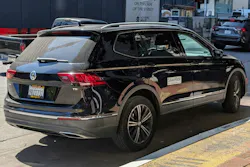
SilverRide’s role in paratransit
Drivers under the SilverRide platform are independent contractors who are tested and must adhere to the Federal Transit Administration’s Drug and Alcohol Training Program. According to SilverRide CEO Jeff Maltz, this makes paratransit a unique challenge compared to a typical door-through-door service.
“[Paratransit drivers],they have to have airborne and bloodborne pathogen training so that if somebody starts bleeding in the car, what do you do? If a power cable falls on top of the car, what do you do? How do you handle an emergency evacuation? All those things drivers need to be prepared for,” Maltz said. “They have to be willing to take on service animals.”
Maltz notes SilverRide also uses technology so that operators can ensure the vehicles are safe. Before an operator takes a vehicle on the road, they do a pre-trip inspection of the vehicle through the company’s onboarding app. They take a photo of all four sides of the vehicle and the odometer, as well as the dashboard to see if there are any warning lights on the vehicle.
“A transit agency can say, ‘Hey, SilverRide, you know, for X day last week, we want to audit you. Can you send us the pre-inspections for every driver you had on the road?’” Maltz noted. “And we could send it to them that day. In this report, we can see if there are dents, we can see if there’s a donut tire on a spare tire instead of the real tire.”
SilverRide is a mobility-as-a-service platform. According to Maltz, the company can operate as a “full turnkey solution or integrate seamlessly with an agency's existing infrastructure, scheduling software or dispatch systems” depending on an agency’s needs.
Passengers can use the SilverRide app to schedule rides, track their driver in real time and view trip history. Rides can also be booked by calling into the company’s call center. Maltz notes SilverRide drivers receive real-time data on each passenger's specific needs, and agency partners get full access to ride monitoring and reporting.
SilverRide informs agencies that handle paratransit trips that they will meet them at capacity. Maltz notes the company can give agencies a different number of vehicles per day and per time period for more efficient operations.
“We can see that [for example], from 9:45 to 11:00, your trips plummet, so what we're going to do is we're going to take our drivers out of service, so we can help you keep productivity high,” Maltz said.
According to Maltz, the company uses artificial intelligence (AI) to constantly analyze driver productivity and notes that the model helps drivers maximize their time.

Metropolitan Transit Authority of Harris County’s (Houston Metro) involvement with RideCo and UZURV
Houston Metro’s METROLift is the agency’s shared-ride, door-to-door paratransit service that operates throughout most of Harris County, including portions of Kingwood, Humble and Clear Lake, Texas. In 2021, the agency partnered with RideCo to manage the booking of paratransit trips and to modernize the experience for riders.
“We really wanted to enhance our platform for our paratransit users," said Houston Metro Vice President of Specialized Transit Service Operations Michael Andrade. "The goal was to create more of an Uber or Lyft-like experience where customers can manage their own rides."
In December 2025, UZURV partnered with Houston Metro to provide an additional option to assign trips as a provider integrated within the program. Under the agreement, UZURV is directly contracted by Houston Metro as a supplemental service provider, so the agency can send METROLift rides to the company. UZURV integrates with RideCo’s technology to provide riders with not only the service they need in a timely manner, but to ensure riders that their drivers have been trained properly. The company created a network of drivers for METROLift for ambulatory rides.
"We focused on our peak travel times in the mornings and afternoons because, as an agency, we can’t continue adding vehicles and operators for just two or three hours of demand during the day,” Andrade said. “Instead, we looked for other ways to provide more options for riders and improve the customer experience during those high-demand periods.”
Andrade mentions that the addition of UZURV enables METROLift to provide real-time GPS tracking, as well as same-day bookings, all integrated in the RideCo platform.
"A lot of the same day service that we've had in the past was more of a manual type operation where we would have to call a provider and say, ‘Hey, can you take this trip for us?’” Andrade noted. “So it would increase hold times for customers and increase wait times; and with this dynamic platform, that's what we're doing is integrating these providers like UZURV into the platform, so it's more of an on-demand, on the fly type of resource that we have available. It cuts out the middleman, and it really improves the customer experience by leveraging the resources that we have out there on the street.”
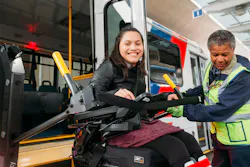
Is this model for paratransit sustainable?
With technology ever-changing, this on-demand paratransit model with the help of TNCs is relatively new. While the technology has been around for a long time, it’s only been about the last half-decade that agencies are starting to use this model for paratransit services. As technology evolves, the TNCs believe the model is sustainable and will only lead to the growth of services.
According to RideCo, it has helped agencies save money. In 2025, the company helped the Southeastern Pennsylvania Transportation Authority save $8.8 million annually and helped provide an 8.8% improvment in passengers per vehicle hour. RideCo also helped the Kansas City Area Transportation Authority save $2.64 million in annualized cost saving through a 19% increase in passengers per vehicle hour and a 16% decrease in cost per passenger.
According to RideCo Head of Marketing John McLeod, the TNC model helps schedule rides using automation, and the right technology makes the scheduling department more cost efficient.
“If vehicles are running around and not being efficient, either with not sharing rides or just operating in a way that's not efficient in terms of taking in real-time data, what's the best route or what vehicle is most optimal to pick up a rider at a certain location, then they’re using resources that may not be necessarily needed,” McLeod said.
RideCo Vice President of Customer Success Dan Finley says the model is sustainable for the company because of the technology constantly updating.
“RideCo is supplying updates every few weeks, whereas the legacy platforms often will install something and leave it there for a year or two or three years until the agency re-ups and installs a new version,” Finley noted. “There are new versions of the RideCo platform with new features for passengers and for the agency itself literally every month.”
Finley notes the software the company has today versus the software it had in 2013 is not even applicable to compare and says the same will be true a decade from now.
UZURV Founder Phil Bayer says AI may help with routing algorithms, but it will not replace the human element of paratransit.
“I don't know how AI is going to perform door-to-door service,” Bayer said. “We can utilize AI to learn how to make dispatch algorithms and routing algorithms better. But in our company, every ride has a human being watching it. There's somebody watching the data for that ride and making sure that that ride is executed safely and efficiently, effectively. What's happening under the hood though is that our very smart system, these sophisticated algorithms are looking for anomalies in that ride. Things that it has learned are triggers to less desirable outcomes, so it's surfacing those rides to our operations team faster, so they can focus quickly on the rides that need help.”
About the Author
 Brandon Lewis
Brandon Lewis
Associate Editor
Brandon Lewis is a recent graduate of Kent State University with a bachelor’s degree in journalism. Lewis is a former freelance editorial assistant at Vehicle Service Pros in Endeavor Business Media’s Vehicle Repair Group. Lewis brings his knowledge of web managing, copyediting and SEO practices to Mass Transit magazine as an associate editor. He is also a co-host of the Infrastructure Technology Podcast.