MA: Boston councilors ask Healey to halt $150M Blue Hill Avenue bus lane project
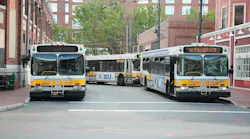
A pair of Boston city councilors representing the neighborhoods at the heart of a divisive street renovation have asked Massachusetts Gov. Maura Healey to pause the project, even as the city and MBTA push it forward.
The redesign of Blue Hill Avenue, a main thoroughfare through Mattapan, Dorchester and Roxbury, has sparked intense disagreement among area residents.
Some, including city leaders and state transportation officials, see it as a rare opportunity to use tens of millions in federal funding to make the area safer and improve public transit by adding a dedicated bus lane down the center of the street. But others have argued the bus lane will worsen car travel and that the multi-year project could harm local businesses, among other disagreements.
The project’s opponents include two city councilors representing the surrounding neighborhoods, Miniard Culpepper and Brian Worrell, who want the city and state to pursue a more ambitious option — an extension of the MBTA’s Orange Line beneath Blue Hill Avenue.
They argue the predominantly Black area has long missed out on subway service and that the officials should seriously consider extending the rails rather than improving the less reliable bus system.
Mayor Michelle Wu and MBTA General Manager Phillip Eng, who also serves as interim state transportation secretary, have argued that the bus project is still worth pursuing and that an Orange Line extension would require billions more dollars and years more work.
Unsatisfied with that response, Culpepper and Worrell asked Healey on Monday to intervene, pause the $150 million project and study the possibility of a subway extension.
“For a community that has experienced generations of transportation inequity, improved bus service should have been the floor of our ambition, never the ceiling,” they wrote in a letter to Healey.
The councilors have also argued that the city and MBTA, a state agency, did not adequately seek community input on the project and instead pushed the bus lane over local opposition.
“We remain troubled by a process that appears to have treated the administration’s preferred design as a foregone conclusion, rather than meaningfully evaluating alternatives alongside the communities most directly affected,” the councilors wrote to Healey.
Wu and Eng dispute that assertion.
A spokesperson for Healey referred questions about the letter to the MBTA.
“Community input is an essential part of every MBTA project,” Joe Pesaturo, a T spokesperson, said in a statement. “The T has participated in numerous public meetings with the City of Boston and met directly with City Councilors. We will continue to engage with the community, answer questions, and work together to ensure the Blue Hill Avenue redesign reflects the needs and priorities of residents, businesses, transit riders and all who travel along the corridor.”
Wu’s office said the city has spent years seeking community input on the project, which relies on $80 million in federal funding. In the last seven years, the city has hosted about 120 public events on the project and issued five surveys to the community, which garnered more than 1,300 responses.
A city spokesperson said public input led project planners to maintain two travel lanes for cars in each direction across most of Blue Hill Avenue, responding to complaints that the bus lanes would sacrifice road space for cars.
The city said it would support neighborhood businesses during construction, in response to concerns that some would struggle to stay afloat during years of roadwork. The latest project designs, unveiled in September, also included a net increase in parking along the Blue Hill Avenue corridor.
“The City will continue working closely with residents, businesses, elected officials, and the MBTA to invest in needed infrastructure upgrades, beautification, and community benefit,” the city spokesperson said.
The letter to Healey reiterated the councilors’ concerns that the project would not improve public safety along Blue Hill Avenue, but would instead undercut it. Critics of the project have argued a center-running bus lane would force riders, including children and seniors, to cross traffic to reach bus stops along the median.
The councilors also said the project planners need to learn from another bus lane project — the center-running lane down Columbus Avenue. The city and T called off a proposed extension of the lane last month, and Culpepper and Worrell said the planners need to examine that bus lane’s effects and evaluate other options for Blue Hill Avenue before moving forward.
The councilors also said the T has not responded to a request for data on crash incidents on Columbus Avenue, and Eng has rebuffed a rare subpoena from the council to appear for a hearing.
But at the core of the councilors’ case against the bus lane is their argument that Roxbury, Dorchester and Mattapan have received unequal public transit, sufficient to constitute a civil rights concern. Residents of the Blue Hill Avenue area mainly rely on buses, which are far more susceptible to delays compared to trains.
Other areas of the city and state are being considered for expanded train service, including an Orange Line extension to Roslindale and the possibility of year-round commuter rail service to Buzzards Bay, Culpepper and Worrell noted.
In recent years, the MBTA has also completed a Green Line extension into Somerville and Medford and opened a commuter rail line to the South Coast.
“We do not question the legitimacy of those investments,” the councilors wrote to Healey. “We question why the residents of Roxbury, Dorchester, and Mattapan, who live along one of the MBTA’s highest-ridership bus corridors, have not received a comparable contemporary evaluation of rail.”
“For decades, our communities have experienced a different standard of transportation investment,” Culpepper added in his own statement. “We cannot continue making decisions about Blue Hill Avenue without fully understanding the consequences for the people who live, work, and operate businesses along this corridor.”
©2026 Advance Local Media LLC.
Visit masslive.com.
Distributed by Tribune Content Agency, LLC.