Montgomery County completes transit depot microgrid project
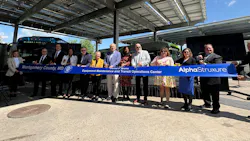
Montgomery County, Md., officials unveiled the recently completed transit depot microgrid at the county’s David F. Bone Equipment Maintenance and Transit Operation Center (EMTOC) in Derwood.
“This microgrid project will support the county’s very aggressive zero-emission bus transition goal of having an emission free fleet by 2035,” said Montgomery County Executive Marc Elrich. "We are aggressively moving towards cleaner energy and cleaner transportation, and we are leading the way. This project is a model for counties nationally.”
The 6.8-megawatt microgrid features 9,800 solar panels spread across 16 canopies. The county notes that power will support charging a fleet of 200 Ride On buses and five buildings.

The microgrid project, overseen by the county’s Department of General Services (DGS), includes 4.8 megawatts of solar generation, two megawatts / 6.9 megawatt hours of battery energy storage and 2.38 megawatts of charging capacity. The EMTOC project builds on the successful Brookville Smart Energy Bus Depot, a 6.5-megawatt microgrid operating since 2022, which was also facilitated by a partnership with AlphaStruxure.
“Today’s ribbon cutting represents the future of transportation and energy in Maryland," said Maryland Lt. Gov. Aruna Miller. "This state-of-the-art microgrid shows what’s possible when we bring together innovation, sustainability and strong public-private partnerships. By investing in clean energy infrastructure and zero-emission transit, we are building a more resilient system that supports our economy, protects our environment and improves daily life for Marylanders.”
The Montgomery County Department of Transportation (MCDOT) operates the second largest bus fleet in the Washington, D.C. region, with growing ridership year over year. Ride On buses provided 19 million rides in 2025 with a fleet of about 400 buses running over 80 routes.
“I am so pleased to see this project come to fruition,” said County Council Vice President Marilyn Balcombe. “This microgrid will add to the many ways that Montgomery County is stepping up to meet our climate goals, ensuring cleaner, greener energy. I am so proud of all the work we do in the County to protect our environment.”
Led by DGS, the county and MCDOT, the project helps Ride On transition to a zero-emission fleet of battery-electric and hydrogen-electric buses.
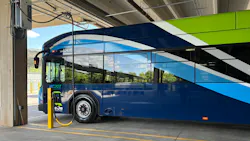
“The EMTOC microgrid is built to orchestrate highly variable changes in energy supply and demand,” said DGS Director David Dise. “Charging several dozen electric buses at once can create a large demand spike, which the microgrid will meet with an ever-changing mix of solar, battery and grid energy. We are also protected from power outages as the system can go into “island mode” via on-site power generation. This project advances us as a trailblazer in climate resiliency.”
EMTOC is the county’s largest of three bus depots within the Ride On bus network. At full buildout, the county says that the EMTOC depot is expected to support approximately 200 buses, including both battery-electric and hydrogen fuel cell vehicles.
“The Montgomery County Department of Transportation has been aggressively seeking grant funding over the past five years to purchase zero-emission vehicles and needs the supporting charging infrastructure,” said MCDOT Director Chris Conklin. “The county currently has 85 electric buses and is preparing to introduce hydrogen electric buses over the next year.”
In 2022, MCDOT notes it was awarded a nearly $15 million federal grant from the Federal Transit Administration to purchase 13 hydrogen fuel cell buses and build a green hydrogen fueling station at EMTOC. The new microgrid at EMTOC aims to power the hydrogen fueling station that DGS will be building as a next step.
With Brookville and now EMTOC reaching the operational stage, the county says it continues to set the pace nationally in electrified and resilient transit infrastructure. The EMTOC project aims to provide infrastructure to support Montgomery County’s long-term plans of building a bus rapid transit (BRT) network—called Flash—to provide faster, more frequent transit throughout the county. Flash BRT is operational on US 29/Colesville Road and the second corridor, along Veirs Mill Road, is scheduled to open in 2028. The new hydrogen buses will be used on the Veirs Mill Flash BRT corridor. The planned Flash BRT network will have a total of 100 stops over eight corridors.
“Once again, Montgomery County makes history as we celebrate building the nation’s largest transit depot electrical grid,” said U.S. Rep. Jamie Raskin (D-MD). “This project provides charging for 200 electric buses which service our ever-growing ridership here in MoCo. Our county leads the way in pioneering cleaner energy solutions that help our people affordably, efficiently and safely get where they need to go.”
Montgomery County and AlphaStruxure note that they worked closely with the local utility company, Pepco, to launch the microgrid project and ensure integrate with the broader grid network. The county notes that the system is designed to support bidirectional energy flows and coordinated grid interaction.
AlphaStruxure will manage the infrastructure, according to the county. AlphaStruxure’s Energy as a Service model has enabled the county to deploy the project without capital costs. The model also means AlphaStruxure takes on designing, building, owning, operating and maintaining the infrastructure.
“EMTOC represents a new standard for how the next generation of mobility infrastructure can be designed, built and operated,” said AlphaStruxure Senior Vice President of Construction and Operations Nicola Santamaria. “The buses and chargers are just the tip of the iceberg when it comes to fleet transition. You need to make sure the energy infrastructure is deployed in parallel. The county continues to lead by aligning infrastructure investment with long-term transit planning. EMTOC, along with its sister site, Brookville, proves that this level of infrastructure can be delivered quickly, without disrupting transit service, and through a model that reduces financial and operational complexity.”
DGS and its Office of Energy and Sustainability, along with MCDOT, led the project in partnership with AlphaStruxure. The county notes that the EMTOC microgrid project was awarded $1.6 million from the Maryland Energy Administration (MEA) to help cover costs under the MEA Resilient Maryland Grant Program.
Project partners include Mortenson for design-build; Schneider Electric for microgrid controls, battery energy storage and electrical infrastructure; WSP as engineer of record; AZZO for network and cybersecurity; Ampcontrol for charge management software; Heliox for EV charging hardware; and Pepco for utility coordination and interconnection. Project lenders include Mitsubishi UFJ Financial Group, Sumitomo Mitsui Banking Corporation and the tax equity partner is Foss & Company.