Denver RTD conducts operational testing on East Colfax BRT project
Denver Regional Transportation District (Denver RTD) is continuing to advance work on the East Colfax Bus Rapid Transit (BRT) project, a project the agency says will bring faster, more reliable and more accessible transit to a busy regional corridor. As construction continues, Denver RTD says its teams are working with project partners to ensure the system operates safely and efficiently before service begins.
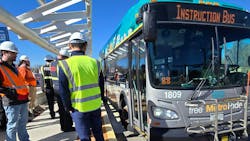
Members of Denver RTD’s Safety and Environmental Compliance team joined project partners along East Colfax to observe operational testing, a key milestone in the development of the new BRT corridor serving Denver and Aurora, Colo.
While Denver RTD is not the lead agency on the East Colfax BRT project, the organization says that it plays a critical role as a safety partner to the city and county of Denver. Through the Public Transportation Agency Safety Plan (PTASP) and Safety Management System (SMS) processes, Denver RTD notes it works closely with project partners to identify potential hazards early and address them before service begins, evaluating risks and ensuring safety is incorporated throughout planning, design, construction and testing.
The agency notes this work includes reviewing new infrastructure, validating operating procedures and confirming compatibility of vehicles, platforms and traffic controls. Denver RTD says the goal is to ensure that when service begins, operators, customers and the surrounding community experience a system that is safe, reliable and ready for day one operations.
“Operational testing is essential to making sure new transit infrastructure performs safely and reliably before customers ever board,” said Denver RTD Deputy CEO Angel Peña. “By bringing operators, safety professionals, engineers and regional partners together in real-world testing, we are helping ensure the East Colfax corridor delivers a safe, accessible and dependable transit experience for the communities it serves.”
Level boarding supports accessibility and faster service
Denver RTD notes that it’s conducting operational testing for level boarding, a key feature of the future BRT stations. Denver RTD teams previously conducted testing at a center-running platform along the corridor to measure the distance between buses and the raised platforms to evaluate how vehicles align during boarding.
Unlike traditional bus stops, Denver RTD notes BRT platforms are built to align with the bus floor, allowing customers to step or roll directly onto the bus and enables simultaneous boarding through multiple doors. Denver RTD says the design reduces the time buses spend stopped at stations, helping improve travel time reliability along the corridor. Once completed, the agency says that BRT is expected to save customers up to 30 minutes in travel time from Denver Union Station in downtown Denver to the Colfax Station at Colfax and I-225 in Aurora.
Denver RTD notes that level boarding provides additional accessibility for customers using wheelchairs, walkers, strollers or bicycles. Testing also evaluated gap-mitigation tools, including bridge plates, to ensure the system meets ADA standards.
BRT project information
Construction on the East Colfax BRT project began in 2024 after more than a decade of community planning and input. As the project continues to move forward, Denver RTD says its Safety and Environmental Compliance team will remain engaged to support a smooth and safe transition to dedicated lane BRT service.