PANYNJ set to begin autonomous shuttle trials as AirTrain replacement solution during reconstruction
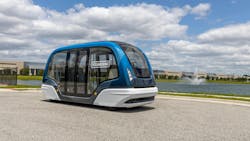
The Port Authority of New York and New Jersey (PANYNJ) will be testing electric self-driving shuttles at Newark Liberty International Airport (EWR) throughout spring 2026 in partnership with three autonomous vehicle technology companies.
The authority is examining choices to provide automated connections between EWR’s existing facilities and the new AirTrain Newark system that’s currently under construction. The new AirTrain Newark is scheduled to open in 2030.
The authority notes that these tests will be carried out with zero-emissions vehicles from each firm separately in an area of the airport that is not publicly accessible. The testing will take place over two-week periods. The tests are being conducted to simulate a high-capacity shuttle network with multiple vehicles operating simultaneously in a complex airport environment. Oceaneering will be tested in March, Ohmio in late March and Glydways in May. The tests are intended to qualify participating firms to respond to a formal PANYNJ request for proposals, which may be issued in 2027.
“As we advance the redevelopment of Newark Liberty International Airport, we are looking for opportunities to improve our passengers’ time at our airport through unique customer-first experiences as soon as you step onto airport property,” said PANYNJ Chairman Kevin O’Toole. “We have been working with self-driving technology successfully for many years, particularly at the airports, and believe autonomous shuttles offer a safe, efficient solution for moving passengers while we concurrently work to build a new AirTrain Newark and the brand-new Terminal B. These tests this spring will enable us to build on our knowledge and prior experiences working with self-driving shuttles and create a highly customized journey that will be unique to Newark Liberty and tailored to our passengers’ needs.”
Firms that responded to PANYNJ’s October 2024 request for innovation were asked how they could service two locations, approximately 2,500 feet apart, for five years. The authority notes that the competitive evaluation process included scored submissions and interviews with top-performing firms. Three firms were selected for tests funded by the authority. Each firm also participated in adverse weather testing earlier this winter to assess vehicle performance in snow and cold weather conditions.
“Autonomous vehicles are in use around the world and around the country, and they are part of the modern travel experience whether in a private car, a for-hire vehicle or on public transit,” said PANYNJ Executive Director Kathryn Garcia. “We are building a new Newark Liberty that meets the demands of the next generation of travel, so we must embrace a future that is inclusive of all the different ways we can move this region.”
The Newark Liberty tests build on several years of autonomous vehicle demonstrations conducted at PANYNJ airports. These include testing in summer 2024 at John F. Kennedy International Airport (JFK) that enabled members of the public to ride in autonomous vehicles at its long-term parking lot 9. Two other previous tests of autonomous platooned vehicles were held at JFK’s Aqueduct Parking Lot in 2022 and 2023 when JFK became the first North American airport to host a demonstration of a self-driving platoon of three vehicles. A test of a self-driving shuttle was also first conducted in mixed traffic at Newark Liberty in 2023 and a second in 2024.
The PANYNJ’s $3.5 billion project to replace the existing AirTrain Newark began in October 2025 and advanced to major construction earlier this year. The current system is unable to be expanded or upgraded to newer technology, and its route will hinder future airport growth, while PANYNJ says the new AirTrain Newark is being designed to be expandable.
When the current system opened in 1996, the airport served approximately 30 million passengers each year. In 2024, Newark Liberty welcomed nearly 50 million passengers. PANYNJ notes that AirTrain ridership is forecasted to grow by 50% by 2040, exceeding the capacity of the existing system. Its new route allows for easier access to the new award-winning Terminal A, eliminating the current 15-minute walk between the AirTrain station and the terminal.