Infrastructure Technology Podcast: How young leaders are reinventing the public transit industry with technology
Key takeaways
- Data center spending: Gavin, Brandon and Jessica kick off the episode discussing a recent news item that the U.S. is spending more on data centers currently than public transit. The hosts discuss how investments in artificial intelligence (AI) need to be regulated.
- AI’s most valuable transit applications may be behind the scenes: Brandon interviews two recent graduates from the University of Massachusetts Amherst in Linus Adler and Tate Coleman, who discuss how AI may provide the greatest benefit to public transit through schedule optimization, runtime analysis, demand forecasting, operations support and route planning.
- Microtransit continues to grow in rural areas: Coleman explains how on-demand transit services function as a publicly operated alternative to ride-hailing services and can improve mobility in areas where traditional fixed routes are difficult to sustain.
- The impact public transit has in different areas: Adler and Coleman explain how even though they grew up in different public transit environments, their appreciation for the industry is the same.
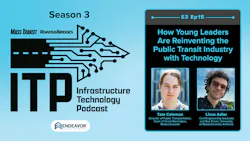




In episode 15 of Season three of the Infrastructure Technology Podcast, Mass Transit magazine Associate Editor Brandon Lewis interviews Linus Adler and Tate Coleman, two recent graduates from the University of Massachusetts, Amherst. Both guests share their personal journeys into the transit industry and discuss why public transportation remains an essential part of creating connected, accessible communities. The conversation begins with each guest explaining how their backgrounds influenced their interest in transit.
Adler describes growing up in a community with limited transportation options while Coleman recounts his experiences using public transit in New York City and later advocating for better transit amenities in rural Massachusetts. Throughout the episode, the guests discuss the importance of hands-on experience in transit operations. Lewis, as well as Roads and Bridges Head of Content Gavin Jenkins and Roads and Bridges Staff Writer Jessica Parks also discuss a recent news item that the U.S. is spending more on data centers currently than public transit.
Episode length
42:14
About the guests
Linus Adler graduated with a Bachelor of Science in Civil Engineering from the University of Massachusetts Amherst. During his time in school, he was an intern for the Massachusetts Department of Transportation’s Highway Project Development.

Tate Coleman serves as the director of public transportation at the town of Great Barrington, Mass. Tate recently graduated with Master's Degrees in Regional Planning and Civil Engineering from the University of Massachusetts Amherst, where he served as a U.S. Department of Transportation Dwight D. Eisenhower Graduate Transportation Fellow during the 2023-2024 academic year.

Here is a transcript from the episode:
GJ: And welcome to another episode of the Infrastructure Technology Podcast. Gavin Jenkins, head of content at Roads and Bridges. And with me, as always, we got Brandon Lewis, associate editor at Mass Transit and Jessica Parks, she is the staff writer at Roads and Bridges. Welcome Brandon. Tell them what day it is.
BL: Today is Tuesday, which means it's also podcast day.
GJ: Alright, excellent. Alright, so before we get to another one of Brandon's great interviews, let's talk about some news and notes, and we're going to use one of our listener emails. We got Jim from Miami writing to us, and Jim from Miami has been listening to us from the start. He's a devoted fan, and he wrote, ‘When will AI stop being talked about like a buzzword and just be used in normal conversation’? And it's an excellent question in many circles of our society, I don't think in our industries, but in many circles of society it is still just a buzzword, but I think that this article that came out this week from the Cool Down, which is a really cool technology and climate change website, they have a really good newsletter, but they have an article entitled ‘U.S. Spending on Data Center Construction Now Exceeds Spending on Public Transportation Infrastructure’, and I think the fact that our government is spending more on these data centers is the signal that is no longer a buzzword, and it is going to start being just normalized in everyday conversation. What do you think, Brandon?
BL: Yeah, so this article to me is really interesting. I think I have mixed feelings on it. It's always about investment in these data centers that they can bring construction jobs, tax revenue and new digital capacity, and that it can also support AI, including tools that help forecast electricity, demand for grid reliability and optimized clean energy systems such as wind, solar and battery storage, but it also says that at the same time, these data centers that they place such substantial on electricity grids and in some areas they consume large amounts of water for cooling and that while these projects can create a surge of construction jobs, they often require relatively few permanent workers. So again, it is a double-edged sword. I agree with you, Gavin, that AI, at least in our industry, it is no longer a buzzword, and I think that you're seeing it really all over, not just in our industry, but anywhere that I can consume media. It's just an acronym. Like the fact that AI is here now, and that everybody knows basically that the AI acronym stands for artificial intelligence.
GJ: Right? Yeah. I'm at the point with the editing that I want to write out artificial intelligence on the first use, but everybody knows you just put AI, I feel like it's already so far past buzzword that you don't even need to write out artificial intelligence on the first reference in an article anymore. You just use it as AI, and everyone knows, but yeah, I completely agree with all your points, Brandon. Double-edged sword all the way. The thing that this article makes me think about, and I want to read a little bit of it, where is the numbers? It says the money, more investment data centers can bring constructive jobs, tax revenue and digital capacity. That's huge. That's absolutely huge. But it can also support the use of AI, including tools to help forecast electricity demand, improve grid reliability and optimize clean energy systems such as wind, solar and battery storage. I think that with the good aspects of it, it just needs to be regulated. We need to get this under control. The data centers, the tech industry. We need regulation, we need smart regulation that needs to be specified. But I don't know. Jess, what do you think? What does this article say to you?
JP: So I think it's kind of interesting. I'm wondering, it puts a couple of questions in my mind. I know that this spending is higher right now but will it hit a peak? How many data centers will we realistically need? I know that we are using AI for and more and more applications, but are we eventually just going to become a country of data centers? I don't think so. So it's like I do think it'll eventually hit a peak, and right now, AI is just ever growing.
GJ: Right.
JP: Now, it is going to be higher, but I don't know if that's going to be forever.
GJ: Yeah. So a Bloomberg article explains that U.S. construction spending on data centers has surpassed $50 billion.
JP: That's crazy. That's so much money.
GJ: It's so much money, and it's a lot of money. We also need roads, bridges and bus lanes.
JP: And rail. And then the other thing is it's used for electricity. I know there was an argument of if they're using more and more electricity in these areas, who's subsidizing it? People were trying to get, I remember there was some arguments about, because they have so much electricity use, is that going to get pushed on to, because the electricity companies are going to need to be producing more electricity to be able to supply these data centers, right? And is that money going to get pushed onto other users of the electrical grid? And I think that was kind of an interesting thing. I was reading about for a little while, a lot of people obviously are pushing for data centers to subsidize the increased need of electrical power, but things don't always happen like that.
GJ: Now I'm sure Maz will cut this out, but just in case she doesn't, there's a really great movie called Edington, which is about a small town in the southwest that is going into chaos, and the backdrop is a data center is being built in the town, and it's like the data center looms large in the background and is hovering above the madness.
JP: How old is this movie?
GJ: It came out last year, last summer.
JP: Okay. I was like, what is it from?
GJ: It stars Pedro Pascal, Walking Phoenix.
JP: Okay. I think I've heard of it.
GJ: Very funny movie. Great cast. Alright now, okay, so Maz will probably cut that out, but if not, that's our discussion on data centers. Brandon, why don't you tell us about who we have on today's show?
BL: So today we have two recent graduates from the University of Massachusetts Amherst. Linus Adler graduated from there with a bachelor of science in civil engineering, and during his time in school, he was an intern for the Massachusetts Department of Transportation Highway Project Development. And then Tate Coleman, he currently serves as the director of public transportation at the town of Great Barrington, Massachusetts. Tate recently graduated with a master's degree in regional planning and civil engineering. He served as a USDOT graduate transportation fellow during the 2023 and 2024 academic year. As you guys can tell from both of these two young gentlemen's bios, they are very smart young men already involved in the transit industry, and this interview we actually did a while ago, way back before they both graduated, so we started talking about their plans going into the public training industry and what they learned to further their education.
GJ: Alright, well, without further ado, here is Brandon's interview.
BL: Tate, Linus, welcome to the Infrastructure Technology Podcast. Thank you both so much for taking time out of your busy schedule to sit down with me today.
LA: Of course. Thanks for having me.
TC: Thank you.
BL: So you guys are both students from the University of Massachusetts Amherst. You guys both have a little bit of different backgrounds in transportation. We're going to talk today a little bit about what you guys have studied, what got you interested in public transit and then what are you guys doing now and how it relates a little bit to the technology field. So let's start. First, I'll ask you to tell me a little bit about the program that you've studied in.
LA: Sure. So I am just about finished with my degree, bachelor's degree in civil engineering at UMass Amherst. I transferred here two years ago, fall of 2023. I spent a year before that at a community college in a general engineering program before coming here. Also, ever since I have been a student at UMass, I've also been working as a bus driver at UMass Transit. We'll get into that. The combination of those two things have made me eligible for a certificate program that the university does, a certificate in transit operations and management, which is available to both undergraduate and graduate students. It requires that I take a certain mix of courses related to public transportation, operations management, analysis, design, those sorts of things and in combination with having a certain amount of experience working at a transit agency, in my case, UMass Transit. So yeah, as soon as I'm done with that this semester, I will be eligible for the certificate. It's an exciting program that UMass does.
BL: And just to let everybody know out there that we are recording this in December of 2025. This is obviously airing in early 2026, but I'm sure by the time this airs, you will have graduated. So Tate, tell us a little bit about yourself and your transit journey.
TC: Thanks, Brandon. Yeah, so I graduated last September from the University of Massachusetts Amherst with a master's degrees in civil engineering and regional planning. I also went through the certificate program as well, the certificate in transit operations and management. So it was more of a multidisciplinary approach that I took rather than necessarily just civil engineering. But I've always been interested in transit since a very young age, and the planning side is really interesting in addition to the engineering and the certificate program really helped as well in terms of looking at the operations side of things as well and getting that experience for the certificate program. The real life experience that I got that went into that program was I was the microtransits program director for the South County Connector transit program in Great Barrington in Berkshire County, Massachusetts.
BL: Yeah, and we're going to talk about that a little bit as well, and you guys at such young ages have taken on very big and important roles, I would say early on in your transit careers. Before we get there though, I mentioned it a little bit earlier, but I do want to just talk a little bit more in depth about what got you guys interested in the public transit industry in general, whether they were just riding a bus, riding a train. Obviously there's ferries, there's so many things that are involved in public transit that I don't think people realize until you get into this industry. So Linus, let's start with you. When did your interest in public transit really start and how did that interest begin?
LA: Sure. I grew up in an area with little to no public transit available, a typical outer New England suburb. We had one bus in my town that went from the town center to the nearby city of Worcester, ran on like 80 minute headway, five days a week. None of the stops were marked, and I did not know anyone in my town who used it or even if they didn't, could have realistically benefited from it. I very much enjoyed whenever I had the chance to go to Boston or other similar locations where transit was actually an option. Something that tons of people used all the time. And I could see from a short period of time when I lived in Boston the difference that it made in the lives of the people who could use it and what they were able to do. Not having to, say depend on owning a car and being able to drive and having the finances to do that and such, not having to build or design a community around where space has to be made for cars to be everywhere and instead places that could be dense, walkable, bikeable, and the fact that they were those things was in part because of the availability of public transportation in those areas. That's what got me inspired to want to work in it, both being as a transit worker myself currently and possibly someday as an engineer who can work to design systems that are available, that are equitable that everyone can use and that benefits the communities that they work for.
BL: Let me ask you really quickly, you mentioned the fact that you are a bus driver as well for the college. Is the fact that you only had that experience that there was only one bus in your town, did that sort of interest you in being like, I want to see how all this works, and I would love to be a bus driver because I only have one bus in my town, and also I'm going to throw a little bit of a curveball at you. You said there was not a lot of public transit around, so are you learning a lot as an engineer about how the bus works and even how rail works and how trains work and tracks and things like that? Or not really?
LA: Sure. So I'll start with what got me into being a bus driver. I found out that it was an option when I was visiting UMass before I was a student here, and I was at a dining hall, and they had an advertisement on a table where it said hiring student bus drivers, and I remember at the time thinking there's no way they can hire students at UMass to drive the bus. It seemed like a crazy opportunity for me, but I had been taking a bus to Amherst when I was going out there to visit my partner at the time before I lived here, and that bus was also a common source of frustration in my life. It was operated with not a lot of regard to the quality of the service that provided. To say it very diplomatically, I'm grateful that it existed at all, but maybe is a little bit of a crusade effort that I want to contribute to this. I want to be a part of what makes this system run and maybe I can help people directly through the work that I'd be doing as a bus driver. It is also just a really neat opportunity that I've been interested in public transportation as a long time and now I can work very much boots on the ground with what actually gets people places, actually driving the buses. And your, sorry, what was the other part of the question?
BL: About the engineering part of it. Are you learning anything about how the bus works or even again, you haven't had a lot of rail experience. Are you learning anything about that side of the industry?
LA: Right. We do have part of the transportation engineering program. There is a class available to undergraduates on public transportation design. It's a 400 level, basically a transportation elective for seniors to take. I took it as a junior because I was feeling a little ambitious at the time, but I wouldn't say that it's necessarily integral to the engineering. You can definitely get a civil engineering degree at UMass without really having to think about public transportation at all. So the people who do study, it's because they're that that's what we are interested in, that we want to learn about it, and that it is available, and I wouldn't say it's unpopular. Definitely a lot of my classmates got into transportation engineering because they're interested in public transportation. I remember when I was in a freshman introductory course and we had to all say, why do we want to become an engineer? And the first hand that went up, the person said, ‘I want to fix the Red Line’. It was very funny. That's awesome hearing that from some freshmen, but people get into engineering a lot of times. I think they're ambitious, they're inspired and they want to change things, and they want to help, and that's a great way to do it.
BL: Now Tate, for you, again, you are already in a role. You are the director of public transportation at the town of Great Barrington, Massachusetts. So talk to me a little bit about that role and before that, what sort of sparked your interest in getting into this industry?
TC: Sure, thanks Brandon. So yeah, originally I grew up in New York City until about nine years old, and I really, that's where I fell in love with transit originally, so I always loved riding the subways, everything. It's a very different scale there than anything in rural New England. But yeah, no, I am told that my idea of fun when I was a toddler was dragging one or both of my parents along on the weekend, a newly designed subway trip, which I definitely believe because it's a lot of different factors of I think why I'm interested and so passionate about public transit. I think it's fascinating how you can move so many people so efficiently with these vehicles. I definitely love rail, but also when my family moved to Great Barrington, Massachusetts, when I was nine years old, which is where I work now, which is western, pretty far west in Massachusetts, rural town of about 7,000.
BL: Completely different than New York City.
TC: Very different, yes. You can imagine. I was not too pretty upset about the lack of where are the subways and the buses and kind of like Linus experience, we only had one bus route in Great Barrington. I did actually have to do research to figure out that there was even a bus. It's not readily apparent. But anyway, I did end up riding that bus somewhat frequently just because it was so interesting. This was the only transit available. I made friends with a lot of the drivers, too, and sort of got involved that way. And also, none of the bus stops in Great Barrington or a number of the surrounding communities were marked. They didn't have any bus stop signs, which is unfortunately not too uncommon in rural New England. So how I actually got involved in transit more formally originally is when I was actually just 13. I began to really notice and sort of talk with folks about the fact that there were no bus stop signs and there weren't many people riding the bus and maybe you should put up signs that might increase ridership.
BL: And you were doing that as a child. You were telling who this?
TC: Well, originally it was talking with various people I knew just to understand a lot of folks, again, didn't ride the service like other places, but actually ended up writing a letter to the editor and an email to our town manager, which is like the mayor in Great Barrington and the Berkshire Regional Transit Authority Administrator. Anyway, just about how it would make sense to put up bus stop signs. They actually, probably not knowing who I was or how old I was, decided to put me in charge of figuring out where signs should go. They said they'd be happy to put them up if I figured out where they went and designed them, so that was my first formal introduction into the public transit realm. Very improbable I would say, but it really shows that even when you're young, you can make a difference in your community. Anyway, so from there, my experience just grew from there. I interned with the Regional Transit Authority for one summer with their operations, and then I also became involved, I chaired the Regional Transportation Advisory Committee for Southern Berkshire County for about five and a half years, and that was both public transit and school transportation and a couple of other accessibility projects as well, and that was really a great experience. I also became progressively more involved in local government in Great Barrington. I first interned with the planning department and then expanded from there, and while I was going to UMass Amherst for graduate school eventually, so that was in 2022, 2023. Pretty soon after I had started, I was asked to lead this new transit program, the South County connector that I had been working on helping develop, which is like an on-demand and some flexible fixed-route service in Southern Berkshire County. Anyway, so I ended up doing that while at UMass Amherst and long story, but many things led to the next. Yeah, so my role now as director of public transportation for the town, which I just recently started last month, so I'm still figuring out exactly what it is, but it includes overseeing the transit department of the town, which is a seven-town transit system with about 20 employees, as well as number of vehicles. The service operates seven days a week, and this is really great coming from having known what it's like to ride around on the more limited fixed route bus service before this service was available, but my role at the town is also a little on the administrative side, and it's shared with the planning community development department, so I'm still, like I said, figuring out exactly what it entails, but also the other factors or the other pieces have to do with other transportation planning projects within the town of Great Barrington. So anyway, yeah, so thank you.
BL: You're welcome, and we are all obviously are part of the same generation here, and I think one of the things that has been sort of a buzzword around transit this year is these new programs when it comes to technologies and the use of AI, or obviously artificial intelligence since we are a technology podcast, as it the Infrastructure Technology Podcast. What sort of technologies are you guys seeing in your studies or is it being instituted or have you had any experience using AI to sort of help in your day-to-day experience when it comes to transit, or what technologies do you guys think will be coming in the future? Linus, we can start with you.
LA: Okay. It's a good question. I mean, I know it's 2025. It's the question to ask: What are we doing about AI? Huge question, and it's interesting to see. I think to back up and look at what problems do we have in public transportation and what do we think the solutions are to those problems and is this a technological advancement we need as a solution? Is it something that AI in particular can solve? I honestly, I think the biggest technological innovation that we've already had in public transportation in the last 30 years or so is the integration of GPS and internet and smartphones and the fact that passengers, people can open their phone and get transit directions from one place to another and have an app that will explain to them how to navigate maybe a system that they've never used before. They don't have to study huge schedule tables or those kinds of things.
BL: It’s the real-time tracking, being able to see, and again, not all agencies have this, so I do want to preface that, but I know agencies are trying to roll out the ability to see, oh, my bus is going to be here in five minutes, or oh, this train's going to be here in two minutes. And not having to sit there and go, is it on time, is it not? And all these agencies are doing digital signage and things like that at the stations as well to help and no, it is a good point. Tate, do you have anything to maybe add or something different?
TC: Sure, thanks. I mean, I definitely agree with Linus there and also sort of on the backend type of things, the geographic information system software, some, I don't know if it's necessarily AI, but some of the machine learning processes and everything have made it a lot easier to use those tools and make them more accessible than to just have very convoluted, very specific processes you have to follow in order to use those tools, which can really help smaller agencies who might not have someone on staff who's really specialized to use some of those planning tools that require so much background knowledge just to open that up for others. Also for on demand transit services, so that's microtransit or kind of like a shared ride, publicly operated, affordable Uber, Lyft type service, the backend, it just keeps getting better in terms of linking rides together and getting better and making that more efficient and more available, especially in rural areas. That can be really helpful. It's also helpful, I've seen with more fixed route, like more city bus route type services, the backend of calculating those runtime. So not only just showing the real time data for riders, but also trying to make the schedules more accurate and crunching lots of data in order to do that. Less of a guessing game and more of figuring that out in terms of predictions of when the traffic is better or worse, when it might take longer to board or get people off the bus. So anyway, those pieces have also been helpful. I've seen that as pretty useful. And then I'll just mention about AI and transit specifically, which is sort of a hot topic, but something that we have been experimenting with in Great Barrington with the transit department is we've been training an AI model, which we're calling the operations assistant that can help for our drivers and dispatchers when there's questions that either they might not be, they might not know an exact specific policy or anything like that, or just the policies or maybe more obscure pieces of our code of conduct or anything like that, rather than having to have a bunch of documents with them at all times. They've got this on the driver tablets now and on the dispatch desk, so that can help them. It's kind of looking up things like an encyclopedia, but way more accessible because it's a more digital document that they can just ask plain language questions and
get answers.
BL: So can they type in a prompt if they say, I have a passenger who's doing such and such and I'm not sure if this is breaking our code of conduct or not. And then the program will say, yes it is, or no, it's not.
TC: Yeah, and it'll cite what the specific issue is, or no, it isn't because which is, it's still in data testing.
BL: Okay, gotcha. I was going to say would it have the ability to tell the driver like, ‘Hey, you should do this to the student”, or you need to stop the bus or will it give guidance, I guess, to the operator?
TC: Yeah, I mean, it's more so in terms of our existing policies rather than interpreting the policies necessarily, but matching up a certain scenario or situation with a policy that we currently have, and it's also helping us as we go through this process of figuring out how can and can't be used. There are questions that operators are asking this that aren't necessarily written down in a very specific policy, and that helps us adjust and edit and add to our operations manual as needed to answer some of those questions a little better. Anyway, just thought that it's kind of a cool technology side of things that we've been working on.
BL: For sure, and we are going to leave it at that. Linus and Tate, thank you so much for joining me today on the Infrastructure Technology Podcast. You guys are doing such great work in your town in Massachusetts to make transit better for everyone at such a young age. Again, we appreciate you today for joining us on the ITP.
LA: Thank you so much.
GJ: And we are back. Brandon Lewis, another great interview. Thank you so much for that. Jess, what did you think? What were your takeaways from the interview?
JP: I love listening to students from my wonderful state of Massachusetts talk about transit. It was really awesome. I think what an interesting program. I think they drove buses as they were in college. I've just never heard of such a thing. I thought that was a really unique, and it was just interesting how involved and their passion really shined through, I believe it was Tate who discussed how he like, wrote a letter to Great Barrington and their regional transportation system to get bus stops, and they had him design the bus stops and pick the location. I was like, I love that initiative. I thought it was a really interesting interview with two men that were very intelligent and passionate.
GJ: That is the takeaway. They're passionate about the transit industry.
JP: They are.
GJ: Brandon, what about you?
BL: So I want this interview because these two students, as you guys could tell listening to it, they may have very similar backgrounds. So they have very different, I would say, transportation stories. So Linus talks about growing up in a suburb in outer New England that had only one bus. The stops were not even marked, and he talked about going up to school there and just seeing how people depend on transit like it's normal, and he was like, oh, this is not at all what I experienced growing up. And then he talked about a story that I thought it was hilarious about how in his freshman engineering class, someone said that they wanted to be an engineer to fix the Red Line, which is just hilarious to me. And then Tate, he talked about that when he was nine years old, his idea for fun on the weekend would be taking his mom and dad on a new subway line, which again, I mean it just shows that the passion that people have for public transit. I talk about this every episode. So listeners, I know you're probably sick of hearing me say it, but this industry has the best people, and it is unique, and there is so much things to do. It is so hard to get bored. I mean, I've been at Mass Transit now for about four years, and every day I am learning something new about this industry.
GJ: Well, not just that. It's also and the next generation is really going to carry the torch, and that's why we've tried to focus on the next generation for the past couple of months is that people like these two guys, they're coming in, and they're going to pick up with the current generation has left off, and they're going to help rebuild and enhance our infrastructure and our transit systems for the rest of the 21st century. It's a lot of optimism coming out of this podcast. In our industry, there is a labor crisis we don't have. There's also an engineer crisis in America where we don't have enough civil engineers to keep pace, and what we're trying to say with this podcast is the people who are coming into the industry, they're passionate, they're intelligent, they're eager, we should be highlighting their achievements and their dedication.
JP: I have to just say one thing real quick though.
GJ: Go shoot.
JP: I think in public transit specifically, you do get a lot more passionate young people now because I think as in the generation that there's growing, that's growing up right now, public transit isn't as much as a necessity all the time. I know it's our places. You do take public transit all the time, but we grew up in a very car-centric culture so a lot of people that are going into public transit now, it's a hobby for them to get a different perspective.
GJ: Well, it's also your generation. You're in your early 30s. Brandon, you're in your late 20s. For the two of you, your generation is driving less than my generation. It was so almost whenever I turned 16, whenever I was a junior, by the time I was a junior senior in high school, just about everyone in my class had their driver's license. Today that is not the case. There are kids graduating high school who do not have a driver's license, and they're relying on public transportation. and so it is a hobby, it is a passion, and we are in good hands with the next generation for sure. So that does it for our episode today. We want to thank Jim from Miami for writing in and giving us that question that kicked off today's episode. Please write us emails, we love hearing from you, write us questions, give us topics to discuss. You can write us at [email protected], and we also want to thank EndeavorB2B, our parent company that has brought us together and gives us this platform to have this wonderful podcast. And who else should we thank, Brandon?
BL: Well, we could also thank the great Tate Coleman and Linus Adler for being great guests on today's show.
GJ: Yeah. And we want to thank you, the listener, for getting to the end of this episode. And we want to thank Karina Mazhikina. We affectionately call Maz our editor and producer who probably cut out that bit about the movie I suggested a little while ago. Jess, any final thoughts?
JP: I was going to thank Karina, so no, I mean, thanks, Karina. We got our thanks out, so thank you so much.
GJ: For Roads and Bridges and the ITP, I'm Gavin Jenkins.
JP: I'm Jessica Parks.
BL: And I'm Brandon Lewis.
GJ: Alright, stay tuned, and we will talk to you next time. Until then, goodbye.
About the Author
 Brandon Lewis
Brandon Lewis
Associate Editor
Brandon Lewis is a recent graduate of Kent State University with a bachelor’s degree in journalism. Lewis is a former freelance editorial assistant at Vehicle Service Pros in Endeavor Business Media’s Vehicle Repair Group. Lewis brings his knowledge of web managing, copyediting and SEO practices to Mass Transit magazine as an associate editor. He is also a co-host of the Infrastructure Technology Podcast.