Infrastructure Technology Podcast: Building smarter infrastructure with AI and real-time data at North Highland
Key takeaways
- Artificial intelligence (AI) in Infrastructure Is reshaping transportation and construction workflows: Episode 10 explores how AI-powered analytics, automation and real-time monitoring are transforming infrastructure management across transportation and construction sectors.
- North Highland and Oklahoma Department of Transportation (ODOT) use AI for smarter infrastructure decisions: North Highland leaders Doug Kraus and Josh Zhou discuss with Roads and Bridges Staff Writer Jessica Parks how their partnership with the Oklahoma DOT is helping agencies prioritize bridge maintenance, analyze roadway conditions and improve long-term planning.
- Real-time data and predictive analytics improve infrastructure safety: The conversation dives into how AI-driven dashboards, sensors and computer vision systems help agencies proactively detect potholes, monitor bridges and identify crash hotspots before problems escalate.
- Will AI take over the construction workforce: After the interview, Parks is joined by Gavin Jenkins, head of content for Roads and Bridges, and Brandon Lewis, associate editor for Mass Transit magazine, where they discuss the impact of AI in the workforce, not only in the construction industry, but in other industries related to the journalism field.
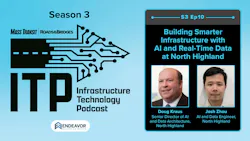




Episode 10 of the Infrastructure Technology Podcast features Roads and Bridges Staff Writer Jessica Parks interviewing Doug Kraus and Josh Zhou from North Highland about how artificial intelligence (AI) is transforming transportation infrastructure, workforce development and public sector operations. The discussion focuses on North Highland’s partnership with the Oklahoma Department of Transportation to deploy AI-driven analytics for bridge management, roadway monitoring and infrastructure planning.
At the conclusion of the interview, Parks is joined by Gavin Jenkins, head of content for Roads and Bridges, and Brandon Lewis, associate editor for Mass Transit magazine, where they discuss the broader impact of AI on transportation, construction and media industries, including workforce concerns, automation trends and the growing role of AI-powered technology in public transit and infrastructure operations.
About the guests
Doug Kraus is North Highlands senior director of AI and data architecture, bringing over 25 years of experience leading analytics strategy and implementation across large complex organizations.

Josh Zhou is an AI and data engineer at North Highland, whose expertise in database management and dashboard development helps transform raw data and clear actionable insights.

Here is a transcript from the episode:
GJ: Hello and welcome to the Infrastructure Technology Podcast. I'm Gavin Jenkins, head of content for Roads and Bridges, and with me as always, we have the man, the myth. He is Brandon Lewis, a legend of Mass Transit magazine. He's an associate editor, and we also have the one they call JP, Jessica Parks. She is a staff writer at Roads and Bridges. How are you guys doing today?
BL: Good morning everybody. It's Tuesday, which means it's another podcast day.
JP: I'm doing great, thanks.
GJ: Alright. Okay, so it is all spring gear. We are fully in spring, and I'm so happy for that. Just want to tell you that the weather is so beautiful here in Pittsburgh and what is so beautiful about it is that there's construction everywhere. We're fixing the roads, we're fixing the bridges, and we have a great show for you today. Jess, tell them who we have on today's show.
JP: So today I'm interviewing Doug Kraus and Josh Zhou. They're from North Highland, and North Highland, they have a partnership with the Oklahoma Department of Transportation deploying AI solutions for critical infrastructure needs. We talked about how these digital tools are reshaping the workforce in the emerging labor market across the transportation and construction sectors. Doug is a senior director of AI and data architecture at North Highland, and Josh is the AI and data engineer at the company.
GJ: Is North Highland an engineering firm?
JP: They're an AI solutions firm.
GJ: Okay. Alright, well this is the technology podcast, so I'm glad that they're in the technology space. That's awesome. Alright, Brandon, do you have anything to add before we jump to the interview?
BL: I think you guys are going to really enjoy this interview, so let's get right to it.
GJ: Alright, let's go. Karina, take us off.
JP: Hi everybody, it's Jessica and today I am joined by two guests from North Highland, a global consulting firm that helps public agencies turn strategy into measurable results through technology, data and organizational transformation. Welcome Doug and Josh.
JZ: Hello. Thank you for having me.
JP: Doug Kraus is North Highlands senior director of AI and data architecture, bringing over 25 years of experience leading analytics strategy and implementation across large complex organizations. Josh Zu is an AI and data engineer at North Highland, whose expertise in database management and dashboard development helps transform raw data and clear actionable insights. Today we're talking about North Highlands partnership with the Oklahoma Department of Transportation to deploy AI solutions for critical infrastructure needs and how these digital tools are reshaping the workforce in the emerging labor market across the transportation and construction sectors. Now let's get right into it. So for listeners who may not be familiar, can you give us a quick overview of what North Highland specializes in and how the firm supports state agencies and public sector partners? If you could specifically touch upon your partnership with ODOT, that would be great.
DK: Sure, yes. So North Highland is a leading change in transformation consulting firm, and our focus is really helping large organizations navigate some really complex business challenges through the intersection of technology and business. We want to make sure that what we put together is aligned to the customer's strategy, but be able to execute it in a way that is sustainable, and it's something that the users will actually use at the end of the day. Our relationship with ODOT is very special in that we started through a specific process to get engaged with them, but really we're trying to help them tackle some very specific business challenges and this is where we melded in both our change in transformation hat with our technology hat to help them achieve those objectives.
JP: That's great. It's so interesting how the applications that AI is able to do nowadays. It's able to help in so many different sectors with such a range of problems, so we love learning more about that, the ITP podcast. So what makes North Highland's approach to AI analytics and strategy different from other firms working in the infrastructure space?
DK: Yeah, it's a great question and it really comes down to, I was talking about some of our key principles or we need to look at this through both the technology eyes and the people eyes because you hear a lot of issues with AI systems that get implemented that are either not functional or just never ever get implemented and it has to do with half of its technology, but the other half is making sure that it's something that is meant for the organization and that people will actually use. Because if nobody uses it, then people waste a lot of time and money, so our approach is really having that end game and state in mind to make sure that we know how to navigate the actual change process of that as well so that it is implemented in a way that is sustainable and usable for the company.
JP: Definitely hear a lot about AI solutions that really just never get used, so that's a really interesting point that you made there. Josh, do you have anything to add on that point?
JZ: I would say here in North Highland, my work experience has been really awesome. I work with lots of, like Doug say, the people really matter, so I work with lots of people with similar background but also get to know other people who come from other backgrounds. This really is important because this is not just about technology, but also about the business and the whole organization, so I totally agree with what Doug said.
JP: Thank you. My next question is when you look across the U.S., what are some of the biggest challenges you see transportation agencies facing when it comes to aging infrastructure and limited funding?
DK: Yeah, it's a very big problem, unfortunately, and when you look nationwide, there's over 600,000 bridges. If you focus just on bridges, and there's 40,000 or more that there's poor condition, and it's a volume issue ultimately because there's just so much that goes on, and they need to maintain that information or maintain those bridges. But part of it is keeping track of all the inspection information so that they understand what's happened in the past, and they know basically what they've done, but sometimes they need a boost in terms of using some information in a different way to help them make other decisions and plan and be able to forecast a bit maybe better for maybe where they want to spend their dollar because they only have a certain amount of money that they get appropriated to get their job done, so they have to pick and choose what's going to be the most valuable thing, mostly from a safety perspective, but also what's going to be efficient for them to build into their plants.
JP: Definitely when you have to prioritize, but in that, before you can eventually be proactive is what I'm seeing. And so Oklahoma has taken a different approach by leaning into AI and analytics. What made this an ideal environment for this kind of innovation?
DK: Well, Oklahoma wants to be the lead in using technology and using AI as a service basically that they could leverage to service the citizens of the state, and that's a mission that they have and really this was the opportunity when we started with them to figure out what is a realistic way to apply AI where we started with ODOT in the bridge division, how can we leverage that to make sure that we could do the work efficiently, but also embed AI as part of helping them do the forecasting through some automation, but also applying tools and forecasting models to give them some insight as to where they might want to spend more time and focus on, and that's where it's really important because these are just tools. At the end of the day, we're not replacing people; we are just augmenting what they're doing and helping them make more informed decisions based upon the information that's at hand. We just can do it quicker now than we've been in the past.
JP: I think that's a perfect segue into the next segment that I want to talk about in our questions. As we're seeing across the country, agencies are seeing significant labor shortages, so how is AI reshaping these kind of roles and skills that infrastructure teams need now?
DK: Really the biggest impact is that a lot of the mundane work that people spend time meticulously or monotonously working through, it's basically replaced that amount of work and the efficiency to do it with more value added work, meaning thinking about the information, what is it trying to tell them, what are the next actions that they want to run instead of spending time pulling all this stuff manually together, and honestly, there's issues with quality at the same time, but really it's accelerating the information to get it in their hands, so they can actually think about what they want to do with it and spend time analyzing it instead of just putting it all together in the first place.
JP: Josh, do you have any thoughts on that topic?
JZ: Yeah, I think AI is definitely going to help with the labor shortage situation in my understanding because AI is first of all, super fast and super intelligent. Lots of work doesn't have to be done manually anymore, and this is where AI can to help you make the decision and be a great assistance to your daily work. And two, on the other hand, today AI can analyze images and all kinds of data, not just the traditional data data, so that means that AI can improve some of the safety of the workers as well because you don't really, like for bridges and rails, you don't really have to go to that spot to find out if that infrastructure, it needs some maintenance. You can just take a photo from a far position and then you will analyze the image quickly with AI, so that's going to help with the job safety, so people are more willing to do those jobs because they don't have to face the dangers of working under those dangerous situations.
JP: I agree. It is so interesting the applications AI has had in keeping employees out of the field where necessary, not having to go under a bridge and climb into this area to try to get a photo, it could do it for you and keep you at your desk, which I think really goes a long way in safety. My next question is, so you work closely with agencies undergoing digital transportation. What trends are you seeing among younger talent entering the infrastructure space, especially those drawn to more tech forward work?
DK: Josh, do you want to hit that one first?
JZ: Sure. Yeah. So I think what I see is today with this AI trend and the revolution going on, we see more and more junior level workers are basically equipped with more capabilities from AI. Previously we have maybe for technology projects, for example, we have 10 junior developers working on the same projects. Now with AI, we don't need that many junior developers so maybe four or five developers and then they can utilize AI to help them perform some work, so I think for those young adults working in the industry, getting to know AI is going to be a great benefit. It will help them boost their working efficiency and so they could focus more other more important items rather than just repeating some of the work that can be done by AI. That's what I see from the industry and from those agencies. Doug, would you like to add?
DK: Yeah, you hit the nail on the head because the effect is that people coming out of schools nowadays have the technical backgrounds because embedded as part of their curriculum and coming out of school with that, it gives them a very big jump and be able to jump into a program and be able to be immediately effective in it. Plus the fact is the work that can be done now in the amount of time that it took before is drastically reduced, which gives them more opportunity to work more even on a strategic level rather than a very mundane task level oriented work where really they're adding value not only from the activities that they're performing, but they can then grow faster and be able to support the organization both from a consulting perspective, but from a client perspective learn very quickly to be more effective basically.
JP: I agree. I heard this term used. It was that AI, it's not replacing the workforce, but it's maximizing the workforce, which is exactly what we need in a labor shortage is how do we get the most out of our employees without overworking them, and it's just a perfect tool to allow you to kind of skip over those, not skip over those mundane tasks, but give you the assistance you need so you can focus elsewhere, so that's what I completely agree with both of you on that. As agencies introduce AI and advanced analytics, what best practices are emerging for upskilling existing workers while also integrating new tech savvy employees?
DK: Well, this is where the change management comes in place because the fact is it's not easy. I mean, let's not say that, ‘Oh, it's a simple shift’, it's not, but we can do this in a way that is incremental, and I think personally the most important thing is that we give it them a goal oriented example that they can grasp onto instead of some generic solution that they just won't fit the pieces of the puzzle together. So part of this I think is one, just giving them some interest in the first place to do it, but the other part of this is making it part of their goals as well because without that, it's not maybe quite the incentive that there is with just learning it just because you're told to learn it. I think part of this is always showing them that they could expand their capabilities and their skills to make them both more marketable and have the experience and say, ‘Look, we're working with this and living this every day’, and that is really important. I believe in making sure that the organization and the people really sustain this long-term because without it, they need to be champions of this long-term, and you have to include them in that process and show them the reasons, show them the way, but it can't be done. Sometimes it's a little longer than others depending on the organization and where they are today in their maturity scale.
JP: Definitely. I think this one is a good question for you, Josh. So how does having real time data-driven insights change the way infrastructure decisions get made?
JZ: Yes, I think that's a great question, so we know infrastructure, they need to be monitored, and they need to be maintained in a way, so it is sustainable, and it works for everybody and keeps the safety of everybody, but how do we keep monitoring that infrastructure is going to be a problem? In old times, we would send engineers almost every week or every month to inspect that infrastructure, but now with today's information technology, we can install those sensors to get the data to understand how our infrastructure is doing and also the cameras taking photos of the infrastructure and all these data can be sent back to the sensor in real time, and all we need to do is to utilize the real time data and develop a dashboard for people to monitor, so you don't need to, like you said, go to those fields anymore. Today you can just sit in a room with just a few people looking at those dashboards. You will know exactly what needs attention and so you can respond to those spots really quickly, so this is being proactive rather than reactive. You don't need someone else to tell you to report there is an issue with your infrastructure, but rather you can get alerted by your dashboard, by your real time system and then react on it.
JP: That's great. And do you have anything to add to that, Doug?
DK: Just augmented a little bit in that it typically from the organizations in terms of the data they get and the frequency, it's always rear facing, meaning backward looking. By the time there is a potential issue, you're finding it out about it way too late, or it's already happened. There's no reason nowadays that you can't get more real time, and there's a lot of terminology around real time, but in essence, instead of getting a monthly or quarterly view, you can get a daily view for example, and you need to be able to see those incremental changes to be able to identify upcoming problems to Josh's point, so it's really becoming at least current state analysis instead of looking at a quarter or two ago.
JP: That's great. No, that's great, and my last question is beyond bridges, what other use cases like crash analytics or cause optimization are emerging as especially promising with these data tools?
DK: You mentioned one big one is, and something we've done a lot of work in the crash analytics space, and it's really a lot to do with safety at the end of the day because that's the number one priority and the tools that are out there accelerate or close the gap between not, again, looking backwards to looking at what's happening now, but also be able to predict hotspots and where is the traffic patterns emerging, where do we see potential issues developing, bringing in factors not just about the road condition or the geometry of the road, but also the traffic patterns, the weather, they all influence the prediction or the probability there's just going to be a problem that's there, so all that is available now to everybody. It's a matter of being able to implement it and spending the time and investment to put it in place so that you could expand that out to not only just from a traffic perspective, but assets in the field, road signs and other infrastructure that's out there that still needs to be managed and maintained, and you can do that now with a lot of imaging as Josh was talking about before, and you don't need to have somebody going out there and taking a picture all the time.
JP: Definitely. Do you have anything to add to that, Josh?
JZ: Yes, just maybe one quick story is that AI can even help with the roads conditions as well. So we talked a lot about bridges, but I'm not sure if you drive on highways a lot, but sometimes we don't like potholes on the rails. It really creates an unpleasant experience to our drivers, and most importantly, it could create a safety issue for our drivers. So AI, by looking at the cameras, they can quickly identify, detect those potholes quickly and even to develop a scoring system with AI to identify the severity of the pothole if it is deep enough that needs to be fixed immediately or even to close the road, so all this can be closely monitored by AI and our computer vision models, and we can respond really quickly and this way our drivers will have a better safety on the road from AI.
JP: Definitely. I've been hearing about the ability to kind of analyze road conditions, and I think that's so important. I drive on the road all the time and definitely agree with you that potholes are an unpleasant experience. So you guys answered all of my questions. I always just like to ask if you have any closing thoughts or if there's anything that I didn't ask you that you'd like to touch upon today.
DK: I guess all I'd maybe like to close with is the importance of people understanding that we're trying to use technology in a way that supports people by else would do. Would we do this at the end of the day? And while it is scary at times and or not easily understood, be able to just get a sense of what it could do, and why I think is really important, and I think it ultimately, like I was saying, that it's meant to be a tool. It's not to me a replacement of people or a placement of thought, and that's really where we need to ground ourselves in going forward because otherwise there's not a lot of use for it.
JP: And well, no, thank you both so much. That's all the time we have for today. I really just want to say thank you to Doug and Josh for both joining us on the Infrastructure Technology podcast. We appreciate your insights and the data solutions, digital transformation and how technology is shaping the future of the infrastructure workforce. Thank you both so much.
DK: Thank you for the opportunity.
GJ: Alright, we are back, and that was Jessica Parks' interview. Jess, excellent job. That was a fascinating interview. Brandon, what did you think?
BL: Yeah, so they talk about keeping people safe in the workforce with AI, and I find it really interesting, they talk about that even a couple years ago, workers and construction workers had to be at site. You couldn't really take a picture of something and evaluate, and I think that it's just going to make roads, bridges, construction just overall safer for the industry and get things done faster. The fact that you don't have to be on site to manage everything, it's sort of a take, if you will, of the new industry that we are in where really I think it started ever since COVID of people moving more towards that remote sort of work-life balance and not having to be at every physical location, even though there obviously is a benefit to it, and I also thought it was fascinating that they specifically pointed out that AI is maximizing the workforce and not cutting jobs, which in the construction industry is probably true in some aspects, but I will say in some aspects in different industries, I will actually disagree on that.
GJ: Isn't that the most interesting thing though is that in the mass transit industry and in the construction industry right now, I feel that AI is just such a net positive. We're seeing so many ways that it can benefit our industries and in other industries it is a threat, and then also overall, you have the AI experts who leave those AI companies and are like, ‘No, we've looked into the abyss, humanity could be extinct by this’. It's hacking the banks, and it's just like, ‘Okay, maybe we should regulate this and have a little discussion’, but in the meantime, our industries are actually being helped by it.
BL: Definitely. Well, in a way I would argue that it's a threat to what we're doing right now. I mean, you see, I sent you guys that story a couple weeks ago of the local paper here in Cleveland using caricatures to do a podcast, so it's running our livelihood right now, but in terms of our industries, I would argue that AI yes, is a good thing.
JP: And do you think that's because of the labor shortage already or do you think that that is, I've heard about it more in context of it's maximizing the workforce when there is a labor shortage problem. Do you think that that's the reason AI is helping only or do you think it's just really the impact it has on the industry and the tools it provides?
BL: Well, I think the bottom line is this. We know that all companies, the bottom line is just money and so whatever way AI can help, whether it's a positive or negative, they're going to find the best ways to maximize revenue, and they’re areas that obviously AI helps with that, and they’re areas where AI could completely eliminate jobs with that, so I think it's a two-edged stone.
GJ: Yeah, absolutely. And then there needs to be a plan for, I mean if it does start taking jobs, what's the plan if we get an entire job market sector that's just out of work?
BL: Well, the crazy thing is, I don't know if you guys are seeing it more so in the roads and bridges industry, I know we've started seeing it in the mass transit industry is press releases from either companies or agencies that are clearly in some way being written by AI. I know I've seen on LinkedIn, I've seen some people's resumes that look like they've been written by AI, which I would not recommend.
GJ: Don't let the clankers write your email or your resume. No, I completely agree with you, Brandon. And another thing that concerns me is like, alright, so they're already talking about having robots drive trucks. We already see what's the Waymo’s in Los Angeles are out on the road. And then recently didn't that robot run a half marathon?
BL: Yes.
GJ: Yeah. Okay. So if the clankers are running marathons now, and Waymo's are becoming more popular in one of our biggest cities, what's to stop them from driving buses? What's to stop them from operating an excavator? I mean, it's coming for both of our industries, and I don't see the discussion on what's going to happen to the human element.
JP: Well, Josh even said in the interview, he said that they don't need as many junior analysts on specific projects anymore, so they have less junior analysts coming in, but they only need one or two on a project where previously they needed four, and he was saying it as in that positive in the way that they are able to spread around these employees more into different projects because of AI, but what happens when AI, it completely replaces entry level jobs too. How are people going to make their way into the industry?
GJ: Right. Yeah. And then what about media entry level job where you're writing stories or doing social media and that's just done by AI. You get onto, if you look onto Twitter, which some people call X, but I still call Twitter, most of Twitter is just bots. It's just AI bots.
JP: By followers getting engagement just from AI.
BL: I will tell you just from experience, and this is a quick plug, you can follow us on social @masstransitmag, as well as roads and bridges. But when X did that whole, ‘Oh, we're going to get rid of bots and take over’, I mean our follower count, I'm not afraid to admit it because it's public knowledge. We lost like 200 or 300 followers, and we just had random accounts following us, and it's the same for everybody.
GJ: Yeah, absolutely. Hey, I'm getting a Teams message right now from Karina Mazhukina, who is our editor of this podcast and a co-producer and Karina’s saying, ‘Hey, are you guys rambling? Stop rambling and keep the episode on track’. So okay, Karina must have the vision to know what's going on here, so Brandon, let's move on from that great interview and talk a little Mass Transit news.
BL: Gavin, you actually had a great tie in already in the episode when we were talking about what's going to happen to excavators to bus operators being taken over by AI, and that's not the case here, but the MTA has unveiled new bus operator training simulators, and these simulators are being installed at the rec training center in the Bronx, and what they are is they feature four environments that are highly realistic, lighting, weather and traffic conditions. Instructors can create customized scenarios to simulate emergencies and challenging operator conditions while integrated performance dashboards, allowing trainers to track operator performance, identify skill gaps and provide coaching to better operate the buses. So what do you guys think of this?
GJ: I'm all for it. I think simulation is a great training technique. It's done in our sector as well. It's done in a lot of sectors, and I think that it's excellent because it actually saves money, I think, and it's faster.
Jp: And I agree with that because it's never a good idea to just throw somebody into the fire, so it's good to have an opportunity to train on a controlled space and have the analytics to see where people can improve.
GJ: Yeah. Brandon, what do you think?
BL: Well, the thing with this that I find so fascinating is I think it's really good to help operators train in different scenarios on how to actually drive a bus because I don't think people think and realize the difference between driving this vehicle that is so wide with so amounts of people versus just driving a car and the different environments that you get in. I find this fascinating that it can simulate different traffic patterns, it can simulate different weather environments. I think the craziest thing, obviously that's up there on the east coast, but we have it in the Midwest as well. When you are in an environment where the weather changes rapidly or traffic changes rapidly, especially when you're driving a bus, to operate that in maybe such a short, tight corridor in such a short window of time can be difficult, and if you don't have any experience prior to that, again, even if it's in a simulation, it gives you a chance to learn. It gives you a chance to maybe see a scenario so that when it arises in a real world situation, you'll know how to handle that situation better.
GJ: Yeah. What's the biggest vehicle you guys have ever driven? Jess? What's the biggest vehicle you've ever driven?
JP: So I've driven a Volkswagen. I've driven a U-Haul, a big U-Haul box truck.
GJ: Brandon, I'm guessing you…
BL: The only vehicle I've ever driven is a little electric wheelchair. The hardest vehicle I've ever driven is the ones that are like those little mopeds at the mall that you go in then don't steer at all, and I'm crashing into every aisle.
GJ: I've driven two big vehicles. Whenever I was in college, I used to deliver ice cream and so it was a big freezer truck, and I once had to back into this place where a convenience store where, so it was easier to deliver the ice cream to the convenience store, and I completely destroyed an awning that was hanging over the front of the store. The second thing is, right after grad school, I couldn't find a job in media, so I was waiting tables, and I wanted a second job to supplement my income, and I got a job delivering ice bags to grocery stores and convenient and gas stations and convenient stores, and I didn't even get through the training. Those trucks are even bigger. They're the biggest truck you can drive without a CDL. They're massive trucks, and I had to drive one on a highway here in Pittsburgh that was under construction and so the barriers were on either side. It was just no shoulders, and it was the most terrifying driving experience. I thought I was going to kill people, and then, of course, it was pouring down rain, and you had an elevator lift, so you put the bags of ice on a dolly and then you went down, and I fell off the dolly in the rain and the ice fell on top of me.
JP: Oh my goodness.
GJ: I was like, this job is not for me. The driving was terrifying. And so to bring it full circle, I have no idea how people drive buses. Bus drivers in this country are… tip your cap to them doing an incredible job driving buses.
JP: It is. You just think of how little turn you have. That's what drives me, but in New York City, I have been waiting and waiting and waiting at intersections for buses. They would just go right through the intersection, have no way of making it through the intersection and they just sit, there. Three rounds of lights.
GJ: Yeah. Can you imagine being a New York City bus driver? I couldn't imagine. I feel like there should just be a documentary about the lives of New York City bus drivers.
JP: The dedicated bus lanes definitely help because they don't have to watch out for other vehicles or pedestrians. I think it helps out a lot. Yeah, I agree with that. Maybe I could do it if I could only go on dedicated bus lanes.
GJ: Alright, well thank you for listening to today's show. That's all we have for today. We'd like to thank some people before we close out. We want to thank, obviously, Karina Mazhukina. The Maz is our editor and producer. She listens to our voices and edits them down and makes them sound good. We also want to thank EndeavorB2B. That is our parent company that brings us together, and they give us this beautiful platform, so we can talk, and we would like to thank you, the listener, for making it this far, for listening to us ramble, for not giving up on us when I talked about Knight Rider a couple weeks ago. And if you want to email us, email us at [email protected] or email us individually. It's our first initial with our last [email protected] and anything else? What else we got Brandon, what am I forgetting?
BL: I think you hit on all the plugs.
GJ: Okay. Alright. Follow us online as well. We're on the LinkedIn, we're on the Instagram, we're on the FaceBook. Alright, I'm Gavin Jenkins, head of content for Roads and Bridges.
JP: And I'm Jessica Parks, staff writer for Roads and Bridges.
BL: And I'm Brandon Lewis, associate editor for Mass Transit magazine.
GJ: Alright, goodbye.
About the Author
 Brandon Lewis
Brandon Lewis
Associate Editor
Brandon Lewis is a recent graduate of Kent State University with a bachelor’s degree in journalism. Lewis is a former freelance editorial assistant at Vehicle Service Pros in Endeavor Business Media’s Vehicle Repair Group. Lewis brings his knowledge of web managing, copyediting and SEO practices to Mass Transit magazine as an associate editor. He is also a co-host of the Infrastructure Technology Podcast.