The unseen trip: Fighting back when the fare doesn’t match the ride

Short ticketing hides in plain sight. A rider buys a cheaper ticket that covers only part of their trip, then quietly travels farther than they paid for. There are no gate jumpers or incriminating video evidence at first glance, just a small underpayment repeated millions of times across a given transit network. In the U.K., fare evasion costs rail operators around £240 million each year, or around US$316 million, with short ticketing representing a growing share of that total. These losses add up quickly, reducing revenue and distorting the ridership data agencies rely on to plan services and secure funding.
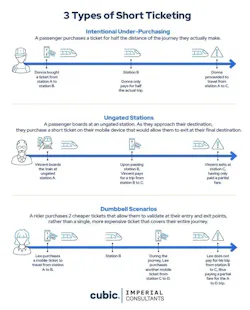
What makes short ticketing difficult to detect is that on paper most offenders appear legitimate. They hold a valid ticket, and gates often check only if a product exists, not whether it covers the full distance. Some riders buy mobile tickets partway through a journey, others board at ungated stations and some combine multiple shorter tickets to mimic their full trip. Across large networks with different fare media and inconsistent validation systems, these behaviors create blind spots that random inspections can rarely catch.
To study this problem at the necessary scale, Cubic Transportation Systems partnered with Imperial College London’s Artificial Intelligence and Data Analytics (AIDA) Lab through Imperial Consultants.
Researchers analyzed 6.5 million entry and exit records across 100 stations over a one-week period using an artificial intelligence (AI) framework that combined several anomaly detection techniques. These techniques identify unusual travel patterns across a network, including methods that highlight outliers and others that compare stations against similar locations. This made it possible to spot patterns that would be difficult to detect through manual analysis alone.
From millions of records into one clear picture
The research team created a simple way to describe every station interaction.
- A marks where a rider actually entered;
- B is the declared destination;
- C is the declared origin; and
- D is where the passenger actually exits.
Comparing these points revealed where journeys did not match, exposing gaps that most systems overlook. Using this approach, the data flagged 30 high-risk stations and five recurring behavior patterns.
Some stations, referred to as “ghost stations,” had large numbers of entry-only or exit-only validations. Others had far more exits than entries, appropriately referred to as “black-hole stations.” A third type, “fake origins,” showed where riders consistently started farther down the line than their tickets indicated. Smaller issues, such as partial taps or faulty readers, appeared as “micro-taps” or “function loss.”
These categories were not used to accuse riders but to help agencies see where systems or fare rules were breaking down. With a clearer view of where problems are concentrated, agencies can more accurately target inspections, fix reader or station ID issues and review pricing structures at the root of under-purchasing. Because the analysis used anonymous operational data, riders’ privacy was protected while also giving agencies a clear view of how the network really behaved.
Policy, design and implementation matter
Short ticketing is not only about enforcement. It is also a product of fare design. When zone boundaries create steep price jumps, riders have an incentive to buy shorter tickets. Solutions like fare capping, streamlined passes and a clear and consistent rewards system across payment types can reduce that temptation.
Short ticketing is also shaped by how journeys are validated in practice. Ungated routes, regional lines and mobile-only products can make validating inconsistent. In the U.K. data, these environments showed some of the clearest signs of irregular travel patterns, where entry and exit records did not fully line up.
Alongside decisions about where gating is most effective, better visibility through AI-generated anomaly maps allows agencies to focus inspections where irregular travel is most likely and correct settings or station codes to close any gaps.
Many short ticketing hotspots turn out to be technical rather than behavioral, caused by issues such as mobile latency or mismatched identifiers.
Fare policy still plays a supporting role. In New York, for example, the OMNY system expanded its open-loop platform to include concessions for registered riders, helping ensure discounts are accessible regardless of payment method. Aligning fare policies across all payment methods helps close the equity gap between cash and digital riders and reduces situations where riders feel pushed toward workarounds.
AI is a tool, not the end-all, be-all
AI should not be the final judge or decider; it should be used for guidance. Algorithms can highlight stations or times of day that appear unusual, but the human element is still needed to confirm what is happening and then decide how to respond. The most effective programs create feedback loops. Analysts rank anomalies, inspectors evaluate those areas and the outcomes feed back into the model to improve accuracy. Collaboration between field staff and data teams strengthens both sides of the process.
Fairness must remain central. Heavy enforcement risks alienating honest riders while random sweeping often wastes time and resources. Targeting true risks allows agencies to act precisely, protect compliant passengers and demonstrate transparency to the public. When riders see that enforcement is informed by data and applied fairly, confidence in the system improves.
Takeaways into action
The framework developed from the short ticketing study provides a model that any transit authority can adapt, turning raw ticketing data into practical guidance and helping agencies shift from reactive enforcement to proactive, reflexive management. Transit authorities can use these types of analytics to identify high-risk corridors, schedule inspections more efficiently, audit the quality of data and evaluate how their fare policies affect rider behavior.
Each recovered fare directly supports reinvestment in the network. Better data leads to smarter service planning, stronger funding cases and improved passenger experience. For agencies under financial pressure, insight like this offers a way to protect budgets without imposing heavier burdens on riders or staff.
It is difficult to stamp out all forms of short ticketing, but it no longer needs to remain invisible. With reliable data and tools, thoughtful fare policies and cooperation between analysts and operations, agencies can close the gap between what riders pay and how they travel. The result, and ultimate goal, is a system that is fairer, smarter and more sustainable for everyone who depends on public transport.
This article references findings from the joint study conducted by Cubic Transportation Systems and Imperial College London’s AIDA Lab, led by Yuyang Miao, Huijun Xing, Tony G. Constantinides and Danilo P. Mandic, as published in the Short Ticketing Detection Framework Analysis Report (2025).
About the Author
 Jeremy Mandell
Jeremy Mandell
Principal Solution Architect, Cubic Transportation Systems
Jeremy Mandell is a solution architect at Cubic Transportation Systems, where he specializes in designing and delivering complex, integrated systems that make public transportation more efficient, seamless and user-friendly for millions of people every day. His role is centered on building strong, collaborative relationships with transport authorities around the world, understanding their unique challenges and strategic goals and translating them into viable and innovative technical and commercial solutions. Previously, he was the director of solution consulting at ORM, which became Paragon DCX after an acquisition, where he led a multi-disciplinary team of product owners, BAs and solution architects. He was responsible for defining the business and technical strategy for product and project delivery in the transportation sector.