How Sound Transit improved escalator and elevator reliability
Key Highlights
- Implemented remote monitoring across 20 elevators and escalators, leading to a 90% reduction in unreported outages.
- Enabled real-time outage notifications via email and text, allowing for quicker technician response times.
- Improved maintenance planning by identifying developing equipment issues before failures occur.
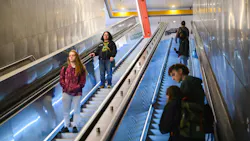
For many transit agencies, facility and station managers don’t discover elevator and escalator outages until after passengers do. The workflow often looks something like this:
- An elevator or escalator shuts down.
- A rider reports the issue.
- An employee confirms the outage.
- A maintenance team is dispatched.
By the time someone responds, the disruption may have affected service for hours—and that’s before the hours (or even days) it may take to repair or replace the equipment. Vertical transportation failures are surprisingly difficult to manage in real time, particularly across a large, distributed system with components from multiple manufacturers, different asset types, varying vintages and stations with diverse traffic patterns. Some issues are immediately apparent, while others are intermittent, difficult to diagnose or unnoticed until they significantly impact riders. That uncertainty makes even the best maintenance teams more reactive than they would like to be.
At Sound Transit, where we manage approximately 275 elevators and escalators across a service area that spans three counties, we’ve wrestled with a simple, but important question: How can we improve reliability when we can’t consistently see what is happening in real time? When an issue wasn’t immediately obvious or formally reported, confirming what was actually happening often required station staff involvement, manual verification, or combing through camera footage to determine whether and when an elevator or escalator went out of service.
That process is workable, but it is far from efficient—particularly at scale. Every step between a failure occurring and our operations team becoming aware of it introduces a delay. Across hundreds of assets, those delays compound quickly. The challenge wasn’t a lack of maintenance expertise—it was a lack of visibility.
For Sound Transit, elevators and escalators are not peripheral assets—they are essential pieces of our transportation system. Like every transit agency, we serve passengers using mobility devices, older adults, parents with strollers, travelers carrying luggage, and many others who rely on vertical conveyance to access the system safely and independently. Reliable operation of these assets is both a customer service expectation and an ADA requirement.
One incident at Mount Baker Station fundamentally changed how I thought about outages. A platform elevator and the adjacent escalator were both out of service. While reviewing CCTV footage with our Business Analyst Nick Champion and Vertical Transportation Manager Carlos Trujillo, who together helped spearhead our work on vertical transportation reliability, I watched a mother remove her toddler from a stroller, carry the stroller up the stairs, and help her child climb alongside her. That moment made it clear we needed to do better. It prompted us to ask not only how often these situations occurred, but how many outages were happening without anyone even knowing about them.
Our experience is not unique. Across transit systems, aging infrastructure, mixed equipment environments, contractor complexity and geographically dispersed assets make it difficult to maintain consistent awareness of what is happening in the field. The question is what to do about it. For us, the answer was not replacing equipment wholesale or reinventing our maintenance operation. It was improving operational visibility so we could make better decisions faster.
We evaluated several remote monitoring solutions through pilot deployments before selecting Knaq, a third-party platform capable of monitoring equipment across multiple manufacturers, vintages and technologies. We piloted the system on approximately 20 elevators and escalators over several months to validate its performance in a real operating environment. Following the success of that pilot, we developed the business case for executive and board approval before deploying the solution across our entire vertical transportation portfolio. We also updated our equipment specifications so that remote monitoring hardware would be included on all new vertical transportation assets.
That shift changed more than our awareness of outages. It changed how we worked. Instead of relying primarily on delayed reporting or manual confirmation, we became better positioned to identify issues earlier, prioritize responses more effectively and intervene before certain problems escalated into larger failures.
The result was measurable. Over one calendar year, Sound Transit achieved a 90% reduction in unreported elevator and escalator downtime following implementation. That represented more than 15,000 additional hours of service availability by allowing outages to be identified and addressed much sooner.
That metric is only part of the story.
Unreported downtime is more than a technical measurement. It represents the gap between when a problem begins and when operations become aware of it. Shrinking that gap matters because every hour of uncertainty has consequences: riders affected, staff diverted and maintenance teams reacting instead of planning.
One of the most valuable lessons from this experience was recognizing how much hidden operational cost exists within reactive workflows. Emergency dispatches are often more expensive than scheduled interventions. Minor issues worsen when they go undetected. Staff spend valuable time confirming outages instead of resolving them. Better visibility allows organizations to focus resources where they are needed most.
Another benefit of remote monitoring has been the ability to identify developing equipment trends before they become failures. For example, monitoring revealed excessive releveling activity on several hydraulic elevators. Correcting the underlying cause reduced unnecessary cycling of the starter, motor, pump, control valve and other hydraulic system components, helping reduce wear while improving long-term reliability.
With real-time monitoring in place, our team now receives outage notifications within minutes via email and text, allowing technicians or operations staff to respond much sooner than previously possible. One of the big lessons we learned from making this change is that operational reliability begins with operational visibility. You cannot respond quickly to problems you cannot see.
For transit agencies considering similar efforts, another important takeaway is that operational improvement does not necessarily require perfect infrastructure conditions. Transit environments are inherently complex. Equipment ages unevenly. Procurement cycles are long. Assets come from different manufacturers. Like many agencies, our equipment operates in harsh environments and is frequently exposed to the elements. Contractors and internal teams often work within overlapping systems. Waiting for complete standardization before improving operational visibility can become an obstacle to meaningful progress.
The infrastructure riders rarely think about can have an outsized impact on how they experience a system. Passengers may never notice a functioning elevator or escalator, but they immediately notice one that is out of service. Success in transit is often invisible. Riders never see the preventive maintenance, coordination or countless operational decisions that keep a system functioning. They experience only the outcome.
No transit agency will eliminate equipment failures entirely. Aging infrastructure, harsh operating environments and complex systems make that unrealistic. But agencies can dramatically reduce the time between failure and awareness, enabling faster responses, better maintenance decisions and improved service for passengers.
Our work to improve the reliability of our elevators and escalators is part of Sound Transit’s multi-year shift toward a conditions-based approach to maintenance and asset management. By using performance data, predictive analytics and risk assessments to determine optimal schedules for intervention, we are improving reliability, extending the life of system components and minimizing unnecessary maintenance. Ultimately, the aim of this agency-wide shift is to optimize maintenance costs and further improve the experience we’re offering passengers.
About the Author
 Shankar Rajaram
Shankar Rajaram
Executive Director of Infrastructure and Asset Management Division, Sound Transit
Shankar Rajaram, Ph.D., is executive director of infrastructure and asset management division at Sound Transit, where he leads agency-wide asset strategy—including vertical transportation alongside rolling stock, infrastructure and facilities—following more than a decade of progressively senior roles spanning rail and vehicle engineering, noise and vibration management, and revenue vehicle program leadership.
He specializes in rolling stock and infrastructure asset management, with particular focus on condition-based maintenance and sensor data integration to drive predictive, reliability-focused maintenance strategies that optimize lifecycle costs. He is a frequent speaker and panel moderator at industry venues like American Public Transportation Association events and the Wheel Rail Interaction (WRI) conference. He holds a Ph.D. in materials science from the University of Southern California.