Arrowhead Transit partners with The Routing Company to bring 21st century transit experience to rural Minnesota riders
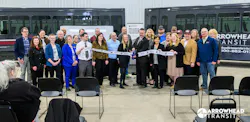
Arrowhead Transit, a rural transit agency operating in 10 counties throughout northeastern Minnesota, needed to solve a number of challenges when it looked to upgrade its transit scheduling and routing software—starting with route deviation.
As a rural operator, the state of Minnesota requires the agency to deviate up to three quarters of a mile on its rural commuter routes. Arrowhead Transit Communications Manager Dominick Olivanti says this means the agency can’t set specific stops and times, throwing “a wrench” in the typical technology available on the market that’s used to operating based off of consistent stops and schedules.
“With the buses moving off of intended road paths and stuff like that, there’s no way that we have technology right now that communicates like Google Maps so you can see what your options are if you’re looking with that behind the scenes technology,” Olivanti said.
So the agency published a request for proposals to see what, if any, technology could take them from manually scheduling and dispatching service into a 21st century solution. Atfer whittling it down to four final candidates, the agency chose to work with The Routing Company (TRC), who Olivanti says “was more than ready to take on the challenge.”
“They worked with us on both our paratransit service and then our [rural] commuter route service,” Olivanti said.
The second challenge the agency wanted to solve with its new software was offering more flexible access to its transit services. Previously, anyone who wanted to schedule a ride needed to call the dispatch center. Imagine being a college student having to call a 1-800 number and sit patiently in a long call queue just to schedule a pickup. For an agency that’s focusing on providing more transit access to community colleges, that’s pretty inconvenient.
“I mean, I can’t even imagine doing that,” Olivanti joked. I conquered.
Now, anyone can use the agency’s new mobile app to schedule, manage and track their trips. The app is powered through TRC’s Pingo platform but is white labeled under Arrowhead Transit, so riders build brand recognition and understand when they’re using the transit system.
“That was another big conversation for us, that when our consumers [use the app]... they know that they’re using our system, and it works and talks and does all the things we need it to do with our people,” Olivanti said.
Introducing real-time arrival information
The app solved two other pain points: eliminating the need for multiple backend software products and rider-facing apps, and providing real-time tracking information.
Living in Northern Minnesota means regularly white knuckling through negative degree temperatures. Previously, a passenger could be stuck outside waiting for 20 minutes, not knowing exactly when their bus would come. Now, riders can track their buses in the app, receiving live updates if a scheduled pickup was added and push notifications for when their bus is about to arrive. Olivanti says the app can even update riders if their bus is going to be a few minutes later than intended and provide a new arrival time.
“We have a four-minute notification and then ‘your bus is outside’ notification so that people can get ready appropriately,” OIivanti said, underscoring how this feature helps sell the narrative of “why public transit works for me.”
Ensuring no one is left behind, the dispatch center remains active and integrates with TRC’s software. Those that use the dispatch call number still receive that critical real-time information. Instead of a push notification, the system automatically calls back on the number that was used to schedule the ride. Riders can also opt for text updates.
Getting to full-scale rollout
In order to get to this full-scale implementation, the agency began with beta testing the backend, picking up a handful of people around the entire service area to try out the app in its various types of communities—ranging from the rural North Shore to heavier service areas. After beta testing, the agency rolled out the new system in quadrants starting in January of this year.
“We did that for a couple weeks and then we would add the next one into the system and do that for a couple weeks and then add the next couple counties and then add the next couple counties until we had full implementation,” Olivanti said.
By April 2026, Arrowhead Transit had fully implemented the backend solution and went live with beta testing the rider-facing app. At the start of this month, all beta testing concluded, and the agency did its full-scale launch.
While change is always tough, Olivanti notes there have been “great conversations with staff” along the way. Migrating from antiquated systems required changing how leadership communicated with employees. It also required changing their operating structure, particularly for the customer service team. Not only did they have to learn how to explain the app, but they also had to retrain on collecting and updating consumer data to create consumer profiles. This ensures riders get real-time updates. Once the new processes were smoothed out, employees were on board.
“They’re excited about the new software because of how it changes their job and how they’re doing their job on the backend,” Olivanti explained, saying the drivers are also benefitting thanks to having GPS onboard vehicles.
Rider adoption has also been strong. The agency is conducting the “It’s Here” campaign to spread awareness about the app. The travel training team is also revamping its curriculum to include the new rider app. During our interview, Olivanti was attending a senior expo. Before he stepped away to chat, he noted that within 90 minutes, 93 people had come up to their table who had the app on their phone asking questions on how to use it.
In addition to the growing rider adoption and reducing call times, Olivanti says he’s excited to expand the demographics they can more easily serve with the new technology.
“I think that this [app] is just us increasing the ability to serve additional demographics and more people,” Olivanti said. “Because while they may technically be able to access the service, there are a lot of other barriers—like the phone barrier, the getting on and riding the bus for the very first time barrier—all those kinds of things. So this technology... it gives off this vibe that we're more sleek, we're more 21st century, we're more modern, we're for you.”
About the Author
 Megan Perrero
Megan Perrero
Editor in Chief
Megan Perrero is a national award-winning B2B journalist and lover of all things transit. Currently, she is the Editor in Chief of Mass Transit magazine, where she develops and leads a multi-channel editorial strategy while reporting on the North American public transit industry.
Prior to her position with Mass Transit, Perrero was the senior communications and external relations specialist for the Shared-Use Mobility Center, where she was responsible for helping develop internal/external communications, plan the National Shared Mobility Summit and manage brand strategy and marketing campaigns.
Perrero serves as the board vice president for LIT, the second vice chair of the American Public Transportation Association’s (APTA) programs and communications committee and is a member of APTA’s Marketing and Communications Committee. She holds a bachelor’s degree in multimedia journalism with a concentration in magazine writing and a minor in public relations from Columbia College Chicago. Her work has been recognized with a first place AdWheel Award, AZBEE Bronze Regional awards, an AZBEE Regional Gold Award and an AZBEE National Silver Award.