Column: How ‘plug-and-play’ technology is making transit more efficient in Portland
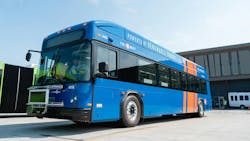
It takes a lot of resources to provide transit services across a major urban region — as my agency, TriMet, does in the Portland, Ore., metro area.
We have over 650 buses and 150 rail vehicles in our fleet. It’s no small task to continually maintain and modernize a fleet of that size.
We’re always looking for ways to be more efficient. A bus can’t serve its route while it’s in the shop and every hour that a maintenance or IT worker has to spend on that bus is an hour they aren’t available to troubleshoot issues elsewhere on our transit system.
Now, we’re getting some of that time back. That’s because of an innovative approach we’ve taken to integrating our on-board systems, which is transforming the way TriMet maintains and upgrades transit vehicles.
Cleaning up the systems
TriMet’s buses are stuffed with technology.
Each bus has an on-board computer that, together with a radio, connects its operator with our operations command center. Riders tap to pay at our farecard reader or put bills and coins into the farebox. Destination displays show the next stop. Security cameras record the inside and outside of the bus. A screen often shows one of the security feeds, reminding riders that they’re on camera.
Of course, each of these systems—farebox, CAD/AVL, passenger information and more—speak their own technical language. Many of them are sourced from different vendors. Some of them are legacy systems that are no longer supported by the original vendors.
At times, we even found ourselves searching eBay for obsolete hardware just to keep buses and trains operating. The parts we needed were no longer available from the original vendors, yet the systems they enabled were still essential to daily service. It became a constant reminder of how proprietary interfaces can trap agencies into using outdated technology.
Like many agencies, we struggled with the complexity of integrating all of these different hardware and software solutions—both new and antiquated, rider-facing and internal, from all of our many vendors—on our transit vehicles. To add or replace equipment, our staff often had to write custom code. That meant long testing cycles and high integration costs.
We wanted a better way, one that would let new and legacy systems coexist without costly, one-off solutions.
As it happens, TriMet was scheduled to replace all of the fareboxes on our buses this year. For our vehicle engineering team, this was an opportunity to try something new: Information Technology for Public Transport (ITxPT), an open framework created by a nonprofit consortium in Europe.
USB for public transportation
ITxPT defines standard data formats and interfaces for transit IT systems. Its goal is simple yet transformative: enable true plug-and-play integration for on-board systems, regardless of the manufacturer. Think of it as sort of a USB for public transportation, defining a standard for hardware and software with specifications that enable them to work together.
Our team piloted ITxPT as part of the farebox replacement project, connecting new Lecip fareboxes with the bus’s existing INIT on-board computer. The results have been revolutionary, both for our bus operators and our support staff.
With ITxPT enabled, each operator has a single sign-on (SSO) experience. When an operator logs into the on-board computer at the start of their shift, the farebox automatically recognizes their credentials as well.
Connected to the on-board computer, the farebox continuously receives real-time information on the current route and stop. That means we can correlate fare sales with that data, improving our reporting and ensuring consistency across our systems.
And the benefits go far beyond that. Thanks to ITxPT, we can now easily pilot and test new hardware, such as next-generation rider information displays or other connected systems.
Instead of lengthy integrations that could take weeks of custom development, new devices can be simply connected, configured and evaluated using standard interfaces. That saves TriMet both time and money.
It also gives us some much-needed flexibility when it comes to upgrading our transit vehicles. TriMet can adopt new technologies quickly, mix products from different suppliers and finally escape vendor lock-in.
A replicable and scalable model
While ITxPT is already well established across Europe, TriMet’s implementation of this framework is among the first real-world deployments in North America.
It’s safe to say it won’t be the last.
Other transit agencies in North America are also exploring the use of ITxPT. Whether they’re smaller than TriMet, about the same size or even larger, a standardized architecture will allow them to integrate on-board systems with greater ease and less expense.
TriMet was invited to share our experience with using ITxPT at the Canadian Urban Transit Association’s (CUTA) spring summit, which was hosted in Vancouver, B.C. We made a joint presentation with TransLink, the CUTA conference host, on how ITxPT standards can enhance interoperability and improve efficiency for public transportation systems like ours.
The response to our presentation was overwhelmingly positive, giving this framework greater exposure and helping to drive interest in its potential.
I’m proud that TriMet is on the leading edge of this adoption in North America. As I see it, the vision of plug-and-play transit technology is finally within reach.
That’s why I’m also excited to see other agencies include ITxPT in their requests for proposals. As the ITxPT community expands, so do our opportunities to work together and improve public transportation for all—here in Portland, across North America and around the world.
About the Author
 Patrick Neumann
Patrick Neumann
TriMet’s Manager of Intelligent Transportation Systems
Patrick Neumann is TriMet’s manager of intelligent transportation systems. Holding a master’s degree from Germany’s Technische Universität Braunschweig, Neumann is an accomplished engineer who has worked on transportation systems in multiple countries.