
Across North America, a quiet revolution is underway: electric buses are appearing on city streets. Early pilot projects have answered the question of whether electrification works, with transit agencies from Los Angeles to Toronto proving that zero-emission buses can perform reliably in urban environments, cutting emissions and reducing noise pollution for communities in the process. The challenge ahead is far more complex: ensuring that electrification can be scaled system-wide in a way that is financially sustainable, operationally resilient, and built to last.
Governments at every level are pushing ambitious timelines. Federal and provincial funding programs have accelerated adoption in Canada, while state and municipal mandates are setting clear targets for fleet decarbonization in the U.S. Billions of dollars in funding are currently available, but those opportunities come with deadlines and uncertainty, so the window will not remain open indefinitely. Meanwhile, public expectations are rising. Communities are beginning to see clean transit not as an experiment, but as a baseline requirement for sustainable urban living.
For many transit agencies, this moment represents a turning point. Electric bus technology works, but how can the system transform to accommodate it? Scaling electrification requires new approaches to planning, infrastructure, financing, and workforce development that extend far beyond simply buying more buses and chargers.
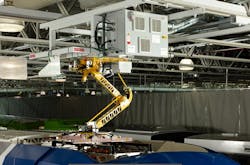
Consider the issue of infrastructure. A depot designed for ten electric buses cannot easily stretch to accommodate one hundred. Agencies that plan incrementally often find themselves boxed in, facing costly retrofits and stranded assets. In contrast, those building long-term scalability into their designs – thinking in terms of decades rather than months – can expand more efficiently, aligning with fleet growth and evolving technology.
Then there’s the grid. Many utilities are unaccustomed to the level of demand a fully electrified fleet can place on local infrastructure. In some regions, interconnection timelines stretch years, delaying projects even when buses are ready to roll. By establishing early collaborative partnerships with their utilities, agencies are finding ways to synchronize fleet electrification with grid modernization, avoiding bottlenecks, and unlocking opportunities to integrate renewables or on-site storage.
Financing is another critical piece of the puzzle. While grants have played an essential role in getting pilots off the ground, they cannot sustain the scale of the transition required to meet future mandates. Transit authorities are beginning to explore new models, from public-private partnerships to energy-as-a-service agreements, which can spread upfront costs and de-risk investments over time. These models are not yet standard practice, but as current funding streams taper off, innovative financing will become increasingly essential.
Rethinking, reskilling, and retooling
At the heart of this transformation lies the workforce. Electrification requires new skills, from drivers who learn different operating behaviors to mechanics who must maintain advanced electrical systems. Agencies that invest in training and workforce readiness early are better positioned to integrate new technology seamlessly into daily operations when the time comes. Those who delay risk undercutting reliability and performance.
There are lessons to be learned from agencies already moving beyond pilots. In both the U.S. and Canada, forward-looking transit systems prove that large-scale adoption is possible. They are building charging hubs with expansion in mind, integrating digital fleet management tools that optimize routes and charging schedules, and embedding electrification into long-term planning cycles. Perhaps more crucially, they are forging partnerships – with technology providers like Hitachi Energy, utilities, and local governments – that align objectives and accelerate progress.
The road forward: making electrification enduring
These examples highlight a broader truth: the success of transit electrification is not just about hardware. It is about systems thinking. The transition must be embedded into the very fabric of daily operations, not treated as a special project but as the new normal. That means designing flexible infrastructure, creating interoperable ecosystems, and embracing digital tools that provide resilience against both technological change and operational uncertainty.
The clock, however, is ticking. Transit agencies that hesitate risk missing out on current funding opportunities, facing higher costs as demand increases, or finding themselves unprepared for regulatory deadlines. Those that act decisively – by planning for scale, engaging with the right partners, and adopting resilient financial and operational models – will set the pace for the industry and secure long-term value for their communities.
The road ahead is not without obstacles, but the trajectory is clear. Electrification has proven its worth; now it must prove its durability. The agencies that succeed in embedding electrification into the heart of their operations will not only meet mandates but will also redefine what public transit means in the 21st century: cleaner, quieter, more efficient, and built for the long haul.