CTA submits revised security enhancement plan to FTA
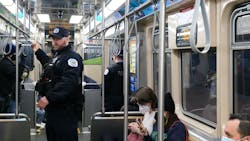
The Chicago Transit Authority (CTA) has submitted its revised security enhancement plan to the Federal Transit Administration (FTA), which includes aggressive crime reduction targets and expanded social service support. The agency says the plan is bolstered by early data that shows crime reduction strategies implemented over the past three months are working. The plan is CTA's formal response to an FTA Special Directive issued in December and details how the agency will significantly expand the law enforcement surge it launched in December.
CTA notes the plan was created in collaboration with the Chicago Police Department (CPD) and the Cook County Sheriff’s Office. CTA is also in frequent communication with the Cook County State’s Attorney’s Office about security initiatives.
"This plan represents my commitment to our employees and riders,” said CTA Acting President Nora Leerhsen. “As part of its holistic approach to security, CTA is significantly increasing policing hours through the Chicago Police Department’s Public Transit Section and off-duty policing program and the Cook County Sheriff’s Police Department has been engaged to bring their officers onto CTA. CTA is also expanding social service support, from introducing mental health teams to funding shelter beds for the unhoused and investing in technology that supports the officers that patrol the system. The January and February results from CTA and CPD’s joint security surge have been promising, and we’ve built on that momentum by creating a sustainable security model that puts people first.”
According to the CTA, the plan includes a 75% increase in monthly system policing hours, including:
- 34% more hours from CPD’s Public Transit Section
- Double the off-duty officers patrolling CTA on their days off as part of CPD’s Voluntary Special Employment Program (VSEP)
- Cook County Sheriff's Police officers working on CTA’s rail lines (4,400 hours monthly).
“CPD, in close partnership with CTA, is committed to enhancing safety on the public transit system for all ridership and employees,” said CPD Superintendent Larry Snelling. “In this updated security plan, CPD will have more officers patrolling the rail system to both deter crime and respond to incidents more quickly. This builds on the progress we have made throughout the past year to hold criminal offenders accountable through an increased police presence on the rail system, the launch of a new Public Transit Strategic Decision Support Center and strengthened, specialized transit crime investigations.”
CTA has worked closely with CPD to implement new police missions across its system, including:
- Transit rider interaction program (TRIP) missions: Teams of six to eight officers board trains and inspect cars at high-incident stations. Over 300 TRIP missions have been conducted since they were launched in January; crime at targeted stations dropped 15%.
- Bus ride-along missions: Officers patrol CTA bus routes with the most reported crimes and highest rates of fare evasion.
- Bus safe corridor missions: Police are stationed at bus stops in high-crime areas during peak hours.
"The CTA is one of the largest public transit systems in America and our office looks forward to working closely with them as they expand and invest in their security environment,” said Cook County Sheriff Tom Dart. “Along with providing Sheriff’s Police officers that will soon be patrolling the CTA, my office will be leading a public safety task force for the new Northern Illinois Transit Authority [NITA] starting in June. NITA is a recently created government body that will oversee CTA, Metra and Pace.
Positive results from security surge
The agency notes it has seen improved security numbers since the December 2025 introduction of the CTA and CPD’s joint security surge, as total transit worker assaults fell 25% in January and 29% in February when compared to the six-month average leading up to the start of the security surge in December 2025. CTA says that when comparing the period since the start of the surge (Dec. 19, 2025) through the end of February 2026, with the same period in the previous year:
- Violent crime on buses reduced by 19%
- Systemwide crime dropped 9%
- Incidents of crime on CTA’s rail system fell 9%
Other initiatives and investments
The plan features other aspects of CTA’s comprehensive approach to keeping its employees and riders safe:
Social services and crisis intervention
- Partnership with Chicago Department of Family and Support Services: CTA funds outreach teams on the Blue and Red lines (24-hour service) to connect unhoused riders with shelter, housing and social services. Since 2023, over 300 people have been assisted with placement in shelters and aided 200 in moving into stable or permanent housing. In 2026, CTA is funding 30 dedicated shelter beds—a five-fold increase—with $1.65 million in allocated funding.
- Partnership with Chicago Department of Public Health (CDPH): CDPH funds overnight outreach by The Night Ministry two nights weekly at Blue and Red Line terminals to connect people with social services and housing. CTA also added a police kiosk at Forest Park Blue Line station for local police to staff and have a presence on the platform.
- Safe ride specialists pilot: This year, CTA is launching crisis intervention specialists and violence interrupters—trained staff to de-escalate mental health and behavioral crises who refer and connect riders to social services.
Fare evasion mitigation
- High-barrier fare gates pilot: CTA will expand the installation of non-ADA, high-barrier fare gates at rail stations that are typically staffed but continue to have high rates of fare evasion.
- Farecard inspection missions: In 2026, CTA is launching farecard inspection missions to uncover the use of free, reduced, or other entitlement fare media by someone other than the authorized holder and revoke the entitlement if the eligible user is allowing the inappropriate use of the fare media.
- Enhanced ridership data: The CTA is using new data tools to track fare evasion more precisely. On buses, it's analyzing passenger counts by route and time of day. On trains, video audits are measuring evasion at individual branch lines. CTA notes that the more detailed picture will help it deploy enforcement resources more strategically and measure whether they're working.
Technology, infrastructure and public messaging
- Artificial intelligence (AI)-powered gun detection technology: CTA is continuing to expand the use of AI-powered gun detection technology with over 1,500 cameras across its Chicago rail stations.
- Enhanced fare messaging: New bus signage and "fare required" audio announcements are being added to CTA buses to clarify fare payment requirements.
Partnerships
- Increased transit crime prosecution in collaboration with the Cook County State’s Attorney’s Office (CCSAO): CTA and CPD are working closely with the CCSAO as it continues to enhance its operations and protocols to proactively and vigorously prosecute transit-oriented crime.
- Project Safe Neighborhoods (PSN): CTA has entered into a partnership with the U.S. Attorney's Office for the Northern District of Illinois to address violent crime on transit—the first PSN deployment on a mass transit system. PSN is a federally funded, nationwide initiative and brings together federal, state and local law enforcement and other stakeholders.