TTC launches six-month pilot to improve bus safety for operators
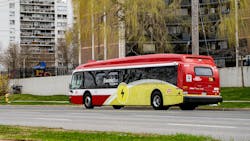
The Toronto Transit Commission (TTC) has equipped 30 buses with technology that will warn operators and vulnerable road users of potential collisions as part of a six-month bus safety pilot. The buses now also feature new displays that reduce blind spots for operators.
“We are always looking at new tools that will help us improve road safety, especially for our most vulnerable road users,” said Toronto Mayor Olivia Chow. “With 1,600 TTC buses on the road every day, any chance to improve TTC bus safety is a chance to improve road safety citywide.”
The agency notes pilot buses will run along the 29/329/929 Dufferin, 63/363 Ossington, 161 Rogers Road and 168 Symington routes, all of which are heavily used by pedestrians, motorists and cyclists. The goal is to determine each technology's effectiveness, incorporate lessons learned into future bus procurements and help to consider whether the systems should be retrofitted into the existing bus fleet.
“Safety is paramount at the TTC, and I welcome any opportunity to improve safety for both TTC operators and transit users,” said TTC Board Chair Jamaal Myers “Through this six-month pilot, the TTC will gather valuable information and insights, and I look forward to seeing the results.”
As part of the pilot, TTC says pedestrians and cyclists outside the buses may hear two warnings:
- “Caution, bus approaching” when near a moving bus.
- “Danger, step back” when there is an imminent risk of collision.
Inside the bus, TTC notes operators receive collision warnings through a flashing panel and an audible alert. The warnings are based on the distance between buses and things around them, as well as how fast they are travelling.
“Our bus operators all receive extensive training to ensure they have the tools and knowledge to keep everyone safe,” said TTC CEO Mandeep Lali. “These new technologies, if they prove helpful, could be another step we take to help reduce the risk of collisions.”
The TTC performed controlled testing of both technologies in 2025. Similar driver-assist technologies are used in other transit systems in York, Ontario, Chicago and Boston.