Op-Ed: Transit tunnel lighting standards need to catch up
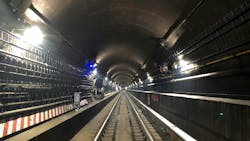
The U.S.’s transit tunnels are older than most people realize. Boston’s Tremont Street subway opened in 1897. New York’s subway followed in 1904. Many of these underground systems were engineered decades before the fire and life safety standards that now govern them existed. The infrastructure works, and agencies maintain it (often heroically) with constrained budgets and limited access windows.
But the gap between what these aging systems were built to do and what modern safety demands is widening, and nowhere is that gap more visible than in emergency lighting.
I have spent nearly two decades developing lighting systems for transit tunnels. I have walked these tunnels and have seen what agencies are dealing with: legacy fixtures on aging circuits, centralized backup systems that create single points of failure and emergency lighting no one can verify is working until it is needed most. The people running these systems are not the problem. It’s the standard they are working against.
The past two decades have delivered hard lessons about what happens when underground infrastructure is tested by events it was not designed for. The September 11 attacks destroyed a subway station beneath the World Trade Center and shut down the nation’s largest transit system for the first time in its history. Hurricane Sandy in 2012 flooded nine of New York City’s 14 underwater subway tunnels, causing more than $4.5 billion in damage and requiring an 18-month tunnel closure for repairs that didn’t begin until 2019.
A 2015 tunnel smoke event in the Washington Metropolitan Area Transit Authority’s Metro trapped hundreds of passengers in near-total darkness for over 30 minutes, resulting in one fatality and dozens of hospitalizations. In Chicago, a 2006 rush hour derailment and fire on the Chicago Transit Authority’s Blue Line subway sent more than 150 riders to hospitals after hundreds evacuated through a darkened tunnel. In Oakland, a 2024 equipment fire at a Bay Area Rapid Transit station stranded passengers on two trains for nearly an hour before evacuation was authorized. And in late 2024, a Brooklyn, N.Y., power failure forced approximately 3,500 riders to evacuate through tunnels and emergency exits.
Each one of these events prompted investigations, audits and renewed commitments to safety. Every one exposed the same reality: The emergency infrastructure in our tunnels was not built for these scenarios. These are not failures of will by the agencies that manage these systems. They are failures of a standard that has not kept pace.
The National Fire Protection Association (NFPA) 130 standard for fixed guideway transit and passenger rail systems is the benchmark against which most U.S. transit agencies measure emergency lighting compliance. On that subject, it sets an extraordinarily low bar.
NFPA 130 requires tunnel egress walking surfaces to be illuminated to just 0.25 foot-candles, with a 10:1 uniformity ratio and circuit continuity to maintain illumination for one hour.
For context: the Occupational Safety and Health Administration (OSHA) requires five foot candles for tunnel work areas. A typical office hallway is lit to 10 to 20 foot candles. The emergency minimum for the path a rider must follow through a dark, smoke-filled tunnel is roughly 1/20 of what OSHA requires for a worker walking to a job site.
NFPA 130 was designed as a baseline. For too many systems, the baseline has become the target.
Beyond light levels, NFPA 130 leaves three critical gaps.
- Backup power architecture: The standard requires emergency illumination but does not prescribe how backup power should be delivered. Most legacy systems rely on centralized UPS, inverters or dual-feed circuits, creating concentration risk. A single failure can black out an entire tunnel section. After September 11, four-hour battery packs were mandated for under-river tunnels in the New York City Transit system, but most agencies nationwide have no equivalent requirement.
- Monitoring and verification: NFPA 130 does not require agencies to remotely monitor whether emergency lighting is operational. A December 2024 Inspector General audit of one major transit system found exits with no working lighting, stairwells inspectors navigated by flashlight and three quarters of serious defects overdue for repair. When asked about monitoring, the agency responded that employee flashlights were sufficient. These findings reflect a national reality for aging systems without tools to monitor critical safety equipment in real time.
- Dual function capability: Transit workers enter tunnels daily for inspection, maintenance and construction in four- to five-hour work windows. A significant portion of that time goes to setting up and tearing down temporary lighting for OSHA compliance. A system that operates in both emergency and OSHA-compliant work modes would eliminate that waste. The current standard does not contemplate this, even though the technology exists today.
Here’s what should give the industry confidence: Many agencies are already ahead of the standard. When major transit systems plan tunnel lighting upgrades, they are routinely specifying two foot candle minimums rather than 0.25, uniformity ratios of 3:1 rather than 10:1, fixture-level battery backup and remote health monitoring to verify that equipment works before an emergency, not after.
This is not happening by accident. In 2022, the Federal Transit Administration published a research report on emergency egress in rail transit tunnels, commissioned in response to safety recommendations from the National Transportation Safety Board. It identified gaps in NFPA 130 and recommended new voluntary standards through the American Public Transportation Association. The report also found that some existing tunnels could not meet current NFPA 130 criteria due to their original design, a standard simultaneously too low for modern expectations and out of reach for some legacy infrastructure without investment.
When the agencies on the front lines are already designing past the standard, the standard needs to evolve.
The economics have never been more favorable. The Consolidated Appropriations Act, signed into law in early February 2026, delivered $21 billion for public transit as part of a $1.2 trillion federal spending package. Tunnel rehabilitation, signal modernization and resiliency upgrades are underway nationwide. Lighting upgrades represent a fraction of the cost of these larger capital projects, and when a tunnel is already closed for other work, the incremental cost is marginal.
But the window is not open forever. Capital project schedules are set years in advance. If lighting upgrades are not in the scope now, agencies will compete for dedicated funding later at a higher cost and with less urgency.
This is not about assigning blame. The agencies operating these systems are doing difficult, essential work under real constraints. Many are already leading the way, specifying performance well beyond NFPA 130. They deserve a standard that reflects their ambition.
NFPA 130 established a common language for fire and life safety in transit. But its emergency lighting provisions reflect a different era. The threats have changed. The technology has changed. The standard should, too.
Riders who depend on our transit systems trust that the tunnels they travel through are safe. We owe them more than a standard written for a different time. We owe them lighting that works when it matters most.
About the Author
 Daniel Lax
Daniel Lax
CEO, Clear-Vu Lighting
Daniel Lax is CEO of Clear-Vu Lighting, a Long Island-based manufacturer of wireless LED tunnel and emergency lighting systems. Clear-Vu’s products are deployed across major U.S. transit systems including MTA/New York City Transit and Bay Area Rapid Transit. Founded in 2008, the company operates from a 100,000-square-foot ISO 9001-certified facility with nearly 130 employees. All products are manufactured in New York and are Buy America compliant.