Broadway Subway Project begins dynamic vehicle testing
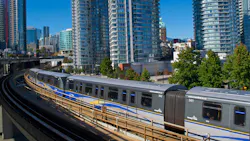
Dynamic testing is underway on the Broadway Subway Project, marking the first time SkyTrain vehicles are operating on the new extension and advancing progress toward a fall 2027 opening.
The Broadway Subway Project will extend the Millennium Line west from VCC–Clark Station to Arbutus Street in Metro Vancouver. Once complete, the extension will provide fast, reliable transit service through one of the region’s busiest corridors, improving access to jobs, education and services.
“Reliable, modern public transit is key to building connected and resilient communities. Today marks the first time that vehicles are operating on the 5.7-kilometer (3.54-mile) Broadway Subway extension, and the start of dynamic testing for the SkyTrains that will call the new guideway home. Our region is growing, and these trains will shape the future of how we move and explore our community,” said Minister of Housing and Infrastructure and Minister Responsible for Pacific Economic Development Canada Gregor Robertson.
The government of Canada notes that once complete, the Millennium Line will have the capacity to move more than three times as many people as the current 99 B-Line, as the trip from VCC-Clark to Arbutus will take 11 minutes, saving the average transit commuter almost 30 minutes a day. Riders will be able to travel on one train with no transfers from Lafarge Lake-Douglas Station in Coquitlam to Arbutus Street in Vancouver in approximately 46 minutes.
The government of Canada notes dynamic testing allows crews to confirm the trains, tracks, signals and communications systems are all working together safely. Different tests will be conducted to ensure that trains have safe clearance, are properly positioned and that signals are working properly. Testing will also examine how multiple trains operate on the tracks at the same time. Initial testing uses driver-operated trains before transitioning to automatic train control.
“The extension will connect to the current SkyTrain network and integrate with the regional bus network in Vancouver, one of our province’s busiest corridors. We need transit that can keep pace. With today’s milestone, we are that much closer to providing just that -- fast, frequent, and convenient transit to jobs, essential services and growing residential communities,” said Parliamentary Secretary to the Minister of Artificial Intelligence and Digital Innovation and Member of Parliament for Vancouver Granville Taleeb Noormohamed.
Testing is being conducted in phases through 2027, beginning at VCC-Clark Station before continuing west towards Arbutus Street. During the first phase of testing, trains will operate at different speeds in both directions along elevated guideway and through tunnels west of Great Northern Way–Emily Carr Station. The government of Canada notes trains will be tested on approximately two kilometers (1.24 miles) of SkyTrain track in the first phase of dynamic testing, including parts of both the eastbound and westbound tracks. During some tests, weight will be added to the trains to simulate passengers.
“Seeing SkyTrain vehicles begin testing on the Broadway Subway extension is an exciting milestone for this project and for the future of transit in Metro Vancouver,” said TransLink President and CEO Kevin Quinn. “This line will give customers a faster, more reliable way to move through one of the busiest corridors in the region while connecting more people to jobs, education, health care and the rest of the transit network.”
Prior to opening day, crews will extensively test the complete system under real-world conditions. According to the government of Canada, during this time period, trains will run all day at normal frequencies, stopping at each of the six new stations as they will once the Broadway Subway extension is open. Track installation is ongoing during testing, and crews are installing the electrical and mechanical systems inside the station that will operate and power the SkyTrain extension.
The government of Canada is contributing C$896.9 million (US$648.4 million) to the project while the government of British Columbia is contributing C$1.96 billion (US$1.42 billion) and the city of Vancouver is contributing $100.3 million (US$72.5 million).