Inside the federal program powering transit rail fleet replacement and domestic manufacturing growth
Every day, America’s transit and commuter rail systems shoulder an enormous responsibility, moving millions of people through their daily routines and connecting communities of every size. Yet beneath this essential service lies a growing challenge: much of the nation’s rail fleet is beginning to show its age. The American Public Transportation Association’s (APTA) 2025 Public Transportation Vehicle Database helps to paint this picture with more than one-quarter of all commuter rail cars, locomotives, heavy-rail vehicles and light-rail equipment in service today being more than 30 years old, representing nearly 6,000 rail vehicles nationwide.
Procuring new railcars is a capital intensive undertaking for transit agencies of any size, but the endeavor is particularly pronounced for small and mid-sized systems with limited state and local funding sources and lower fare revenues, which together restrict their capacity to finance major capital projects. As a result, many agencies keep rail vehicles in revenue service well beyond their intended useful service life, a practice that ultimately drives up maintenance costs and jeopardizes reliability across the entire network.
In 2021, as part of the Infrastructure Investment and Jobs Act (IIJA), Congress, recognizing a growing need to support transit operators accelerate railcar replacements, created the Rail Vehicle Replacement Program, a competitive program providing federal grants to state and local governments to help facilitate rail vehicle replacement. The program complements existing federal formula funding provided to transit agencies, with an emphasis placed on supporting transit agencies with rolling stock that has already or is soon to be past its useful service life.
The five-year authorization provided $1.5 billion in funding, $300 million annually, made available through allocations from the Mass Transit Account of the Highway Trust Fund. To date, funding has been awarded for nine fleet replacement projects across eight states, supporting the production of more than 770 new rail transit vehicles.
While these newer trains will help to modernize transit systems, bringing new capabilities and improved reliability for the riding public, these projects also play a dual role in supporting the domestic railcar manufacturing supply chain. As required by the Buy American Act, 70% of the added value of federally funded rail projects must be produced within the U.S. That requirement, which many throughout the industry exceed, supports a nationwide ecosystem of manufacturers and component suppliers. Railway Supply Institute (RSI) members span every segment of this ecosystem, from wheelset and bogie fabrication to the original equipment manufacturers that integrate components and complete final manufacturing and assembly at facilities located across the country.
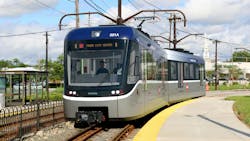
One example is in Cleveland, Ohio, where RSI member Siemens Mobility is currently manufacturing new light-rail vehicles (LRV) for the Greater Cleveland Regional Transit Authority. Supported in part by a $130 million Rail Vehicle Replacement Program grant, the project will fully replace railcars that have been in continuous service for more than 40 years. The project also sustains more than 2,500 jobs at Siemens’ Sacramento, Calif., plant and supports the more than 2,000 suppliers that Siemens partners with nationwide. Cleveland’s LRV replacement is just one of the few currently illustrating how fleet replacement projects generate broader economic activity throughout the economy.
Communities that lack rail service frequently host the facilities where America’s railcars, components and locomotives are manufactured, leading to downstream benefits across the U.S. RSI’s most recent economic impact study highlights the national scale of the rail supply industry, supporting more than 239,000 direct jobs, with each job in rail supply generating an additional 2.9 jobs throughout the economy.
On Capitol Hill, Congress is drafting the next long-term surface transportation bill with funding from IIJA set to expire on Sept. 30, 2026. Relative to IIJA’s total transit authorization, the Rail Vehicle Replacement Program accounts for roughly 1.5% of total funding. While representing a modest portion of overall funding, early outcomes demonstrate meaningful results, modernizing fleets, improving service reliability and bolstering a domestic supply base capable of meeting future demand.
As lawmakers begin to shape the next surface transportation bill, the Railway Supply Institute is continuing to educate policymakers about the program’s role in sustaining reliable transit service and maintaining a strong manufacturing sector. Replacing America’s outdated rail vehicles is a practical and overdue investment. It supports daily mobility in communities nationwide, reinforces the competitiveness of U.S. suppliers and ensures transit systems are prepared for future capacity needs. By pairing fleet renewal with a robust domestic supply base, the U.S. can meet everyday mobility needs while strengthening a manufacturing sector that supports communities nationwide.
About the Author
 Jim Riley
Jim Riley
Jim Riley is the president of the Railway Supply Institute (RSI), a leading trade association representing the full supply chain of the U.S. railroad industry. RSI’s membership spans locomotive, freight and passenger railcar manufacturers; railcar owners and lessors; suppliers of mechanical systems and components; railway measurement and maintenance systems; and communications and signaling technology providers.
Before joining RSI, Riley was with the National Waste & Recycling Association where he served as interim president and CEO, general counsel and senior vice president of government affairs. He previously was senior director of government affairs at the National Stone, Sand & Gravel Association. He holds a bachelor’s degree from the College of the Holy Cross and a Juris Doctorate from the Catholic University of America, Columbus School of Law.