O’Hare Flyer team unveils privately-funded 15-minute battery-electric airport express train plans
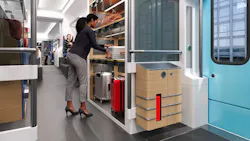
Chicago business and civic leaders have revealed plans to upgrade the airport transportation experience in Chicago with O’Hare Flyer, an effort designed to provide a 15-minute ride from Chicago’s downtown loop to O’Hare Airport’s Terminal 2 on a dedicated track, with departures every 15 minutes.
“O’Hare Flyer will connect our world class downtown with our world class airport in 15 minutes,” said O’Hare Flyer Founder and CEO Dave Lundy. “This is a first-of-its-kind express train in the U.S. and will give Chicago a safe, reliable, world-class rider experience on a fast, whisper-quiet battery-electric train.”
Designed for travelers, O’Hare Flyer aims to provide concierge-level service on trains with seats designed for comfort and luggage racks in every car. The train will run on continuous rail and recharge at its downtown station near the Old Post Office and at its Terminal 2 O’Hare station.
“This is an important first for Chicago and for the country. O’Hare Flyer will build on Chicago’s heritage as America’s rail capital and center of innovation,” said O’Hare Flyer Founder and Chief Engineering Officer Mark Walbrun. “By combining three existing but underused freight rights-of-way into a dedicated express rail service, we will create the best airport transportation experience in America—and one of the best in the world.”
Over the last three years, with the O’Hare Flyer project in exploratory development, the project team has built up a platform of partners and service providers, with most based in Chicago. These partners include engineering, law, architecture, urban planning, design, marketing and public relations firms. Two of the big four accounting and consulting firms are also supporting the project.
“For decades, Chicago’s economic and political leaders have dreamt about a fast connection between O’Hare and downtown because it is economic development rocket fuel,” said O’Hare Flyer co-founder Kristi Lafleur. “This quiet, pollution-free electric train will attract visitors and more businesses to downtown and the region. It is also important and noteworthy that it will be led by and for Chicagoans.”
Lundy also noted that the project team would work to ensure the economic benefit of the project was felt directly in the region it was designed to serve, including through working with local partner entities to ensure that local contractors have an opportunity to participate. Further, he says the project team values the role that organized labor plays in Chicago’s economics and says the organization looks to “executing a Project Labor Agreement with the Chicago and Cook County Building and Construction Trades Council.”
O’Hare Flyer will run on freight rail right-of-way owned by three class one railroads: CSX, Canadian National (CN) and Union Pacific (UP). The O’Hare Flyer has reached agreement on terms, memorialized in a Letter of Intent with CSX and is moving forward with the other carriers as well.
Going towards the airport, trains would start moving south and turn west near Roosevelt Road, where swap between a mixture of CSX and UP rail lines before reorienting north on CN tracks, which would gain an additional dedicated track to support the service.
“CSX is pleased to work with the O’Hare Flyer team to support a safe and reliable transportation option for Chicago travelers,” said CSX Senior Director of Passenger Operations Andy Daly.
While the project has a tentative agreement with CSX, the CN and UP agreements have not been finalized, though host a “pathway to ‘Yes’,” according to Lundy—as reported by the Chicago Sun Times.
O’Hare Flyer is a private endeavor. The project is not seeking government subsidies or funding that could otherwise go to regional transit agencies such as the Chicago Transit Authority or Metra. The project, according to the Sun Times report, hosts a price tag of $2.25 billion, which the organization says would be primarily commercially funded—though it hasn’t shared how much it’s already raised.
“O’Hare Flyer will be a job creation engine and an investment in working families and communities across Greater Chicago,” said Chicago and Cook County Building and Construction Trades Council President Mike Macellaio. “Our [Memorandum of Understanding] is an important first step toward a Project Labor Agreement that will help ensure this landmark project is built by Greater Chicago’s highly skilled unionized construction workforce while expanding opportunities for local workers and delivering lasting economic benefits throughout the region.”
With an objective to launch the project within the next five years, the O’Hare Flyer team is now meeting with public officials, business, finance, government and community groups and will be expanding outreach throughout the region in the months ahead.
“O’Hare is one of Chicago’s greatest assets and a major competitive advantage in our ability to attract businesses, workers, investment and visitors from around the world," said Chicagoland Chamber of Commerce President and CEO Jack Lavin. "O’Hare Flyer will be a gamechanger, creating a faster, more reliable connection between the airport and downtown, making it easier to do business in Chicago and strengthening our position as a premier destination for corporate headquarters, conventions and tourism.”
According to Lundy, the project could be complete in five years, with preliminary construction beginning next year, if the requisite approvals and community engagement processes are complete in a timely manner.
About the Author
 Noah Kolenda
Noah Kolenda
Associate Editor
Noah Kolenda is a recent graduate from the Craig Newmark Graduate School of Journalism with a master’s degree in health and science reporting. Kolenda also specialized in data journalism, harnessing the power of Open Data projects to cover green transportation in major U.S. cities. Currently, he is an associate editor for Mass Transit magazine, where he aims to fuse his skills in data reporting with his experience covering national policymaking and political money to deliver engaging, future-focused transit content.
Prior to his position with Mass Transit, Kolenda interned with multiple Washington, D.C.-based publications, where he delivered data-driven reporting on once-in-a-generation political moments, runaway corporate lobbying spending and unnoticed election records.