FRA awards $5.3 billion in National Railroad Partnership Program funding
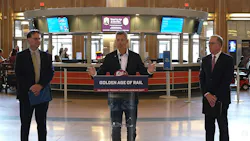
The Federal Railroad Administration (FRA) has awarded $5.3 billion in National Railroad Partnership Program funding to support 41 rail projects in 23 states across the U.S. that will enhance safety, upgrade critical infrastructure and purchase new trainsets for Amtrak.
In total, the $5.3 billion grant package will:
- Close over 30 grade crossings and upgrade over 1,000 more with new infrastructure and technology.
- Purchase 43 trainsets to replace Amtrak’s aging fleet in high-demand corridors.
- Overhaul 41 locomotives currently serving Amtrak’s Midwest and Pacific routes.
FRA says the funding places a significant emphasis on targeting "high risk" crossings for closure and replacement, which are those with a documented accident history of three or more incidents and/or two or more fatal incidents during the past five years. Grade crossings—intersections where roads cross railroad tracks at-grade—are the second leading cause of rail-related deaths in the U.S., as nationally, more than 2,000 incidents and 200 fatalities at grade crossings occur each year.
Examples of projects that were rewarded funding include:
- Seven projects that will improve service for Amtrak State Supported Service and Long Distance routes around the U.S.
- The city of Cocoa, Fla.,'s Cocoa Multimodal Station and Rail Project to help bring passenger rail service directly to the Space Coast.
- The Massachusetts Bay Transportation Authority's (MBTA) Haverhill Commuter Rail line project.
Amtrak funding
Amtrak’s State Supported Service Line includes 32 routes sponsored by state departments of transportation or other rail authorities and operated by Amtrak. The company notes the short routes provide a critical connection between cities in a region. The Long Distance Service Line operates 15 long-distance trains, most of which operate overnight, feature sleeping cars and connect towns, cities and major urban areas across routes that extend more than 750 miles.
The funding covers:
- $2 billion for the acquisition of up to 43 new trainsets and associated improvements. The new trainsets will help replace legacy equipment that is at the end of its service life on State Supported services in multiple states, as well as grow Amtrak’s fleet to enable additional locally-sponsored routes. The trains will be fully built in the U.S. with nearly 100 suppliers in 31 states.
- $659 million in funding for Maintenance Facility Modernization and Viaducts in the Chicago region, Amtrak’s Biggest Long Distance Hub.
- The relocation of maintenance facilities from the 14th Street Yard to the Canal Street Yard, which Amtrak says will improve the efficiency of its Midwest Maintenance facilities while supporting anticipated ridership growth.
- The rehabilitation of more than a dozen aging viaducts, bridges and ancillary structures at the new Midwest Maintenance Facility.
- $37.2 million for the Chicago River Bridge Project for Amtrak, Metra, Freight and Maritime Service.
- Extending the useful life of the existing South Branch Bridge and developing plans for a future bridge replacement. Amtrak notes that the current bridge is over 110 years old with significant reliability issues and maintenance needs that will be addressed in this rehabilitation. The project will support Amtrak, commuter and freight rail traffic over the Chicago River.
- Amtrak and CSX will improve the long-distance passenger rail experience in South Carolina with the replacement of 31 miles of track at the end of its life, installation of 3,500 feet of bypass track and additional work to bring infrastructure supporting several Amtrak services into a state of good repair. This project will also create dedicated station tracks for the Florence Station.
- Track improvements near Havre and Lohman, Mont., will increase reliability and reduce passenger service delays.
- New onboard shunt enhancement devices for Amtrak’s rolling stock will improve train system reliability and safety protections for all 32 state-supported routes and all of Amtrak’s 15 long-distance routes.
Over the past year, Amtrak has advanced several projects funded by the FRA. In July, Amtrak awarded contracts to begin major rehabilitation of Dock Bridge in New Jersey. Amtrak and New Jersey Transit partnered on the Portal North Bridge, which recorded its first passenger service in March. In Boston, Amtrak broke ground on Southampton Rail Yard, a modern facility that will support the new Airo fleet when it enters service in late 2027.
"Thanks to these new grants and continued support from [U.S. Department of Transportation] Secretary [Sean] Duffy and [FRA] Administrator [David] Fink, Amtrak is investing in vital projects that will drive economic growth, create jobs and improve and expand rail service for millions of Americans,” said Amtrak Interim President Byl Herrmann.
Cocoa Multimodal Station and Rail Project
Brightline says the $57.5 million in funding awarded for the project marks the culmination of a decade-long shared vision to bring high-speed passenger rail directly to Brevard County, Fla. Brightline trains currently operates passenger rail service right through the heart of the Space Coast, connecting Orlando International Airport to Miami along the Florida East Coast Railway tracks.
The city of Cocoa and the Space Coast Transportation Planning Organization (SCTPO) have a long history of supporting the relaunch of passenger rail in Florida. In 2016, in response to Brightline’s private endeavor to provide higher-speed rail service, the SCTPO conducted an initial Station Location Analysis. Building on that foundation, the SCTPO completed a formal Intermodal Feasibility Station Study in October 2024. The study zeroed in on intermodal connectivity, estimated travel demand, prepared station area concept plans and conducted a “Shape Your Station” survey, which reinforced strong community support for passenger rail in the Space Coast region.
"This is a transformational moment for the city of Cocoa and the entire Space Coast," said Cocoa Mayor Michael Blake. "This station in Cocoa will serve as a catalyst for economic growth, increased tourism and expanded transportation options for residents and visitors alike. The Space Coast will no longer be a pass-through for passenger rail. This is an investment in our community’s future and a milestone that will benefit generations to come."
The total combined capital investment will be directly utilized to build out the following infrastructure components:
- Station infrastructure: Final design and construction of a brand-new, in-line passenger station featuring family-friendly amenities. On-site circulation and parking facilities will be developed on land already owned by the project partners to optimize resource management.
- Track and rail optimization: Laying approximately four additional miles of double track and installing all necessary rail infrastructure within the existing corridor to ensure smooth, efficient passenger operations.
- Station construction and operations: Brightline Trains will partner with the city of Cocoa to construct the station. Brightline will maintain and operate the new Cocoa station.
“Brightline is thrilled to partner with the city of Cocoa and the SCTPO on this monumental step forward for Florida’s transportation infrastructure,” said Brightline Florida CEO Patrick Goddard. “From the moment we launched our Orlando expansion, the Space Coast has been an important part of our vision. This grant is a testament to the power of public-private collaboration, and we look forward to building, operating and welcoming passengers to a world-class station that connects Brevard County to the rest of the state.”
Haverhill Commuter Rail line project
The $139.6 million in funding will support the final design and construction of the Haverhill Double-Track Project, a major upgrade project that will add approximately 6.8 miles of new track between Reading and Andover, Mass., to allow trains traveling in opposite directors to keep moving instead of waiting for one another. The project will also upgrade four stations in Reading, North Wilmington, Ballardvale and Andover with high-level platforms, to make those stations more accessible and will modernize signals to improve safety at 15 rail crossings.
“Since taking office, we’ve made historic investments to turn the MBTA around, and riders are seeing the difference with fewer slow zones and more reliable service,” said Massachusetts Gov. Maura Healey. “Now we’re keeping that momentum going. This $140 million award will help us make major improvements to the Haverhill Line that mean fewer delays, safer and more accessible stations and better service for riders. We’re grateful to our federal delegation for helping us bring this funding home to Massachusetts.”
The MBTA notes that parts of the Haverhill Line have only one track, which means a train sometimes has to wait for another train traveling in the opposite direction to pass. If there is a problem with a train or the track, that single-track section can also cause delays to ripple across the line. Approximately 10 miles of new fencing will also be installed along the corridor between Andover and Reading to help prevent unauthorized access to the tracks.
The improvements will benefit not only MBTA Commuter Rail riders but also Amtrak’s Downeaster service, which operates between Boston and Brunswick, Maine and CSX freight service. By removing delays and increasing capacity, the project will strengthen passenger and freight rail connections throughout the region and support future improvements to rail service.
“This $140 million investment is not only going to make major safety, reliability and accessibility impact along the Haverhill Commuter Rail Line, but it will also directly support Amtrak Downeaster operations and freight rail,” said Massachusetts Department of Transportation (MassDOT) Interim Secretary and MBTA General Manager Phillip Eng. “New double track gives us more operational flexibility and the ability to decrease commute time along the line. Upgrading four stations with high-level platforms is another step closer to a fully accessible MBTA system and modernizing our signals will help to move trains more safely and reliably through the intercity area. Improving freight allows for more efficient movement of goods and helps to control costs for the public. I’m grateful for the leadership of Gov. Healey to make these continued improvements possible and for our Congressional Delegation, MassDOT and the MBTA for advocating for this funding with the foresight that it will have benefits for decades to come. I also want to thank the Federal Railroad Administration for their partnership and ability to move this project forward and through construction."
About the Author
 Brandon Lewis
Brandon Lewis
Associate Editor
Brandon Lewis is a recent graduate of Kent State University with a bachelor’s degree in journalism. Lewis is a former freelance editorial assistant at Vehicle Service Pros in Endeavor Business Media’s Vehicle Repair Group. Lewis brings his knowledge of web managing, copyediting and SEO practices to Mass Transit magazine as an associate editor. He is also a co-host of the Infrastructure Technology Podcast.