Gov. Hochul awards $1.75 billion for MTA system modernization, accessibility upgrades
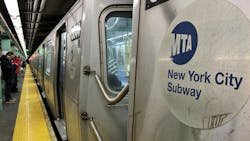
New York Gov. Kathy Hochul announced the advancement of $1.75 billion in transit projects for the Metropolitan Transportation Authority (MTA), designed to modernize the subway system and funded by revenue generated by congestion pricing. The MTA Board gave its approval for a design-build contract to modernize subway signals on the A and C lines in Brooklyn and Queens, advancing a significant upgrade to service reliability in the system.
The MTA Board also approved accessibility upgrades to five subway stations, including the major complex at 42 St-Bryant Park, which serves 111,000 daily riders on the 7, B, D, F and M lines.
“Nearly one year in, congestion pricing has already sped up traffic and cleaned our air, and now it is supporting generational upgrades to our subway system,” Hochul said. “We've already shown what we can do when we support transit — ridership continues to climb and subway performance is at record highs. When these projects are completed, hundreds of thousands of riders will benefit from even more reliable and accessible service thanks to these significant investments.”
The project will bring Communications-Based Train Control (CBTC) to the Fulton Street Line in Brooklyn and the Liberty Avenue Line in Queens between Jay Street-MetroTech and Ozone Park-Lefferts Blvd stations. The upgrade replaces century-old legacy signal systems that date back to the line’s opening in 1936. It will also repair and replace switches, install upgraded tunnel lighting and run cabling to support the deployment of cellular service through the tunnels.
More than 600,000 daily riders across the A and C trains will see substantial upgrades to reliability, faster travel speeds and better service upon the project’s completion. Previous CBTC installations on the 7, L and Queens Boulevard (E, F, M, R) lines have had improvements to on-time performance and train speed increases of up to 10%, all while upgrading operations and safety systems.
“Almost one year since implementation, the list of improvements funded by congestion pricing keeps growing. These latest projects mean that riders on the A and C will get faster and more reliable service and less time being delayed by old signals,” said MTA Chair and CEO Janno Lieber.
CBTC-centric projects are now more than 33% cheaper per mile than prior projects, a breakthrough for the MTA as it continues its plans to modernize signals throughout its system. Further funding from congestion pricing will be put toward upgrading the signals on the 6th Avenue Line carrying the B, D, F and M, while the 2025-29 MTA Capital Plan includes CBTC upgrades on eight lines and over 75 miles of track.
The project is being delivered as a bundle of two different subway segments. The Fulton Street Line, running from Jay Street-MetroTech in Brooklyn Heights to Euclid Avenue in East New York, is funded as part of the MTA’s 2020-24 Capital Plan and is made possible by Congestion Relief Zone revenues. The Liberty Street Line, running from Euclid Avenue to Ozone Park-Lefferts Boulevard in Ozone Park, is funded as part of the 2025-29 Capital Plan.
This project advances as the MTA adds more R211 subway cars to the A and C lines. All R211 come equipped with technology that works with CBTC signals, leading to a better overall commute for millions of daily riders — including more reliable service, fewer delays, more frequent trains and less waiting.
Upcoming accessibility upgrades at subway stations
Two contracts were also awarded as part of the announcement to deliver accessibility upgrades to five more subway stations, continuing the MTA’s rapid pace to make the system more accessible.
This includes ADA Package 9 at three stations in Queens and Brooklyn:
- Parsons Blvd F
- Briarwood E, F
- Gates Avenue J, Z
The other package will make the Bryant Park-5 Av Complex in Manhattan fully accessible:
- Bryant Park-42 St B, D, F, M
- 5 Avenue 7
These five upgrades will bring the total number of ADA-accessible stations awarded this year to seven. They are part of the 23 stations that will ultimately be made accessible through Congestion Relief revenues.
Since 2020, the MTA has completed accessibility upgrades at 39 stations. With these new awards, another 39 stations are now under construction. The 2025-29 Capital Plan includes funding to make an additional 60 subway stations accessible in the coming years. Currently, there are 154 total accessible subway stations.