Assessing Generative vs. Discriminative AI in Rail Preventive Maintenance
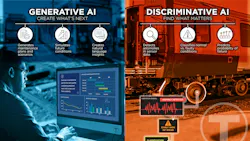
Despite immense universal interest and investment (up to $2.5 trillion in 2026, a 44% increase since 2025) in artificial intelligence (AI) technology globally, successful implementation of AI tools has been comparatively low in passenger and freight rail, as well as in public transit agencies. Prior to implementation, it’s imperative to understand the differences between generative and discriminative AI and advantages of each within the context of the rail industry.
AI tools have a history of research
Preventive maintenance requires a proactive approach to ensure that equipment can run smoothly, avoiding the high costs and disruptions of unplanned breakdowns. It complements reactive maintenance, which addresses a defect only after it occurs. Contrary to some preconceptions, there are many advantages to using the latter in the context of the rail industry. If the criticality of the failure is low, or if there are no associated significant safety risks, or it is relatively straightforward to address the issue after it occurred, a reactive approach may be the optimal path forward. However, preventive maintenance quickly becomes the preferred, and aspirational, option if the failure will result in significant disruption, safety incidents, long lead times for replacement parts or substantial labor burden. It is not surprising then, that AI applications for preventative maintenance are and should be a major priority.
According to Research and Markets Railway AI Market Report 2026, the total market size for railway AI is expected to grow from $3.5 billion to over $6 billion over the next four years. Unsurprisingly, a significant portion of this value can be attributed to preventative maintenance. At the same time, according to McKinsey’s report, The Journey Toward AI-enabled Infrastructure, out of the companies researched for their AI usage, only “25% of companies have implemented multiple use cases at scale and roughly 35% of companies have one or two use cases at scale, with other use cases being in pilot stage.” These reports illustrate that while the market is showing rapid expansion and potential, the number of players actively using AI systems is still relatively low. Regardless of a specific AI solution, both the incumbents and the new players should take this opportunity to allocate time and resources to explore what AI options are most worth pursuing.
Use cases of discriminative and predictive AI
The passenger rail industry should consider what types of AI applications have existed for preventative maintenance for track and rolling stock and where the industry is going next. The distinction between discriminative and predictive versus generative AI becomes very important. Discriminative AI and predictive AI tools rely much more on conditionality-driven probability distributions, and their outputs provide accurate representations of reality in a very specific context, as well as some conditional estimation or forecasts for the same context. The question it would be best suited to answer is: Given a certain set of parameters, what is most likely to happen?
An example of discriminative AI application in maintenance was discussed in “A Big Data Analysis Approach for Rail Failure Risk Assessment” (2017), which discussed a “new image processing approach for automatic detection of squats, especially severe types that are prone to rail risks.” It proposed a methodology that combines ultrasonic measurement technology and images taken by cameras. The images are processed by Deep Convolutional Neural Network (DCNN), analyzed and findings communicated to the users. Similarly, “Research on deep learning method for rail surface defect detection” (2020) discusses a new video analysis technology combined with advanced object detection algorithms based on DCNNs and offers an additional layer of object detection algorithm to boost efficiency for evaluating the severity of track issues due to corrugation, fatigue block and stripping off block.
These examples illustrate that discriminative and predictive AI tools are exceptional at predicting outcomes, classifying scenarios, detecting issues and risks, forecasting possible delays on the system and estimating maintenance needs. It also shows that discriminative and predictive AI is not new and has been explored for years. The obvious limitation of well-trained discriminative AI, however, is that while it can marginally improve with more training, or better quality data, its output will always be specific to the problem and task at hand. In the example given above, users would not be able to freely ask a discriminative AI tool to assess the pros and cons of this approach of squat analysis to what has been attempted by other teams or organizations and to generate an analysis suggesting further reading or inquiry.
Generative AI’s role in rail maintenance
Generative AI has different goals, so its output is also different. Those who have used any modern generative AI tools (Anthropic’s Claude, OpenAI’s ChatGPT, Google's Gemini, Microsoft's Copilot or Perplexity AI) know that at the very basic level, you can ask the generative AI agent a question, and it will generate some sort of answer or output for you. To be able to produce useful and good quality outputs, these models not only learn on an unfathomable amount of data, but also rely on joint probability as part of their learning and output process. By removing the conditionality and modeling most likely output continuations based on the large amounts of observed data, generative AI has a lot more freedom to consider a wide range of parameters and generate outputs that reflect more variables.
Instead of specific detection or probability of a certain event (which is what we would expect from discriminative AI), generative AI can suggest a set of critical improvements and expansion of the U.S. passenger rail network over the next 10 years or generate a comprehensive set of new and improved rolling stock maintenance procedures. In the preventative maintenance context, generative AI can be used for standard operating procedure summary generation; training video generation based on either SOPs or training materials; and track and rolling stock inspection report generation that would combine video, image and voice of inspectors into a single document.
There have been some examples of successful utilization of generative AI for these purposes. SNCF, the French rail operator, stated that predictive maintenance is a perfect example of a good area of application of generative AI, leveraging Internet of Things sensors on the rolling stock to significantly reduce downtime. Deutsche Bahn implemented BahnGPT in early 2025, with specific highly specialized individual applications in rail operations and maintenance. The McKinsey report gives several examples of generative AI uses, including maintenance co-pilots, service scheduling and, in some nascent cases, network infrastructure digital twins.
There are several drawbacks associated with generative AI systems, but the biggest ones are sycophancy, hallucinations and knowledge cutoff. Sycophancy, or the willingness of generative AI agent to agree with the user even when the user is clearly wrong, is a strong limitation when it comes to preventative maintenance, where model correctness has a significant premium.
When it comes to AI hallucinations in highly technical fields, it becomes a much bigger issue and even in the most modern models, this problem is still present (albeit, to a much smaller extent). Knowledge cutoff, while applicable to both generative and discriminative AI, is also important in this context. It means that the model only learns from the data that it has been presented with, so if it does not continuously learn new data, its output will become obsolete. If a new portion of the track has been built or an old fleet of rolling stock retired, but the AI has not learned that yet, it will continue to provide confident responses that are now false. While this is a non-issue for modern LLMs, which are retrained continuously, it might be a critical oversight for a rail organization trying to build new capability without a re-training procedure for its AI tools.
Moving Beyond Predictive AI
There are several accounts of the rail industry adopting and using discriminative and predictive AI models successfully, and this trend is all but certain to increase in the future. Generative AI applications are much less common but are also growing. While this is a positive sign, it is not enough. To successfully adopt AI enterprise-wide solutions with emphasis on rolling stock and track predictive maintenance, a more aggressive approach needs to be taken.
The most successful organizations will champion selective applications of discriminative and generative AI models, utilizing the former for detection, categorization and analysis of faults and risks and building with the latter to produce informed recommendations and plans for seamless execution of predictive maintenance programs. Pioneering AI leaders will be expected to take a step further, investing heavily in agentic AI functionality that would leverage both elements of AI to deliver the most robust tools and processes to elevate rail industries to a new level.
About the Author
 Nikita Chuyko
Nikita Chuyko
Director of Right-of-Way Diversion Planning and Integration at the Massachusetts Bay Transportation Authority
Nikita Chuyko is an international operations and transformation leader with more than a decade of experience driving complex, large-scale initiatives across public transit, aerospace and marine sectors. Known for building organizations from the ground up and navigating highly regulated environments, Chuyko brings a rare combination of strategic vision, operational rigor and stakeholder-centered leadership.
He currently serves as director of right-of-way diversion planning and integration at the Massachusetts Bay Transportation Authority (MBTA), where he founded a new department responsible for strategic planning and governance of all planned rail service outages on heavy and light rail. He joined MBTA as Harvard Business School Leadership Fellow in 2022. His work has resulted in significantly improved planning timelines, a significant reduction in canceled outage requests and millions of dollars in annual savings while advancing compliance with federal and state regulators.
Previously, he held senior leadership roles at Rolls-Royce plc in the UK, Europe and Asia, where he led global operations, post-merger integrations and agile transformations. His career also includes experience at Danaher Corporation and Boston Consulting Group.
Chuyko earned a Master of Arts with First Class Honors in Philosophy and Economics from the University of Edinburgh. He later earned an MBA with Honors from Harvard Business School, focusing on general management, operations, finance and negotiations.