Maryland Gov. Moore unveils Baltimore Region TOD Strategy
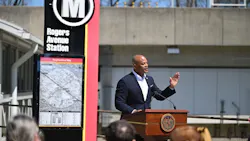
On April 6, Maryland Gov. Wes Moore unveiled the Baltimore Region Transit-Oriented Development (TOD) Strategy, which will advance TOD across the Baltimore region in an effort to grow the state’s economy and lower housing prices. The governor also revealed the first step toward securing a development partner to develop the North parcel of the Rogers Avenue Metro Station.
“We have said from the beginning that if this is going to be Maryland’s Decade, it has to be Baltimore’s Time,” said Gov. Moore. “Part of making that real means making sure our investments in Baltimore’s metro and light-rail system lead to opportunity—opportunity to live near transit, opportunity to strengthen communities near transit and opportunity to create work, wages and wealth near transit. That is what it means to leave no one behind.”
The Maryland Transit Administration (MTA) is advancing the nearly $1.4 billion light-rail modernization program, which includes modernizing the Baltimore Central Light Rail Line from Hunt Valley to BWI Thurgood Marshall Airport with new, modern, low-floor vehicles and upgrades all the light-rail stations, systems and maintenance facilities.
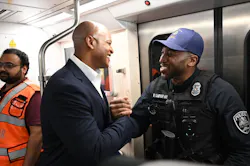
Gov. Moore, Baltimore Mayor Brandon Scott and state transportation officials also experienced the city’s new metro subway cars on a ride from Rogers Avenue to Charles Center. The $400 million investment secured by Maryland’s congressional delegation supports the purchase of 78 new rail cars and an upgraded communications system that improves reliability and on-time performance.
“For generations, restrictive housing and transportation policies were intentionally used to limit opportunity and investment in so many of our neighborhoods. Today, the opposite is true,” Scott said. “Working with the state and public and private partners, we are intentionally anchoring housing projects near transit—just as we envisioned in Our Baltimore, a comprehensive development plan for the city. This strengthens our communities, attracts new residents and creates opportunity for local businesses as we continue to drive Baltimore’s Renaissance forward.”
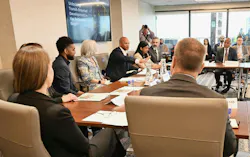
Following the subway ride, Gov. Moore convened a roundtable in partnership with the Greater Baltimore Committee and Greater Washington Partnership, who jointly lead Baltimore’s Transit Future—a coalition of business and civic leaders advocating for regional transportation investment. Elected officials and business leaders from across the Baltimore region discussed the importance of working in partnership to advance TOD and connect Marylanders to economic opportunity.
During the roundtable, the governor expressed the need for partnership between the state, localities and businesses to fully realize TOD’s potential impact—including over 5,000 new housing units and almost $1.4 billion in state and local tax revenue from developing state-owned land alone.
“As a civil engineer, I’ve seen how infrastructure shapes opportunity,” said Maryland Lt. Gov. Aruna Miller. “Transit-oriented development is how we make that opportunity real—building communities where people of all abilities can live, work and thrive, all within reach.”
Local elected officials and business leaders also received a briefing on the Maryland Department of Transportation (MDOT)’s Baltimore Region TOD Strategy. The strategy was built through partnership and engagement with local partners and is a roadmap for increasing new investment and development around Baltimore’s metro and light-rail network. The strategy identifies key policy and financial tools, offering an actionable vision for how the state, local jurisdictions and private partners can work together to create vibrant, walkable communities near transit while expanding housing options, generating jobs and connecting residents to opportunities across the region.
“Realizing transit-oriented development on state-owned land will be a catalyst for development across the Baltimore region,” said MDOT Secretary Katie Thomson. “Transit-oriented development expands housing options and grows our economy. We’re pleased to bring Gov. Moore’s vision to fruition and work with local communities, elected leaders and businesses to transform the areas around transit stations into more vibrant and better-connected communities.”
MDOT issued a request for qualifications for a joint development opportunity at the Rogers Avenue Metro Station. The effort aims to develop nine acres of state-owned land currently being used for a parking lot. The project will aim to turn the parking lot—which generates neither state nor local tax revenue—into an asset that increases transit ridership, increases housing supply, maximizes the return on state transportation infrastructure investment and supports local community needs
“Transit-oriented development puts transit at the heart of our communities and creates vibrant, walkable spaces where people can live, work and connect,” said MTA Administrator Holly Arnold. “By aligning development with our transit investments we are expanding access and growing economic opportunity.”