House, Senate Appropriation Committees reveal bipartisan 2026 THUD Act
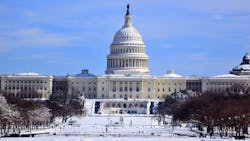
The U.S. House and Senate Appropriations Committees have released a bipartisan fiscal year (FY) 2026 Transportation, Housing and Urban Development (THUD) Appropriations Act draft as part of the Consolidated Appropriations Act of 2026.
This drafted act delivers most of the funding that transit advocates were calling for, putting forth the majority of public transit and passenger rail spending outlined and authorized in the Infrastructure Investment and Jobs Act (IIJA).
The THUD Act delivers $21.1 billion for public transit for FY 26—an increase of over $160 million from FY 25—as well as $15.9 billion for passenger and freight rail—a decrease of just shy of $300 million from FY 25.
Public transit funded mostly to IIJA-authorized levels
Between the new act and the IIJA, public transit would receive $21.1 billion in funding, $1.2 billion short of the amount authorized in the IIJA for the period.
The funding provides $3.3 billion for Capital Investment Grants (CIG) program, a figure over $500 million short from 2025 funding levels. The funding is set to support 21 projects laid out in the Joint Explanatory Statement that’s paired with the legislation. The dollars also come with a new set of rules that forces the Federal Transit Administration (FTA) to dole out project funds within 120 days of the enactment of the act and makes it so the FTA can’t alter award amounts by more than 10% of the stated need.
The THUD Act also fully funds the public transit contract authority outlined in the IIJA, totaling $14.6 billion. These funds go toward FTA formula and bus competitive grant awards.
The act also provides funding for 2026 FIFA World Cup host cities to plan and operate public transit services during the matches. The more than $100 million in funding for the undertaking is being divvied out via a formula that considers the number of matches being hosted in a city and the seating capacity of the host venues. Additionally, another $94.3 million has been earmarked to support transit for the 2028 Olympic and Paralympic games in Los Angeles.
Other appropriations made in the act include:
- Safety and security funding: $15 million for costs incurred to improve safety and security on transit and reduce crime. These funds will be delivered to the 10 public transit agencies in the country with the highest ridership rates noted for FY 24.
- Congressionally directed spending: Nearly $150 million for public transit projects earmarked from members of Congress for funding projects in their home state.
- Ferry grants: $25 million under the Urbanized Area Program to support both low- and zero-emission ferries, as well as ferry services in rural communities.
- Bus testing facility: $1.5 million for the operation and maintenance of bus testing facilities for safety and reliability testing of new stock.
- Accelerating Innovative Mobility initiative funding: $2 million in funding to test and advance new service delivery models and integrated payment solutions for transit.
- Tribal transit funding: Under the highways and bridges portion of the act, $200 million of funding is being delivered for the Tribal transportation program.
The act also includes some rule updates, including the blocking of the Rostenkowski Test—a rule that says the federal government can’t spend more out of the Highway Trust Fund than it expects to bring in from gas taxes and other like revenue—that could have led to automatic, across-the-board cuts to public transit agency funds. Further, the act disallows the U.S. Department of Transportation (USDOT) from stopping projects that seek a CIG share of more than 40%. Finally, the act made it so the USDOT could no longer enforce any COVID-19 related mask mandates.
Passenger and freight rail funding sees significant dip from IIJA-authorized levels
The THUD Act would advance $15.9 billion for passenger and freight rail in FY 26, a $5.1 billion drop from the amount authorized by the IIJA.
The funding delivers $1.6 billion for Amtrak National Network grants, and $850 million for the Northeast Corridor, though the overall figure is a decrease of $1 million from the funding levels of FY 25.
Other passenger and freight rail grants awards and adjustments include:
- An additional $65 million to the IIJA-authorized $7.2 billion for the Federal-State Partnership for Intercity Passenger Rail grants.
- $137 million for Consolidated Rail Infrastructure and Safety Improvement grants (CRISI), $87 million of which is already set aside for specific CRISI projects while also updating the guidelines to include that commuter rail projects that use or implement positive train control systems can tap these funds.
- $5 million to go to the Union Station Redevelopment Corporation to rehabilitate and repair the Washington Union Station complex.
- The act also rescinds $928.6 million for high-speed and intercity rail from the Capital Assistance for High-Speed Rail Corridors and Intercity Passenger Rail Service account that was funded in 2010.
Other changes and recissions were made in the act regarding passenger and freight rail, including the emptying of the Railroad Research and Development account of its $1 million balance and the Railroad Safety Grants account of its near-$800,000 balance—both permanent cuts according to the bill text.
The act also would bring new rules for Amtrak, including the prohibition of using its funds to discontinue or substantially alter any long-distance route operated in FY 18. Further, it mandates that Amtrak can’t reduce the number of uniform officers below May 1, 2019, staffing levels with the funding. Finally, the act would cap the amount of overtime the funds can be used for paying out to a maximum of $35,000 per individual employee unless needed for emergency situations approved by the president of Amtrak.
Initial reactions
The act, which is bipartisan and bicameral, garnered mostly positive reactions—at least when it came to public transit. While compromises were made from initial versions in either chamber, comment from the House Majority Appropriations Committee Chair Rep. Tom Cole (R-OK), the chamber that sought lower funding levels in its version of the act, speaks positively of the package.
"With 250 years behind us, we’ve forged the greatest volunteer military in the world, transformed transportation through the Interstate Highway System, supported breakthroughs like unlocking the genetic code and transformed security preparedness across domains," Rep. Cole said in part in a statement alongside the package release. "These bills recognize that legacy and the obligation to carry it forward. It reflects the core tenets of American strength: combat-ready forces, secure communities, effective education and health systems and modern transportation. At every level, it applies innovation and discipline to deliver results without waste."
On the Senate side, Senate Minority Appropriations Committee Vice Chair Sen. Patty Murray (D-WA) says that while the package falls short of all the goals the Senate had, it “invests in working people” and staves off “extreme cuts” that would’ve raised costs while reasserting Congressional authority.
“[This package] makes major new investments to keep people safe while flying—and delivers vital funding to improve America’s roads, bridges, railroads and public transit,” Sen. Murray said in part in a statement. “Each of these bills reassert Congress’ power of the purse and ensure that Congress, not President [Donald] Trump and Russ Vought, decide how taxpayer dollars get spent—by providing hundreds of specific spending directives that the executive branch must follow.”
While the Chair of the Senate Appropriations Committee Sen. Susan Collins (R-ME) didn’t release a comment alongside the act, she said last week that she planned to get the legislation passed.
“Our goal is to get all of these bills signed into law,” Sen. Collins said last week to Politico. “No continuing resolutions that lock in previous priorities and don’t reflect today’s realities. No more disastrous government shutdowns that are totally unnecessary and so harmful.”
As for public transit associations, the reactions were high spirited, echoing the sentiment of Murray that while they weren’t exactly what was hoped for, the act was strong. American Public Transportation Association President and CEO Paul Skoutelas says the act provides certainty to the industry.
“This bipartisan agreement is a strong affirmation that public transit and passenger rail are essential national infrastructure,” Skoutelas said in a statement. “It provides funding certainty that allows public transit agencies to continue investing in capital projects, safety and reliable service that millions of Americans rely on every day.”
Skoutelas continued, explaining that every $1 invested in public transportation outputs approximately $5 in long-term economic value while pointing out that nearly 80% of the federal investment in public transit flows to the private sector, supporting American manufacturing and supply chains and creating jobs.
The House has voted to advance the package with a vote of 341-88. The Senate is expected to take up the act next week ahead of the Jan. 30 deadline to keep the government funded and avoid another shutdown. Mass Transit magazine will continue to follow the act and provide updates as it advances through the legislative process.
About the Author
 Noah Kolenda
Noah Kolenda
Associate Editor
Noah Kolenda is a recent graduate from the Craig Newmark Graduate School of Journalism with a master’s degree in health and science reporting. Kolenda also specialized in data journalism, harnessing the power of Open Data projects to cover green transportation in major U.S. cities. Currently, he is an associate editor for Mass Transit magazine, where he aims to fuse his skills in data reporting with his experience covering national policymaking and political money to deliver engaging, future-focused transit content.
Prior to his position with Mass Transit, Kolenda interned with multiple Washington, D.C.-based publications, where he delivered data-driven reporting on once-in-a-generation political moments, runaway corporate lobbying spending and unnoticed election records.