New report finds Massachusetts’ fare share funding positive impact for public transit, but more funding needed
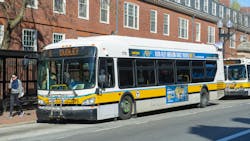
A new report by the Transportation for Massachusetts (T4MA) and Massachusetts Budget and Policy Center (MassBudget) found that fair share funding has led to significant investment in the state’s transportation system, including stabilizing the Massachusetts Bay Transportation Authority’s (MBTA) finances for the past year; however, fair share funding alone will be insufficient to solve challenges that include a $24.5 billion MBTA state of good repair backlog.
“Fair share has been a major success story for transportation, but as we write our next chapters, we need more resources to fully repair and improve our systems,” said T4MA Executive Director Reggie Ramos. “We’re turning the corner on decades of underinvestment, and we can build on the strong foundation fair share provides to finally bring to life the system our residents deserve.”
The report, Taking Stock of Transportation, has been endorsed by more than 40 organizations across the state and examines how much progress has been made in solving transportation funding challenges since January 2025. The January 2025 timeline represents the same timeframe when Massachusetts Gov. Maura Healey’s Transportation Funding Task Force released a set of recommendations for long-term, sustainable transportation revenue. The report notes the task force recommended directing a larger proportion of fair share dollars to transportation, leveraging fair share revenue to finance future capital investments and aggressively pursuing other large federal investments.
The report details that fair share has supported an additional $100 million in Chapter 90 funds so far this year for municipal roads and bridges and an overall 122% funding increase for the 15 regional transit authorities, which will be able to provide fare-free service to all riders throughout the year and continue to expand their reach. Fair share funds also closed a $700 million MBTA deficit, preventing a fiscal cliff. However, the MBTA now faces a $560 million deficit for the coming year.
According to the report, there is $3.38 billion in fare share spending available for fiscal year (FY) 2026, including the supplemental budget, due to exceeding projections in its earliest years of collection and creating a surplus of additional revenue. The report notes this scenario is highly unlikely to be fully sustained in FY 28 and beyond as budget writers create more accurate predictions.
T4MA is hopeful that fair share continues to collect at least $3 billion per year, which will be more or less the amount that can be devoted to both education and transportation.
“As the state faces billions of dollars in federal funding cuts, it is rewarding to see how the fair share surtax—enacted by Massachusetts voters—has become the most important and reliable funding source for transportation operations and capital investments,” said MassBudget President Viviana Abreu-Hernández. “Still, it is imperative that additional resources are identified to achieve the reliable, efficient and high-quality system that Massachusetts riders deserve. This report helps to answer critical questions about the current status and the future of funding of Massachusetts transportation.”
The report notes that as fair share funds level off, the task force’s recommendations around aggressively pursuing federal funds face an uncertain future. Looking forward, the commonwealth’s $18.5 billion, five-year Capital Investment Plan (FY 2026 to FY 2030) relies on $8.3 billion in federal funds, or nearly 45 percent of the total. In total, 41% of the MBTA’s capital plan relies on federal funds.
“With a cloudy federal landscape, we need to control our own destiny in planning for our transportation future,” said Alternatives for Community and Environment Executive Director Dwaign Tyndal. “Fair share gets us partway there, but people across the commonwealth who count on getting to school, doctor’s appointments and seeing family need our leaders to put a plan in place to meet our challenges ahead.”
The report points to several revenue options on the table that could supplement fair share funding, as detailed in T4MA’s Funding Our Future report released in 2025. These include congestion pricing as New York City has successfully introduced, which could raise $220 to $440 million per year while reducing traffic. T4MA notes increases to ride share fees could bring in $140 million.