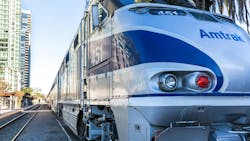
Throughout the year, Mass Transit magazine has covered more than 1,000 rail stories, ranging from new services to rolling stock purchases, infrastructure upgrades, fare changes, safety and security improvements and efforts toward upcoming climate goals. But what piqued our reader’s interests the most this year? The launch of an extension? Upgrades to a system’s security? The answer may not be what you expect.
Take a look at Mass Transit magazine’s rail stories wrapped, spotlighting what rail content our readers engaged with the most.
New York City Transit tests open-gangway cars on G Line
Starting with the fifth most viewed rail story, our readership was interested in a foreign concept to U.S. transit systems—open gangway subway cars. The piece announced the Metropolitan Transportation Authority’s (MTA) new R211 pilot rolling stock on its G Line, the second pilot of the project after the open-gangway cars were first introduced on the C Line in 2024. While the use of these rail cars is essentially standard practice outside the U.S., trialing them stateside drew attention from our readership. The MTA has continued commitments with the open-gangway cars, adding R262 open-gangway cars to its 2025-2029 Capital Plan in October for its 1 and 6 lines.
Seattle Mayor issues executive order to speed up West Seattle, Ballard light rail delivery
At number four, readers were interested in the details of an executive order issued by Sound Transit Board Member and Seattle Mayor Bruce Harrell that pushed for a quicker delivery of light rail to West Seattle and Ballard, Wash. The order sought to do so through improved coordination of the city’s efforts on the project. It established the Office of the Waterfront, Civic Projects & Sound Transit, adjustments to the permitting process to be considered by the city council, funding for additional staff for all steps of the project process and a four-year work plan to ensure a safe transit experience.
The West Seattle portion of the project is expected to be completed in 2032 and the Ballard component by 2037-2039. Though Harrell lost his bid for reelection, his successor, mayoral-elect Katie Wilson, is expected to continue the charge toward project delivery based on her campaign’s focus on public transit and her being the creating force behind the Transit Riders Union in 2011, partly behind saving King County Metro bus service from major post-recession cuts.
L.A. Metro, Sound Transit near completion on rail extension projects
Coming in at number three is a combined look at the wrapping up of two major extension projects in the Los Angeles County Metropolitan Transportation Authority (L.A. Metro) and Sound Transit systems. L.A. Metro had completed the majority of the construction of Phase 1 of the D Line Subway by the May update, already finishing tunneling, track laying, station construction and art installation, readying for the connection of the communication and power systems. As of its most recent progress report issued at the end of November, L.A. Metro has begun pre-revenue service trials of the system with revenue service expected to start between January and March of 2026.
For Sound Transit, as of the May update, crews were beginning overnight testing of the Link 1 Line connections to the new Federal Way Link Extension. They had to suspend overnight service for approximately four weeks to ensure the new extension was ready for primetime. As of today, the extension has opened ahead of the previous 2026 projection, beginning passenger service on Dec. 7.
Caltrain’s new electric train fleet more efficient than expected
In the penultimate slot is a piece about how Caltrain’s new electric rolling stock is harnessing what would typically be wasted energy via regenerative braking, cutting the agency’s electricity costs by $3 million per year—more than a 15% savings. Combining the savings with credits it expects from the California Air Resources Board’s Low Carbon Fuel Standard Program, Caltrain says the first year of electric service will have lower fuel costs than the previous diesel service. Since publication, Caltrain announced that it will qualify for a new billing rate starting in April 2026 from Peninsula Clean Energy and San Jose Clean Energy. The new billing rate is expected to generate $1 million annually for the agency through all of the energy it returns to the grid as approximately 23% of the energy it uses, is returned to the grid.
Hudson River Tunnel project on track for 2035 launch
Coming in at number one for our most viewed rail story of 2025 is an update on the Hudson River Tunnel project, a decade-long project designed to connect Bergen Palisades in New Jersey and New York Penn Station in Manhattan, N.Y. The project is commencing over three phases and will require two major tunneling components. The first being the creation of two new rail tubes under the Hudson River for the first time in 115 years, and the full rehabilitation of the existing one track in and one track out of the North River Tunnel for the second. As of the February update, a $1.18 billion contract for the Manhattan Tunnel Project was awarded to Frontier-Kemper-Tutor-Perini JV. That portion of the project is expected to be completed by 2029. As of now, the Gateway Development Commission—the authority behind the project—has completed the manufacturing of its first tunnel boring machines. The machines are set to be delivered to the Palisades in North Bergen for boring to begin in early 2026. The second set is set to be shipped in the first quarter of 2026. Other preparation measures have been carried out in tandem with the machine fabrication, like stabilizing the soil in the river before drilling and the construction of shafts to safely begin the tunneling process. The project has also entered headlines this year as well as its funding was “terminated,” or put under administrative review at the federal level due to issue taken with contracting requirements, though short-term construction hasn’t been impacted. The project is still expected to be completed by 2035, though questions of funding could impact the final delivery timeline.
The Mass Transit mag editorial team wants to thank all our readers who engage with our content throughout the year—whether through the website, newsletters, magazines (print or digital) or social media. We look forward to another year of being your go-to, trusted source on the latest happenings in the North American public transit industry.
About the Author

Noah Kolenda
Associate Editor
Noah Kolenda is a recent graduate from the Craig Newmark Graduate School of Journalism with a master’s degree in health and science reporting. Kolenda also specialized in data journalism, harnessing the power of Open Data projects to cover green transportation in major U.S. cities. Currently, he is an associate editor for Mass Transit magazine, where he aims to fuse his skills in data reporting with his experience covering national policymaking and political money to deliver engaging, future-focused transit content.
Prior to his position with Mass Transit, Kolenda interned with multiple Washington, D.C.-based publications, where he delivered data-driven reporting on once-in-a-generation political moments, runaway corporate lobbying spending and unnoticed election records.