Op-Ed: Designing sustainable transit for all ages
By 2030, the World Health Organization notes that one in six people globally will be 60 or older, and it’s a significant problem for the future of transit. Many cities across the U.S. already struggle with inequitable access and infrastructure strain where transit systems are aging faster than we are. These pressures only intensify as the population ages. This demographic shift brings questions around the future of mobility: How do our transportation systems age alongside us while maintaining equity, sustainability and long-term climate resilience?
It’s a tall order. Traditional transit models are often high-carbon, inflexible and designed around car dependency, not built for the needs of older adults or a world looking to decarbonize. While some cities have programs to limit congestion and reduce urban emissions, many are finding it difficult to rely on aging public transit systems that don’t offer universal accessibility. Addressing this issue requires a transformation centered on electromobility and inclusive designs that support cleaner and more accessible movement for all.
The cost of car-dependent systems
Across the country, transit networks were often designed to assume that residents can drive. It makes sense when looking at the numbers. According to census data, 92% of U.S. households have access to a car. Public transit alone emits 1.86 million metric tons of carbon dioxide annually. This is equivalent to powering 387 million homes for a year or taking over 3,100 million transatlantic flights. It would take around 2.2 million acres of forest to absorb that carbon each year. These systems are contributing to air pollution, respiratory illnesses and more.
Those without access to automotives (like many older adults) tend to suffer, as only 55% of Americans have access to public transit. Despite the rise of micromobility and rideshare services, high-capacity transit remains the only scalable solution for dense urban areas.
Public transit as the backbone of urban cities
Public transit is capable of moving large numbers of people efficiently, affordably and with lower emissions, but many global cities still have significant gaps in access. These gaps tend to appear in neighborhoods with older populations, limited walkability or fewer healthcare services, where long wait times and distant stops can make routine trips difficult.
Reduced service frequency, aging vehicles and limited station accessibility create additional barriers for older adults and riders with disabilities. A lack of reliable transit options intensifies social isolation, making it harder for people to remain connected to medical care, employment and community life.
Why building more isn’t always the answer
While many cities focus on expansion efforts over renovations (adding more track mileage, more buses and more stations), scaling the existing flawed model does not resolve fundamental issues. In fact, this often carries additional environmental costs. Expansions can increase embodied carbon from construction materials and energy use, and adding new vehicles or routes without electrification may lock in emissions for decades to come.
Instead, cities should look to find an approach that modernizes and optimizes existing networks. Modernizing to incorporate more sustainable practices delivers greater mobility per dollar invested than expansion alone.
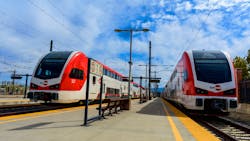
To address both equity and environmental concerns, cities must go beyond traditional public transit and embrace electromobility, such as buses and trains powered by clean electricity. Electric buses and trains reduce emissions, improve air quality, lower operating costs and provide quieter, smoother rides overall.
Building reliable, low-emission service
Successfully implementing this shift requires coordinated investment. Cities and transit agencies must collaborate to consider how routes, vehicle types and energy systems work together to achieve reliable, equitable and low-carbon service. Planning for electrified fleets often involves coordinating grid capacity to support large-scale charging, strategic placement of charging depots and on-route chargers, and renewable power generation to maximize emissions reductions. For example, an electric bus fleet powered by coal-heavy grids will not deliver meaningful emissions reductions.
Electrification is most effective when combined with a holistic approach to sustainable mobility. Shifting modes of transportation strategies, such as reducing private vehicles and leaning more on active mobility like public transit, cycling and walking, can help lower emissions by 20-50% in urban areas, according to Local Governments for Sustainability, known as ICLEI.
Data-driven tools and scenario modeling can also lend support by calculating potential emissions reductions for various interventions. This helps visualize how changes in transit networks, active mobility infrastructure or electrification strategies could reshape a city’s emissions.
The path forward
Designing transit systems that work for older adults ultimately makes cities more functional for everyone—from parents pushing strollers and people with disabilities to residents seeking low-cost, low-carbon travel options. Electrified, accessible transit reduces emissions while improving equity, economic opportunity and public health. Prioritizing inclusive, sustainable public transit today helps cities ensure mobility, independence and quality of life for generations to come.
About the Author
 Balsam Nehme
Balsam Nehme
Executive Director of Sustainability and Implementation
Balsam Nehme is a leading advocate for sustainable design and development. Over her career, she has crafted sustainability solutions for over 100 LEED certified infrastructure and building projects.
She is at the forefront of Sidara’s global sustainability journey – she is responsible for translating Sidara’s vision into measurable impact, guiding clients toward high-performance design, advancing net-zero commitments and amplifying the group’s voice on global platforms.