MN: Potential Link BRT riders get sneak peek as $196.7 million project moves forward
Kathy Taubman sees Link Bus Rapid Transit as a way of improving her commute to her shifts as a hospital volunteer.
The Charter House resident said she regularly uses Mayo Clinic shuttles to reach Mayo Clinic Hospital- Saint Marys but sees the planned downtown public transit as an improvement.
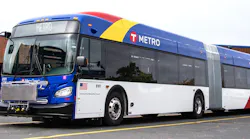
"I think it's a great idea," she said Wednesday while touring a 60-foot electric bus, which will be part of the city's Link BRT system when it launches in August next year.
Fellow Charter House resident Bernice Huseby, who said the buses remind her of rail systems in other cities, predicted Link BRT will likely see its heaviest use by downtown employees, but nearly anyone downtown could benefit.
Rochester Public Library Board President Steve Baule said some of the people who account for 400,000 annual library visits will see those benefits. .
"The Link will help remove transportation barriers, making it easier for residents and visitors to access the library," he said.
The library, along with Destination Medical Center Economic Development Agency, the City of Rochester and Rochester Public Transit hosted the bus tours and other activities as part of the DMC Exchange, a week of events showcasing the economic development effort's progress.
When the 2.8-mile downtown route launches, city officials estimate 11,000 rides will be given on the first day.
With service planned from 5 a.m. to midnight on weekdays and 8 a.m. to midnight on weekends, Link BRT will feature five dedicated stops in each direction between the end points. Stops at each of the 12 stations are expected to occur every five minutes during peak periods and every 10 minutes the rest of the day.
It means any user, whether commuting to work or seeking to move between locations within walking distance of a station, won't be expected to wait more than 10 minutes for a bus and should be able to reach any station within less than 30 minutes.
The fare-free service will mean such rides don't require a ticket or pass, with room for roughly 80 people seated and standing in each bus..
Transit and Parking Director Rachel Fautsch said Wednesday's effort to showcase the future system was intended to highlight more than the buses and stations.
"It's about the future we are building together as a community," she said. "As Rochester continues to grow, we need transportation options that support residents, employees, patients, students, businesses and visitors alike."
DMC EDA Executive Director Patrick Seeb said the Link system is already helping spur development needed to support Mayo Clinic's "Bold. Forward. Unbound. In Rochester." expansion, as well as other efforts.
He pointed to plans for the 342-unit Citywalk Apartments at the intersection of Second Street Southwest and Sixth Avenue as an example, noting developers opted to increase the number of apartments after hearing about how the new transit effort would tie into Mayo Clinic's growth.
"They said 'we can do better than that. We can be bigger than that. We can be more significant than that,'" Seeb said of the Citywalk developers. "Their project went from a $40 million project to a $140 million project."
While construction along Second Street, between Civic Center Drive and Avalon Cove Court Northwest, has created frustration amid development, Sarah Ghandour of the Minnesota Department of Transportation's Transit and Active Transportation Office said she anticipates positive changes when work is complete.
"It's exciting to envision what this area will look like one year from now," she said.
With implementation of the first state's BRT outside the metro area expected to improve access to jobs, medical care and other destinations for daily activity, she said, "it fits with our goals focused on building a transit system that offers more reliable, predictable and accessible services across Minnesota."
The Minnesota Department of Transportation provided nearly $4.4 million to support the $196.7 million project, with the Federal Transit Administration contributing a $84.9 million grant. Other funding includes $61.2 million in state and Olmsted County DMC transit funds and $11.1 million in state DMC infrastructure funds, as well as local water and sewer assessment funds.
Wednesday's tours and activities to introduce the Link system to residents won't be the last.
The Rochester City Council approved a $82,957 contract, funded through the Link budget, to hire Fieldtrip, a marketing agency, for support in raising awareness and informing potential riders of how the system will operate as the launch nears.
© 2026 the Post-Bulletin.
Visit www.postbulletin.com.
Distributed by Tribune Content Agency, LLC.