When Noah Berger arrived in Lawrence, Mass., to take the role of CEO and administrator for the Merrimack Valley Transit Authority (MVTA) in 2021, he went to a bunch of community organizations and asked two questions:
- What are we?
- What are we doing well and not doing well?
The response from the community: we have no idea.
This caused Berger and his partner, Deputy Administrator Nio Mendez, to rethink the entire brand of the authority, even its name.
How MVTA became MeVa
Berger and Mendez wanted to rebrand MVTA into a transportation system the community could be proud of. During the course of their first year working together, the two participated in focus groups with the community to get an understanding of what a working transit system would mean to this particular 225 square mile region in Northeast Massachusetts.
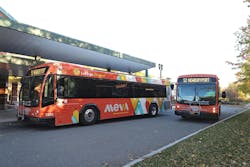
Ultimately, after gaining all sorts of feedback, MVTA was rebranded into Merrimack Valley Transit (MeVa). According to Berger, the name MeVa comes from a mashup of the words ‘Merrimack’ and ‘Valley', which was perceived by the community as being hipper. The name also worked well in both English and Spanish, which is important to the agency, as the city of Lawrence is 83% of Latino ethnicity.
Not only was the name of the agency different, but its buses changed colors from a dark red with a blue stripe to an orange base with multiple vibrant colors around the border, inspired by colors represented in old San Juan, Puerto Rico, as well as the Ciudad Colonial in the Dominican Republic to better reflect the community.
“I hear people say they can't help but smile when they see our buses go by now because it just has that vibrancy, that dynamism that kind of reflects who we are as a community and who we are as a transit agency,” Berger said.
The renovating of a new transit hub
When undergoing the rebrand, Berger says the agency reevaluated every route it was running to see if the juice was worth the squeeze on continuing to operate in a certain area. Mendez notes the decision on bus routes came down to four questions:
- How long is it taking our riders to get to where they need to go?
- What streets are we using?
- Which streets can we avoid to reduce delays?
- Which parts of these routes have the highest ridership?
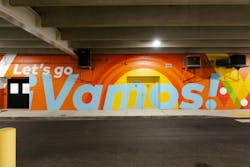
With the rebrand, the agency knew it needed a central hub. Located in Lawrence, the McGovern Intermodal Transportation Center was built in 2012 as a bus garage. Once the rebrand was official, MeVa renovated the station to be up to date with the new branding. The station reopened in September 2024 and features murals on the interior walls to improve the station experience. The new artwork was created by Elevated Thought, a Lawrence-based art and social justice community organization.
Mendez notes the center is more than just a bus station for riders. It is located where the Massachusetts Bay Transportation Authority Commuter Rail runs service, making it easy for riders to integrate multiple modes of transportation.
Fare-free transit
In March 2022, the agency decided to stop charging fares for its services as a way to increase ridership during the COVID-19 pandemic. MeVa used COVID-relief and American Rescue Plan Act funds to cover the revenue that would have been gained from fares.
The MeVa Board approved the agency for a two-year fare-free pilot. In February 2024, a month before the pilot was set to conclude, the Merrimack Valley Planning Commission presented data to the MeVa Board that showed the benefits of the pilot. The data revealed that collecting fares ultimately led to slower service due to riders counting change and constant fare box issues, so the board decided to make the fare-free pilot permanent.
The report also broke down the benefits of free public transit for the community, which included the ability to take public transit to medical appointments, school, grocery stores and leisure activities, creating more access for residents and less congestion on the road.
Since the board decided to make the free-free pilot permanent, ridership has continued to grow. As of January 2026, ridership is 60% above pre-pandemic levels.

Expansion of services
Part of the reason for the ridership increase is the expansion of services MeVa has undergone since the name change. Currently, the agency provides 26 fixed routes on its bus schedule and is looking to implement two new services come April. In December 2025, the agency received part of a $10 million Transit Connectivity Grant from the Massachusetts Department of Transportation that will help fund two new bus routes:
- The No. 25: A Methuen Crosstown service that will directly connect riders to key medical, educational and recreation trips.
- The No. 28: A new route that will connect Lawrence and Methuen, Mass., with health care and jobs in Salem, N.H.
In 2024, the same type of grant helped MeVa begin planning to run its two highest ridership routes (Route 24 that connects Lawrence and Lowell and Route 1 that connects downtown Lawrence and Haverhill) every 20 minutes instead of every 30 minutes. That change went into effect this past July and combined with the two new routes that are coming in April, Mendez notes this is something riders have been asking about for a long time.
“I started at the agency 11 years ago as a bus driver, and that’s all I would hear people talking about, and we’re finally giving the people what they asked for, which is more service on the road,” Mendez said.
MeVa's paratransit service is known as miniMeVa. Berger points out that miniMeVa conducts service beyond what is required by law.
“The ADA requires that you serve within three quarters of a mile of a fixed route,” Berger said. “You're eligible in our fixed route communities if you're 60 or over, and for our non-fixed route communities, anyone is eligible.”
Mendez adds that miniMeva also conducts service to Bedford, which is usually completely outside of the agency’s coverage zone. For miniMeVa, the agency runs nine low-floor vehicles, making it easier for those with mobility devices and/or challenges to get on and off.
Later this summer, the agency is set to debut a new type of service to its riders, as two zero-emission ferries will be available to residents living in Haverhill, Amesbury and Newburyport, Mass. As part of the 2022 Federal Transit Administration’s Ferry Grant Program, MeVa was awarded a $4.2 million grant to fund two zero-emission ferries that will travel in the Merrimack River along the North Shore Region of Massachusetts.
According to Berger, residents in the area use the river when the weather is adequate for canoeing and kayaking, but that the area was also laid out for transportation use, noting that 11 of the street names in the area are named after the word ferry.
“When you think about our service area, it was built around the Merrimack River, and ferry was the primary mode of transportation,” Berger said, noting how overtime, other modes gained traction and the ferry fell to the background. “Now, we are focusing on turning back to the river.”
Berger says the ferry won’t have full service right away at launch, but the hope is that there will be a robust ferry schedule the agency is running by summer 2027.
Unlike the soon-to-be ferry service, all of MeVa’s buses are gas-powered, which according to Berger, is more of a strategic decision than a funding decision.
“When we did our due diligence and looked at if we were to go to battery-electric [vehicles], would the range fit our service needs, and it didn't seem like it would,” Berger said. “It would require us to basically double our fleet for the same level of service.”
He notes, however, hybrid buses have been successful.
“The benefit of hybrid is that through geofencing, you can actually control when [the buses] are running all electric and when it's on diesel, so you can target it depending on the neighborhood… you have all the benefits of battery-electric without worrying about the charging,” Berger added.

Safety and security
Even with all the changes and the addition of services MeVa is making to improve the rider experience, Berger and Mendez both believe what makes it unique for being such a small rural agency is its commitment to safety.
Berger says it’s not so much having police officers nearby or at its stations or on its buses, but it's the safety training program the agency puts its operators through. He tells a story that a few years ago he received a call that one of the agency’s buses had been in a bad crash, as a drunk driver was driving on the wrong side of the road and collided head on with a MeVa bus. The operator of that bus said the agency’s safety training program saved his life.
“That operator told me if it wasn’t for our safety program, he probably would have died that day,” Berger said. “He knew what to do in that situation and get everybody out of the bus safely because we train our operators based off of potential life-threatening scenarios, and we give them hands-on experience.”
Berger also notes the agency is working on installing digital mirrors on its buses, which will act like backup cameras, but they have a 360-degree view of the entire bus, eliminating blind spots for operators. The agency also has lug nut indicators under all the wheels on its buses, which will tell operators instantly if the lug nut on a wheel is loose.
Progress is progress
Nearly five years ago, Berger didn’t know what the identity was of the transit agency he was taking over as CEO and administrator. As his deputy administrator and a former bus driver, Mendez knew she and Berger had to find that identity. Now, in 2026, with a name well-known and new services on the way, Berger and Mendez feel the identity of MeVa has been found: getting people where they need to go on time by using reliable public transit. While they are both excited about the future, they know the agency will need to be able to adapt at any moment to meet the growing needs of travel in today’s society.
About the Author
 Brandon Lewis
Brandon Lewis
Associate Editor
Brandon Lewis is a recent graduate of Kent State University with a bachelor’s degree in journalism. Lewis is a former freelance editorial assistant at Vehicle Service Pros in Endeavor Business Media’s Vehicle Repair Group. Lewis brings his knowledge of web managing, copyediting and SEO practices to Mass Transit magazine as an associate editor. He is also a co-host of the Infrastructure Technology Podcast.