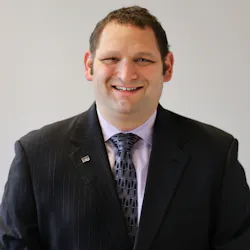
One word to describe yourself: Passionate
Alma Mater: Northeastern University
Fast fact about yourself: As a Massachusetts transplant, I learned the state through the commuter rail map. For a while, if a town didn’t have a commuter rail stop, I probably didn’t know where it was.
What’s your best experience on transit and what made it memorable? I always enjoy being out on transit and helping someone who is lost or trying to figure out the system. Whether it’s a tourist debating which stop to use or someone trying to coordinate where they should be picked up, it feels good to share what I know and help make transit a little easier for someone in that moment.
Andrew Brunn, track engineer and project manager at HNTB Corporation, has worked on rail transit projects in New England for over a decade, providing hands-on assistance, delivering technical expertise and uniting diverse teams on a variety of projects. Most notable is his long-standing partnership with the Massachusetts Bay Transportation Authority (MBTA), where he works across disciplines to deliver projects advancing the agency’s mission.
One such project was MBTA’s track improvement program, which addressed speed restrictions by working through state-of-good-repair backlogs. Brunn’s role included leading a team that assessed over 275 track miles across heavy and light-rail lines. The team conducted overnight visual inspections, confirming defects and ensuring the scope of work improved the overall health of the system. These state-of-good-repair projects allowed the MBTA to lift all the speed restrictions, improving the passenger experience and operation performance.
Another project Brunn manages is the MBTA’s Codman Yard Expansion and Improvement Project to accommodate the new Red Line fleet and enhance operational flexibility. The project will add six new tracks without expanding the yard’s footprint. Brunn tapped into his expertise to design a larger crossover to reduce wear on the trains and the infrastructure. He also led factory inspections for critical special trackwork components, which included 150-foot radius turnouts and a No. 8 double crossover. Once complete, the project will increase storage capacity by 36 cars, lower maintenance costs and decrease noise disturbances for the surrounding community.
Brunn leans on his innovative mindset to collaboratively develop solutions that are technically sound and practical to build and maintain. When it comes to track improvement, he uses visual inspection, design and construction experience and MBTA testing so repairs address root causes—not just symptoms.
For instance, Brunn leverages hi-rail based LiDAR scanning at the MBTA, so he can use the data to create track charts, support asset management and solidify constructable designs.
In addition to project work, Brunn mentors junior staff at HNTB, taking them into the field to get hands-on experience. He supports entry-level engineers as a group leader, creating a collaborative and multidisciplinary culture. He's also active in his community, preparing meals for seniors, distributing food throughout his area and traveling to storm impacted areas to support rebuilding efforts.
Brunn is described by colleagues as having a holistic perspective, technical leadership and a collaborative spirit that leads to safer, more reliable transit services.
Is there a specific experience that led you to where you are today?
Like a lot of kids, I had an early interest in transportation, but I didn’t realize my passion for transit until I was a rising senior in high school through an American Public Transportation Association youth summit called Teening up for a Greener Future. Having family members working at New Jersey Transit and Paris’ Régie Autonome des Transports Parisiens helped me realize engineering was the right path for me to start my studies. Later, Northeastern’s co-op program gave me a great experience at the MBTA and confirmed that I wanted to work in rail. At HNTB, mentors helped me grow in all aspects of track design, including special trackwork design and track inspection.
What do you enjoy most about your job?
I want to help improve public transportation for riders and for agency employees who operate and maintain the system. Some projects have a direct impact on riders, and others are more behind the scenes, but they all move toward the same goal: a better, more reliable rail network. Public transportation gives people options, efficiency and, for many, an essential way to move through their daily lives.
What’s the most challenging part of your job?
The biggest challenge is balancing physical constraints, funding, schedules and outcomes. As we work to make systems better, construction and maintenance naturally create short-term impacts for the public. The challenge is finding the right way to deliver long-term benefits while minimizing disruption as much as possible. It takes experience, collaboration and an understanding that everyone is trying to do the best they can with the resources and time available.
What is the accomplishment you’re most proud of and why?
I’m most proud of my work supporting the MBTA’s Track Improvement Program. Our team spent many nights in the field reviewing existing track conditions and developing scopes of work to help remove speed restrictions and improve the state of good repair around them. The goal was not just to do the minimum required, but to help improve the system more broadly. It was meaningful because the work had a real impact on riders and system reliability.
What is an accomplishment you would like to work towards in your career?
I’m excited to keep building on the type of work I’m doing now and even on a larger scale and with broader impact. I enjoy helping improve transit systems, and I would like to continue taking on complex projects that can benefit more people. I’m driven to find ways to apply what I’ve learned to bigger challenges.
What is your best advice you can share from your area of expertise?
Don’t pass up opportunities that are in front of you and seek out new ones when you can. Put yourself in positions where you can learn from experienced people, ask questions and get outside your comfort zone. The senior people in this industry have a tremendous amount of knowledge that they’re happy to pass on. Learn as much as you can from them and be willing to speak up and get involved.
About the Author
 Megan Perrero
Megan Perrero
Editor in Chief
Megan Perrero is a national award-winning B2B journalist and lover of all things transit. Currently, she is the Editor in Chief of Mass Transit magazine, where she develops and leads a multi-channel editorial strategy while reporting on the North American public transit industry.
Prior to her position with Mass Transit, Perrero was the senior communications and external relations specialist for the Shared-Use Mobility Center, where she was responsible for helping develop internal/external communications, plan the National Shared Mobility Summit and manage brand strategy and marketing campaigns.
Perrero serves as the board vice president for LIT, the second vice chair of the American Public Transportation Association’s (APTA) programs and communications committee and is a member of APTA’s Marketing and Communications Committee. She holds a bachelor’s degree in multimedia journalism with a concentration in magazine writing and a minor in public relations from Columbia College Chicago. Her work has been recognized with a first place AdWheel Award, AZBEE Bronze Regional awards, an AZBEE Regional Gold Award and an AZBEE National Silver Award.