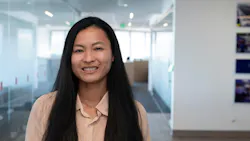
One word to describe yourself: Persistent
Alma Mater: Undergraduate: Arizona State University; Graduate: UCLA
Fast fact about yourself: I love to create things. I cannot sit and passively relax—I have to be doing something with my hands. My specialties include sewing my kids' clothes, fixing things around the house and tending to my California native garden.
What’s your best experience on transit and what made it memorable? When I was young, my family visited our relatives in China every few years, and we often rode the train. These were the days before high-speed rail, and I’m sure those long journeys were exhausting for my parents who were toting me and my siblings along, but it was incredibly exciting as a kid. I have such vivid memories of the busy stations, the sleeper car bunk beds and buying snacks and instant noodles through the window from vendors at stops.
Doreen Zhao joined STV immediately after earning her Master of Urban and Regional Planning from UCLA and has spent her entire professional career during the last 12 years focused on transportation and environmental planning. She earned her AICP certification in 2015 and has consistently taken on responsibilities that extend beyond her formal role, stepping into leadership positions when projects required continuity, judgment and coordination across disciplines.
She currently serves as an associate and planning manager at STV and leads the firm’s Southern California planning group. She oversees multidisciplinary planning efforts, supports design coordination and environmental documentation and mentors a growing team of planners. She also serves as deputy project manager on multiple major transit programs, balancing technical oversight with team leadership.
Early in her career, she served as planning lead on environmental documents for the California high-speed rail program, including the Burbank to Los Angeles and Los Angeles to Anaheim sections. She later applied that experience on the Los Angeles County Metropolitan Transportation Authority’s (L.A. Metro) C Line (Green Line) Extension, supporting alternatives analysis and environmental coordination for a corridor shaped by evolving design decisions and extensive community input.
Colleagues say Zhao is adept at bringing together environmental analysis, transportation planning and design coordination to ensure decisions are well documented, consistent and clearly explained. On all her projects, she works closely with agency teams and residents across several cities to translate technical information into clear, accessible concepts.
Beyond her project work, Zhao is actively involved in the broader transit industry. She currently serves on the national steering committee for the Mpact Transit + Community conference, where she helps curate programming focused on livability, accessibility, equity and sustainability. In this role, she reviews proposals from across the country and helps shape sessions that highlight practical lessons and transferable approaches for transit agencies and practitioners. Zhao is also involved with WTS-Los Angeles and has supported organizational committees dedicated to professional development and inclusion. Internally at STV, she has consistently supported early-career professionals, previously leading the firm’s early-career professionals group and organizing mentorship and learning opportunities. She currently chairs employee activities committees for STV’s Southern California offices, helping strengthen workplace connection, collaboration and employee well-being.
Is there a specific experience that led you to where you are today?
I had studied architecture in my undergrad and therefore entered UCLA’s planning graduate program to study urban design. During my first quarter, I decided to take a transportation policy and planning class for fun, and I was immediately hooked on its complexity. Transportation was something I had always taken for granted, as someone who owned a car and could travel easily, but that class opened my eyes to the many ways that transportation intersects all facets of life and the many inequities that exist in our communities that are often a direct result of poor planning. After taking that class, I knew this was a problem I wanted to help solve.
What do you enjoy most about your job?
The best part of my job is getting to use all parts of my brain. I decipher engineering drawings and crunch data and then translate that complex, technical information into graphics and reports that can be easily understood by the public. I speak the technical language of designers and environmental specialists, but I also have to be able to engage one-on-one with community members at public meetings because the ultimate goal is making sure they understand the impacts and benefits of projects. Bridging disciplines requires a certain kind of creativity that I really enjoy.
What’s the most challenging part of your job?
Planners love data and coming up with solutions that are backed up by technical analysis, but decisions are not made solely on this basis. In my experience, factors such as politics and funding have just as much power in shaping projects. It’s tough to watch projects go in completely different directions than you expected, but I know this is the nature of our work, and planning is a long-term game.
What is the accomplishment you’re most proud of and why?
Very early in my career, I began working on the California high-speed rail project, where my firm was leading the design and environmental clearance for one of the geographic segments. That project was a crash course in everything in the project development process, from alternatives analysis to CEQA/NEPA to permitting. I was fortunate to have good mentors to show me the ropes, and I slowly took over the oversight role for all the planning and environmental work. It took years to get the project approved, and I was proud to look back at my own growth, from starting as a complete novice to reviewing and signing off on thousands of pages of our environmental documentation.
What is an accomplishment you would like to work towards in your career?
I would love to see a project I’ve worked on get built. This isn’t something I can control, but planning is so early in a project’s life cycle that it can take years—or decades—for big capital improvements to be completed. I intend to keep on at it and trust that at some point in my future, I’ll get to see some of my work be implemented.
What is your best advice you can share from your area of expertise?
A key to delivering the best version of a project is working with the community to address their needs and concerns. Planners can be seen as technocrats with our data and analysis, but this is why community engagement is critical; it’s not just a process requirement, but it grounds us in reality. There is so much to learn by talking to the people you are trying to help, to ensure your work actually will improve their lives.
About the Author
 Brandon Lewis
Brandon Lewis
Associate Editor
Brandon Lewis is a recent graduate of Kent State University with a bachelor’s degree in journalism. Lewis is a former freelance editorial assistant at Vehicle Service Pros in Endeavor Business Media’s Vehicle Repair Group. Lewis brings his knowledge of web managing, copyediting and SEO practices to Mass Transit magazine as an associate editor. He is also a co-host of the Infrastructure Technology Podcast.