Industry Leaders Connect Sustainability and State of Good Repair
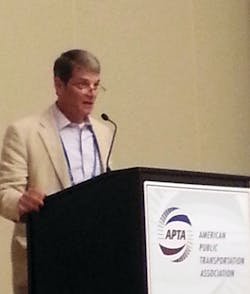
The American Public Transportation Association’s (APTA) 2012 Sustainability and Public Transportation Workshop kicked off in downtown Philadelphia, Pa., this week. “Innovative Partnerships for Sustainability and State of Good Repair,” will focus on the connection between sustainability and “state of good repair” (SOGR) and how innovative partnerships are being forged to advance both objectives.
Here to Hear Best Practices
APTA Sustainability Committee Chair; APTA Board of Directors Member; and General Manager, King County Metro Transit Kevin Desmond welcomed attendees to the workshop and outlined the goals and objectives. With the increasing fiscal constraints, agencies experiencing record ridership growth in all modes, aging infrastructure, and severe weather events causing damage across the country, Desmond said we need to figure out how to keep up with the backlog of needed projects, how to prioritize, and how to find the dollars to invest in the needed sustainable practices.
APTA Board of Directors Member; General Manager, Southeastern Pennsylvania Transportation Authority (SEPTA) Joseph Casey shared an update of SEPTA’s achievements in sustainable practice and said finding ways for bikes, buses and pedestrians need to co-exist. One of the strongest advocates for sustainability in the region is Mayor Michael Nutter. Via video message, Mayor Nutter said SEPTA has become recognized as a national leader for sustainable practices and that in Philadelphia, they plan for action.
Going Beyond Green
Rina Cutler, deputy mayor, mayor’s office of Transportation and Utilities, city of Philadelphia and SEPTA board member, led a roundtable discussion on the evolution of sustainability at SEPTA to implement a comprehensive sustainability planning framework focused on the triple bottom line – economic, social and environmental sustainability – as the key to the region’s long-term sustainability.
Cutler talked about an earlier time when words like “sustainability” and “livability” didn’t exist before. With Mayor Nutter’s goal of making Philadelphia the greenest city in America, the connection between sustainability, SOGR and livability is key. She acknowledged that looking at how one pays for this is a challenge that needs to be addressed. And generating a laugh from the audience was her added comment, “There are two places in my office where things go to die. First is my law department and second is my finance department.”
Turning it over to SEPTA’s CFO & Treasurer Richard Burnfield, he said he’s also known in the office as CF-No. Back to a more serious note, he stressed, “Sustainability is figuring out a way to grow, evolve and improve over time.”
Being creative in their approaches, whether it was in partnerships or grants, is necessary with the difficult financial restraints SEPTA faces. Burnfield also said they look at the return on investment (ROI), whether it’s a big or small projects and how it will impact the authority in the short-term and in the long-term.
Talking more about ROI, Delaware Valley Regional Planning Commission Executive Director Barry Seymour said there may not always be a dollar ROI, but it’s important to look at all metrics, including the softer ones which are equally important. “If less people are screaming at you, that’s a positive return.” When it comes to the social infrastructure, to what extent are your community groups, ridership groups, engaged in the process? Do they feel they have an opportunity to voice their concerns?
Jeffrey Knueppel, assistant general manager/chief engineer for SEPTA added that as time goes on, you get more experienced at things and there are ways to structure things to reduce costs. “We may have a couple initial projects that come out with a bottom line that’s not so great; we learn things going forward.”
Sustainability is About Relevancy
Everyone seemed to agree that “sustainability” has become over-used and often creates a negative reaction to many, so looking at things in new ways is increasingly important. Cutler said, “Sitting in a room figuring out how to get a bus from Point A to Point B is no longer the way. We need to be relevant to our customers nad what Congress wants, because they hold the purse strings.
“We need to think of ourselves as providers in a different way.”
One of those ways is the health-obesity-transit connection. Cutler said the city has been looking at their food deserts — where there aren’t any grocery stores in the neighborhood, and they saw people were going to corner convenience stores and getting less healthy options than fresh produce.
Burnfield said, “Sustainability is about relevancy going forward. Transit needs to prove it has an important role to play …” and he explained why SEPTA has a role in farmers markets.
With the access to healthy food issue that the city was facing, it is an issue that is critical to the sustainability to the region. “Farmers markets at our stations provides an opportunity to our neighborhoods to have access to fresh, good produce.” He stressed, “We make those transit hubs important.”
Rephrasing the Conversation
As a concept, sustainability is a framework for their long-range planning, Seymour said. As the MPO, he said they look at the environmental resources of the region and how they can provide social equity: access for everybody.
When talking out in communities he stressed how words are really important. Five years ago they did a lot of work looking at reducing greenhouse gas emissions, but now, he explained, they talk about “energy savings” and “reducing costs.”
“It’s the same results down the line,” he explained, “but you’re selling it on their self-interest. Choice of language is very important.”
Cutler said they found through research while most people are supportive of the pieces of what they want to accomplish, they hate the word “sustainability” because they think of “Big Brother”-like government.
With 350 local governments in his region, Seymour provided some thoughts on how he works at getting buy-in for what they do. “Their world view is that local community.”
Cutler added, “All politics are local. You need to make it relevant at the local level.
“You have to engage in a conversation with your stakeholders and community. If you’re not providing with what they’re looking for, you’ll never be successful.”
Everyone agreed that the politics of transportation has become political and it’s become a part of the partisan “big government” vs. “small government.”
Cutler said NIMBY was the first time someone looked at that and it was the general thought, “I don’t want people who take buses to come into my community.” The next generation of that while she was on the West coast, she said, is BANANA: Build Absolutely Nothing, And Near Anybody. Coming back East, it was NOPE: Not On Planet Earth and she ended with, “It’s sad to say there’s now CAVE: Citizens Against Virtually Anything.”
Bringing people together facing the same challenges with some having better success than others, the sessions over the next few days are planned to help address the concerns of politics, funding and sustainability.