Bringing High-Speed Rail to America - Part I
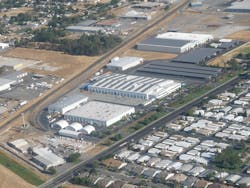
The US High Speed Rail Association held the first day of its High Speed Rail Conference: "Brining High Speed Rail to America" in San Francisco Wednesday, May 23. The day before the conference, there were transportation tours available. Tours included the Siemens manufacturing plant, the Transbay Center construction site and BART’s Command and Control Center.
Experienced high-speed rail experts met with business and political leaders to discuss challenges and opportunities of bringing high-speed rail to the United States. The conference was held at Autodesk, a leader in 3D design, engineering and entertainment software.
On the Siemens tour, attendees learned about its current operation and future potential. Siemens employs 336,000 people globally, 60,000 in the United States, and 4,779 in California, with 1,180 of those being employed in rail.
They have been building rail cars here since the 80s and they procured a 20-acre lot that is currently empty, but ready to build facilities to produce high-speed trains. Armin Kick, director - High Speed Rail Development, Siemens Industry Inc. Mobility, said, “We’re serious if anyone needs some high-speed rail.” That would also mean approximately 200 additional jobs at the plant.
In the past four years they have invested $50 million into their plant to expand and improve. They installed solar panels that produce 2 megawatts of power, which provides about 85 percent of its power. The rooftop system also provides shading for the employee’s cars.
Welding is a key skill so there is a welding school facility for employee training. The engineers have figured out how to build the light rail vehicles with 30 percent fewer welds with no increased safety risk and that means lighter vehicles.
Siemens has more than 1,000 vehicles in 17 United States and Canadian locations and there were a variety of cars being assembled on the tour, including Edmonton, Houston, San Diego and Minneapolis.
What was surprising to those on the tour, was that everything is built by hand. Because it is such a small market, robotics wouldn’t be cost-effective. The tour went through the approximately 10 stages to making a light rail vehicle. And in the parts warehouse, Stephen Robillard, a vice president in Siemens Mobility Division stressed, “If it doesn’t work here, it won’t work anywhere else; you need the parts to keep things moving.”
It takes 16 to 18 weeks to make a car and they make about 90 LRVs each year. And one fact that stuck with us was that it takes more than 26 miles of wiring for each vehicle. When looking at a high-speed train, that jumps to more than 100 miles.
Siemens sponsored two reports, one for The United States Conference of Mayors: “The Economic Impact of High Speed Rail on U.S. Cities.” Siemens also sponsored a report for the Midwest High Speed Rail Association: “The Economic Impacts of High Speed Rail in Transforming the Midwest.” Both look at the economic impact of the development and implementation of high-speed rail.
Another tour offered was of the construction site for the Transbay Transit Center, a $4 billion project that will replace the current Transbay Terminal at First and Mission streets in San Francisco. The project, dubbed the “Grand Central Station of the west,” brings together 11 different public transit systems and will also create a 40-acre pedestrian-friendly community of 2,600 new housing units, one-third being affordable. It’s also the first high-speed rail project to break ground in the United States.
Executive Director of the Transbay Joint Powers Authority Maria Ayerdi-Kaplan mentioned that in addition to all of those benefits, they’ve also been working the local schools teaching youngsters about engineering and architecture and they’ve also teamed up with the First Lady on the hiring of veterans being a focus of theirs.
USHSR President & CEO Andy Kunz kicked off the conference by providing background of the United States HSR front. The vision is a 17,000-mile network for the United States with trains reaching speeds in excess of 200 miles per hour. It’s meant to be a national electric project to revive the economy by creating jobs, reducing our dependency on oil and reducing our carbon footprint.
The estimated cost is $600 billion, or $30 billion per year. Kunz pointed out,” We already spend more than that on transportation; it’s just changing the way we invest in transportation.”
The challenges we face are there is a lot of confusion about what high speed really is and which projects are truly high-speed; there is a well-funded negative campaign against high-speed rail by think tanks, the oil industry and others; there is a lack of a dedicated funding source; there is lack of broad support in congress; the benefits of HSR are not clearly articulated and aren’t always consistent; there are long lead times before the public will see results; and there needs to be an organized, national campaign.
Energy independence is an economic and social emergency, he said. “American oil consumption is extremely wasteful.” America has only 5 percent of the world’s population yet consumes 25 percent of the world’s energy because we build wastefully: spread out and built primarily for auto use. “We consume 20 million barrels of oil every day directly for transportation.”
A fully loaded 6-car train can substitute for nearly 100 city blocks of moving cars, he pointed out. And, while a single subway line can deliver 60,000 to 80,000 people per hour per track, a superhighway can only deliver 2,400 cars per hour per lane.
Mineta Transportation Institute Executive Director Rod Diridon stressed, “We are creating a new industry for America.” And in doing so, he said it’s important to remember the disadvantaged business enterprises and the small businesses. “It’s something that is imperative to maintain as we go into the contracting.”
He showed attendees a book that was recently published on the Golden Gate Bridge, which celebrates its 75th birthday on Sunday. He said it’s interesting to look at a project that:
- Was a major public works project
- Had never been done before in the United States
- Had no funding up front
- Had a huge price tag attached to it
- Was to be built during a depression when there was no money
- Where there was at one point 2,300 individual lawsuits against the project
- Where there was political opposition from the governor, mayor of San Francisco and legislators up and down the state
- Was unanimously opposed by the environmental community
But no one today can imagine how we could function without the Golden Gate Bridge. How could there have been all of these questions and opposition to building it?
Diridon said, “We have to remember those past challenges as we look at this challenge.” He continued, “That project took leadership. It was built by community leaders that said it was time to do it.”
He cited various studies done over the years that illustrate high-speed rail would be beneficial to the state of California and he asked, “How many times do we have to hear that high-speed rail is good for the state?
“We need jobs in this state. We need mobility. We need to move away from petroleum-based and carbon-based energy.”
He also said this issue has become partisan and it is a “fish-or-cut bait issue,” telling legislators, “If you vote for this we will love you forever. If you don’t vote for it, we don’t want you anymore.
“It has to be clear and you have to be that direct.” He stressed, “This is one of those issues where if it doesn’t happen, by golly we need new leaders in the state of California.”
Check back tomorrow for more coverage from last week's conference.