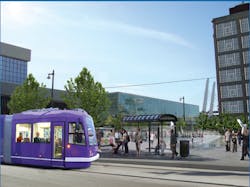
A Milwaukee alderman is pulling in help from influential right wing think tanks to come into that city and try to stop a streetcar project, which has already fallen more than two decades behind in plans.
Ald. Bob Donovan held a press conference at Milwaukee’s city hall March 6, flanked by Cato Institute fellow Randal O’Toole, and members of Americans For Prosperity and Wisconsin-based conservative think tank The MacIver Institute in an effort to make his case against the proposed streetcar in the downtown area of the city.
“This issue is certainly controversial. It has gotten to the point where arguments, tempers have flared and I believe unfortunately there are individuals in this community that if they don’t like a particular message, find it necessary to attack the messenger and that’s disappointing,” Donovan said. “I will simply say this: I don’t give a damn who the messenger is as long as the message is accurate and if any individual has evidence to point out that somehow Mr. O’Toole’s study is inaccurate I would urge them to come forward. Otherwise I would simply ask them very humbly and very respectfully to shut up and start telling the truth to the citizens of Milwaukee.”
Milwaukee has been in the planning process for a 3.5 mile downtown streetcar system for several years after money and financing got mired in nearly 20 years of political debates between state, county and city officials. Eventually money was allotted to fund a 2 mile loop for the project by federal officials and the system is set to start construction in 2014.
O’Toole has been an outspoken critic of rail systems and rail transportation across the U.S., however, he described himself as a “train nut,” to attendees of the press conference saying he wishes they worked better economically than buses.
“At one time about 100 years ago today, more than 800 American cities had streetcar lines and since then between 1913 and 1966, all but six of those cities tore out their streetcar lines and replaced them with buses, and all the reasons they replaced them with buses are just as valid today,” O’Toole said. “Buses cost less, they cost less to build, they cost less to operate, they’re more flexible, they can go to wide ranges of places — anywhere a street goes — you don’t have to build a lot of infrastructure, they’re compatible with cars, they do not cause a lot of congestion by themselves and they can move a lot of people.”
O’Toole has been a vocal critic of the Portland, Ore., streetcar system, which is a favorite example used by rail supporters who say it shows the economic power of using the mode of transportation. However, O’Toole said the only reason there has been development along the line is due to government subsidies, saying city leaders offered hundreds of millions to developers after the line opened in 2001 because the city’s first light rail line failed to get any development when it first opened.
“So when they built the first streetcar line in 2001, they immediately gave developers hundreds of millions of dollars in subsidies to develop along the line and about three-fourths of the line has these hundreds of millions of dollars of subsidies and they did get billions of dollars development because of those hundreds of millions of dollars of subsidies, not the streetcar,” O’Toole said.
One aspect of the Portland streetcar system is that Milwaukee-based Rockwell Automation was approached to build the propulsion system for streetcars. Ald. Bob Bauman who is a supporter of the streetcar project said he’s concerned that halting such projects and advocating against them will hurt the Milwaukee company, but Donovan disagreed.
“I’m sure Rockwell will do just fine one way or the other,” Donovan said. “They don’t need Milwaukee’s streetcar to be successful.”
O’Toole’s visit to Milwaukee to advocate against the streetcar comes at a time where relations between Milwaukee and Wisconsin state leaders is reaching a caustic apex of loathing and new budget proposals adding fuel to a tinderbox of mutual animosity. In recent weeks Gov. Scott Walker introduced a new biennial budget which failed to restore $14 million in reduced transit aid from the last budget, while adding $500 million in new funding for road construction projects that critics say favor the western, affluent suburban areas in metro Milwaukee. Walker and Milwaukee Mayor Tom Barrett have also traded barbs in recent weeks about claims Walker and Republican leaders hate the city and new fuel has been added to the fire over Wisconsin Department of Transportation plans to widen part of I-94 on the west side of the city, which could result in the construction of a double decker freeway and critics say potentially cause some portions of a graveyard to be paved over along with decimation of the Story Hill neighborhood, which is considered one of the premier neighborhoods on the west side of the city.
City leaders are also still sore with Walker for his refusal to take nearly $1 billion in federal aid to build a high-speed rail line connecting Milwaukee, Chicago and Madison, which was returned to the federal government shortly after Walker took office in 2011.
“We do not to be the governor’s punching bag,” Ald. Nik Kovac said. “We want to be successful and one of the ways we’re going to be successful is by making this smart investment, which I should remind you, the governor has nothing to do with.”
Immediately following the press conference, Bauman and Kovac along with city engineer Jeff Polenske held their own press conference to refute the claims made by O’Toole, saying the project will be a success and derided the fact an outside influence was coming into the city and trying to undermine city projects.
“Frankly this man is a charlatan,” Bauman said. “This man is a hired gun. His job is to advance a political agenda and that political agenda is essentially anti-city and anti-urban."
Critics of the Milwaukee streetcar plan have cited the small reach of the project to say it’s not going to be successful. Baumann said city leaders have reached out to federal officials to get more money to fund extensions for the rail line, but they will not release more money until the initial phase is built.
Polenske said the project is moving forward and despite the political controversy. The system will connect with the city’s intermodal station in downtown and will be accessible to 80 percent of all parking in the area to encourage people to “park once,” when they come into the area for entertainment or work.
“I think you’re free to have your opinion as to what you’re in favor of or what you’re supportive of and what you’re not supportive of, but the fact of the matter is we do have a great project here,” he said. “We have $54 million in federal money that has been legislated specifically for a streetcar project in downtown Milwaukee and we’re on the cusp of bringing on the final designer to get into the final engineering and prepare the documents for construction.”
About the Author

Joe Petrie
Associate Editor
I came to Mass Transit in 2013 after spending seven years on the daily newsbeat in southeastern Wisconsin.
Based in Milwaukee, I worked as a daily newspaper reporter with the Waukesha Freeman from 2006-2011, where I covered education, county and state government. I went on to cover courts for Patch.com, where I was the main courts reporter in the Metro Milwaukee cluster of websites.
I’ve won multiple awards during the course of my career and have covered some of the biggest political events in the past decade and have appeared on national programs.
Having covered local government and social issues, I discovered the importance of transit and the impact it can have on communities when implemented, supported and funded.