Using Value Capture Strategies to Finance Transportation Infrastructure
[Opening image can be stock of a modern, bustling city with a streetcar ... like Portland ... and there are people walking, a streetcar, businesses. The article is about when that streetcar/rail line goes in, those businesses get more people, more traffic, more money]
There are many different types of infrastructure, but they tend to be lumped together. Certainly repairing potholes and building a new bridge is infrastructure, but are they on the same scale as a new airport or a national high-speed rail network? To differentiate between smaller local or regional projects and the larger, big ticket national projects, some are calling the latter, Megastructure.
There is a consensus that the United States has been underfunding its infrastructure. The American Society of Civil Engineers (ASCE) has stated that just putting existing infrastructure into a state of good repair will cost in the vicinity of $2 trillion. And that doesn’t include trillions more for new infrastructure required by the additional 100 million people that will be here by 2050.
Strained federal and state budgets will be hard pressed to lay out these trillions of investment dollars using conventional tax-and-invest models. But the advantage of a well-designed transportation project is that nearby properties generally experience an increase in value. Isn’t it then in the private developer’s interest to subsidize some of the public sector’s infrastructure construction costs? That is the theory behind Value Capture financing.
How Did We Get Here
A lament, spoken by both lawmakers and transportation advocates, is that funding transportation projects has never been so politicized. It should not be — there is no such thing as a Democratic road or a Republican tunnel. Unlike the unrelenting, three-month continuing resolutions to fund transportation, as has become the standard operating procedure over the past few years, legislators used to craft a deal for five or more years. Legislation of that duration gives certainty to developers, manufacturers, contractors and the states. The surface transportation bill that was signed last year, MAP-21, only secured $105 billion in funding for just 27 months, not the five years at higher levels that many wanted.
So what’s changed? The Highway Trust Fund (HTF) is broke. Unlike past years when the federal gas tax could fund the HTF on its own, it has been necessary to use general tax revenues to keep the fund solvent. There is resistance to raise the federal gas tax because, since the 1980’s, 20 percent of the revenue from tax has been allocated to transit. Some legislators have had issues with the transit allocations, which have been used to fund bike paths, sidewalks and building restoration. Fuel tax revenues are down because gas mileage has improved and green vehicles are now available. But the biggest change has been the ban on Congressional “earmarks.” Prior surface transportation bills breezed through Congress with overwhelming support because the votes were incentivized by earmarked projects in key Congressional districts. Every Congressman could have a photo-op with a shovel at a ground-breaking ceremony for a new project. With earmarks gone, there is less motivation to compromise.
The earmark game has evolved. Its latest incarnation is disaster relief appropriation. Victims of Hurricane Sandy have suffered from the damage done by the monster storm. Congress, after some controversy, recently passed the second part of the $60 billion relief bill. But not all funding is targeted at direct losses from Sandy, and not all the funding will go to the affected areas. Some spending is for a new roof on the Smithsonian museum in Washington. Tens of billions will not be spent until 2015, much to repair federal assets and to mitigate “future disasters.” From a Northeast infrastructure standpoint, there are positives — more than $5 billion is appropriated for tunnel and infrastructure repair, including more than $300 million for Amtrak. Amtrak can now start work on the portals in New York City’s Hudson Yards for the two new tunnels under the Hudson River. But is this a prudent and productive way to fund critical infrastructure — lurching from disaster to disaster? It bears noting that the recent “fiscal cliff” showdown between the President and Congress resulted in increased federal taxes by $60 billion, ironically the same amount of the Hurricane Sandy relief bill. Meanwhile, the federal government continues to run annual trillion dollar deficits, federal debt is racing toward $17 trillion, sequestration — the across the board cuts totaling $1 trillion over 10 years — is still on track for this March, and the debt ceiling will have to be raised yet again in May. This fiscal path is unsustainable, so any thoughts that future infrastructure spending will be easily accommodated by general tax revenues, is optimistic at best.
Proposed Paths
With the uncertainty of long-term federal funding there is renewed emphasis on finding other ways forward. Some still opine that increasing taxes on the "top 2 percent" will produce enough revenues to balance the budget and fund critical infrastructure. It is not the intent of this article to make a political statement about the pros and cons of such a plan. But taxing all the income from the top 2 percent to feed a federal budget, that spends nearly $10 billion a day, would run the government for less than a month. This, in itself, is not a feasible plan.
Some hope the private sector will fund infrastructure. There are instances of this happening on a small scale and larger projects are being considered. The challenge is that the rate of return on such projects may not attain the goals of investors.
Others tout public-private-partnerships, also known as P3s. There have been successes, but primarily on a smaller scale (projects of several billion or less). A significant concern arises with P3s when the public sector, due to an inadequate contribution, is not an equal partner. Nonetheless, there is tremendous upside potential for well-designed, synergistic P3s that could move megaprojects forward.
Another avenue that is starting to gain traction is value capture financing. On first blush, it appears to be a relatively straightforward proposition. It has been proven that land located near newly built infrastructure appreciates in value. Any development on that land will likewise be worth more. This is especially true if the new infrastructure is transportation related. The appreciated private asset is now able to generate more revenue for its owner. The principal behind value capture is that some of this additional private revenue can be "captured" or harvested to pay for the capital costs, and in some instances, subsidize the operating and maintenance expenses of the new infrastructure.
Value Capture Mechanism
The government entity cannot negotiate empty handed. In most instances, especially with projects for which no infrastructure is yet in place, it is necessary to kick-start the process by bringing something of value to the table. This value could be in the form of dedicated tax revenues, land grants, zoning variances, etc.
In simplest terms, an infrastructure development project consists of three distinct phases. Phase 1 is the initial phase — proposals are fleshed out, initial design work commences and permitting/approvals are granted. A quasi-independent Joint Powers Authority (JPA) may be established to run the project. At this point the government entity must be well on its way in identifying funding sources. Key areas for funding are dedicated sales taxes, land grants and federal/state grants. The funding can be city/local, county/regional, state, or federal or some combination of all four. These commitments are required by the underwriters that will float the bonds for construction. The underwriters might also require that a government entity guarantee interest payments should the revenue projections come up short. There is limited opportunity for revenue from private developers, mainly in the form of TDRs or transferable development rights, which are essentially easements or zoning variances for the developer’s project.
Phase 2 is the construction and development stage. This stage, as one would expect, is very capital intensive. The bonds are floated to provide the cash necessary for construction. The Joint Powers Authority needs to be generating sufficient income to pay the interest coupons on the bonds, as most underwriter covenants prevent the use of bond capital to make interest payments. In Phase 2, there are few opportunities for revenues from private developers.
The last stage is Phase 3 when the fruits of both the infrastructure construction and private development start to come on-line. The Joint Powers Authority can start collecting passenger facility charges (PFCs) from direct users of the transportation infrastructure, and special assessments or payments in lieu of taxes (PILOTs) from the private developers. For existing properties in the infrastructure development envelope, special business improvement districts (BIDs) can be established to funnel a tax-like assessment to the Joint Powers Authority for their appreciated value.
This is a simplified example of how value capture could work. Not all projects will require Joint Powers Authorities, since JPAs would not be cost effective for smaller projects. Taxing mechanisms could be different; initial startup process could be altered. There really is not a "cookie cutter" formula. Other considerations are that Federal Transit Administration (FTA) regulations on value capture mechanisms are still evolving and state laws vary on what is and is not permitted.
Value Capture in Action
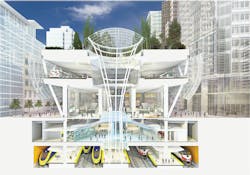
For some real world examples, consider two projects that are currently utilizing value capture to fund transportation infrastructure. In San Francisco, there is the $4 billion Transbay Transit Center Project. The project includes a new transportation terminal, as well as housing and retail development, in the downtown financial district. The transportation terminal will facilitate connections between 11 different transportation systems, including commuter rail, heavy rail, light rail, Amtrak, buses and in the future, California high-speed rail. The development will also include 2,600 new residences, 3 million square feet of new office and commercial space, and 100,000 square feet of retail.
Situated in the Far West Side of Manhattan is the Hudson Rail Yards Development Project. The transit component is the extension of the #7 subway line, which is being funded with revenues derived via a value capture mechanism. The commercial-residential component of the project includes four high-rise towers that encompass 5.5 million square feet. Hudson Yards is a mixed-use development that will include office, retail, residential, parks, open space, culture and entertainment. At the completion of the project, it is anticipated that 30,000 people will work there and 10,000 people will live in the residential tower.
The projects share similar aspects even though it could be argued that they were started for different reasons. Transbay was driven by the need to construct a 21st century transportation center, a high-speed rail station, and other commercial-residential development, with transportation being the important priority. In New York City, the #7 Line was extended to provide subway service to an area of the city that lacked connectivity. The follow-on, high-density development in Hudson Yards, including potential expansion of the nearby Javits Convention Center, was the primary objective.
Value Capture Terminology
Most value capture agreements are incredibly complicated and have idiosyncrasies unique to the areas they serve. But certain terminology will pop up in most agreements. For example:
- Joint Powers Authority (JPA): The governmental or quasi-governmental entity that has overall management and financial responsibility, including bonding authority, for the project. The Hudson Yards Infrastructure Corp. (HYIC) JPA is interesting in that it has no employees of its own.
- Special Assessment District or Business Improvement District (BID): A predefined area for which the JPA or managing entity can assess taxes or fees to support the project.
- Tax Increment Financing (TIF): A method for collecting taxes or fees in a BID. A baseline assessment is established for the properties in the BID. The increase in value of those properties in future years, relative to the baseline year, is subject to special assessments.
- Interest Support Payments (ISP): Should the JPA be unable to generate enough income to cover interest payments to bondholders, another entity can be compelled to make up the difference. In the Hudson Yards example, New York City itself is obligated to cover any shortfalls in HYIC revenue.
- Development Impact Fees: Fees (generally one time) assessed to cover the cost of public facilities (water, public safety, schools, etc.) required to support the new development
- Transferable Development Rights (TDR): TDR’s are special rights to a property that, in effect, grant zoning variances to the developer. The most common variance is permission to exceed established height or density regulations. In the Transbay project, the TDR fee was $4 million, which allowed the developer to construct an additional 160,000 square feet of marketable space. In Hudson Yards, the TDR fee was over $200 million for the high-rise towers.
- Passenger Facility Charge (PFC): A per-ticket or per-vehicle charge for users of the facilities. Transbay has different schedules for different transit systems, ranging from $.25/trip for AC Transit to $2.00/ticket for CA high-speed rail.
- Payment in Lieu of Taxes (PILOT): To incent developers, JPA’s can establish a property tax-free zone. But the developers aren’t entirely off the hook — they are required to make payments to the JPA, based on assessed value. These PILOT’s are generally significantly lower than what the developer would normally have pay to the city under prevailing tax rates.
- Tax Equivalency Payment (TEP): TEP’s are remittances by the local taxing authority (e.g. New York City) to the JPA of the taxes collected by the city in the BID for existing buildings and improvements.
Scalability
There are currently dozens of transportation projects using value capture financing. Most project value capture revenues in the millions to hundreds of millions of dollars. Only a few show value capture revenues in excess of $1 billion. Two of them, Transbay and Hudson Yards, are mentioned in this article. It comes down to scalability. Value capture is successful when there is a relatively small, well-defined area, preferably in the same city or county. It is not evident that value capture methodology alone would be able to scale to address the financing requirements of a megaproject such as high-speed rail (HSR), where the project costs are in the hundreds billions of dollars and are spread over wide geographical areas. Value capture could play an important part in a local project, as it is in Transbay, where the transit center will be home to the San Francisco HSR station. It would be difficult to see value capture alone being able to finance construction in the long distance right of way from Los Angeles to San Francisco.
Megastructure Financing
There is a requirement for a broader solution, with a predictable, reliable revenue stream to finance large-scale, national megaprojects, such as high-speed rail. A national HSR system would offer 220 mph top speed, 160 mph average speed service that is time-competitive and cost-competitive with air travel, in the 200 to 600 mile sweet-spot distance. The challenge is securing the one-half to three-quarters of a trillion dollars for construction costs. Finding the votes in Congress to appropriate $25 to $30 billion per year from general tax revenues, for 25 to 30 years, will be difficult in the current political and fiscal environment.
What is needed is a dedicated funding source, one based on a user fee for existing high-speed travel. The proposal is a High Speed Passenger Transport Fund (HSPT) that would be based on a 6 percent fee on:
- Airline Tickets
- Charter Flights
- Air Freight Revenues
- Amtrak Tickets
- Future High-Speed Rail Tickets
The HSPT fee will generate $10 billion in revenue per year. The revenue would be split three ways: 20 percent ($2 billion) each to existing intercity rail and the air travel’s NextGen air traffic control system, and 60 percent ($6 billion) to high-speed rail. The guaranteed revenue would permit the HSR JPA to bond $100 billion to purchase main line right of way (ROW), and land for stations and transit-oriented development (TOD). The funds would also be used to start the permitting and environmental work. The JPA would enter into public-private-partnership arrangements with private contractors and developers that will actually build the HSR network. Additionally, the same revenue stream could be utilized to initiate value capture financing programs at local transportation centers for future HSR stations.
Value capture, by itself, is an important instrument in the toolbox to spur local transportation infrastructure. It would require the combination of Value capture and public-private-partnerships, both supported by the revenue from the High Speed Passenger Transportation Fund, to finance and build transportation megastructure for a 21st century America.
Richard J. Arena ([email protected]) is president of the Association for Public Transportation (APT) and is on the Advisory Board of US High Speed Rail (USHSR). The views in this article are his own and do not necessarily reflect those of APT or USHSR.